Lead generation for marketing agencies works best as a small, repeatable system: a tight ideal client profile, one or two outbound channels, a written qualification standard, and pipeline math that tells you how much outreach it takes to replace churned retainers. Buyers make that system necessary: 83% of U.S. B2B decision-makers self-research before ever speaking to sales, according to a 2026 SurveyMonkey and Reddit survey of 1,202 decision-makers. Referrals alone rarely reach them in time.
This guide covers the steps, the channel trade-offs, and a worked formula you can run with your own numbers.
Table of Contents
- Why referral-only agencies stall
- The Retainer Backfill Equation
- Step 1: Define your ideal client profile
- Step 2: Pick channels and build an auditable list
- Step 3: Run outreach that reaches the buying group
- Step 4: Turn replies into qualified meetings
- Metrics to track (and their denominators)
- In-house, freelancer or outsourced: which model fits
- Pilot one segment before you scale
- FAQs
Why referral-only agencies stall
Picture a six-person agency. The founder sells between client calls, referrals arrive unevenly, and nobody owns the follow-up when a promising conversation goes quiet. Revenue swings even though the work is good.
That agency doesn't necessarily lack demand. It usually has four separate gaps: unclear targeting, inconsistent prospecting, loose qualification, and a weak handoff to whoever closes. Sending more messages fixes none of them on its own.
The commercial case for measuring more than replies is documented. In the Content Marketing Institute and MarketingProfs' B2B benchmarks report (survey fielded July 2023, 894 B2B respondents), 52% of marketers named lead quality as a metric they use to assess content performance, and 58% said content marketing helped generate sales or revenue in the prior 12 months. Those are self-reported outcomes, not proof that any one campaign caused a sale, but they show that quality, not volume, is what teams try to measure.
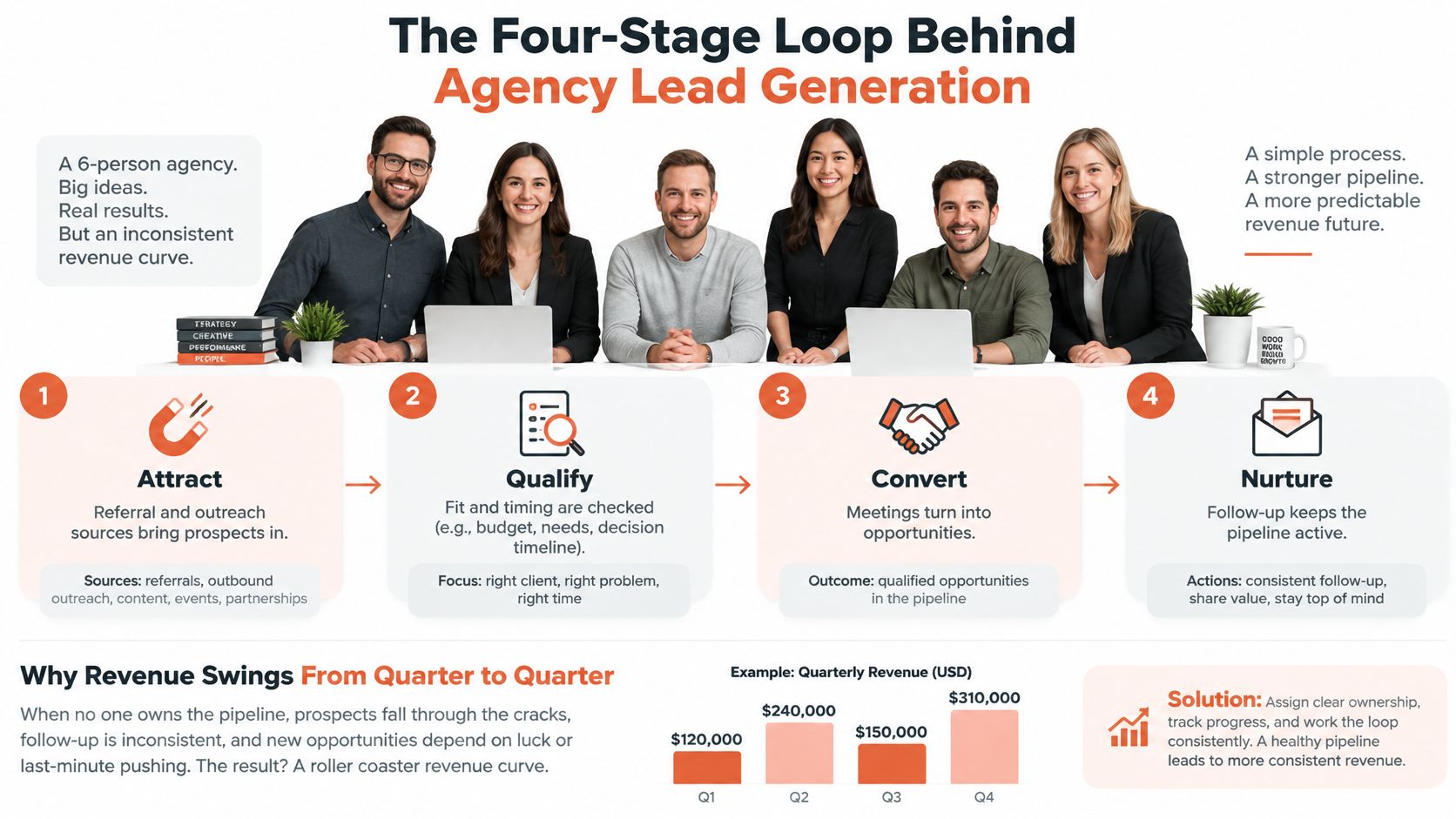
Give one person ownership of the pipeline, even if research, writing and selling are split across the team. Otherwise everyone finishes their task and nobody checks whether good-fit prospects become opportunities. Between active buying conversations, a lead nurturing track keeps not-yet-ready accounts warm.
The Retainer Backfill Equation
Most agency lead generation advice skips the arithmetic. Before choosing channels, work out how much outreach your growth target actually requires. We call this the Retainer Backfill Equation: start from the clients you will lose, add the clients you want to gain, and work backward through each conversion step.
Contacts needed per year = (retainers lost + net new retainers wanted) ÷ close rate ÷ meeting rate ÷ positive reply rate
Every input below is an illustrative example, not a benchmark. Replace each one with your own data.
| Input (example values) | Value | Running result |
|---|---|---|
| Active retainers | 12 | — |
| Annual retainer churn (example) | 25% | 12 × 0.25 = 3 retainers lost |
| Net new retainers wanted | 3 | 3 + 3 = 6 new clients needed |
| Close rate, qualified meeting → signed (example) | 20% | 6 ÷ 0.20 = 30 qualified meetings |
| Positive reply → qualified meeting (example) | 40% | 30 ÷ 0.40 = 75 positive replies |
| Positive reply rate per contact (example) | 2% | 75 ÷ 0.02 = 3,750 contacts per year |
| Contacts per account (buying group) | 3 | 3,750 ÷ 3 = 1,250 accounts |
| Research time per account (example) | 10 min | 1,250 × 10 ÷ 60 ≈ 208 hours per year |
That last row is the one founders underestimate. About 208 hours a year is roughly 4 hours a week of research alone (208 ÷ 52 ≈ 4), before writing, follow-up, or sales calls. If nobody has those hours, the plan fails no matter how good the copy is.
Two ways to use the equation:
- Raise a rate instead of volume. If better targeting lifts the positive reply rate from 2% to 3%, contacts needed fall from 3,750 to 2,500 (75 ÷ 0.03).
- Find the weakest step. If replies are healthy but few become qualified meetings, the problem is qualification or targeting, not outreach volume.
Step 1: Define your ideal client profile
Start with your strongest retained clients, not a prospecting database. Compare revenue against delivery effort, retention, scope stability and access to decision-makers. A large account that eats senior time may be a poor model for growth.
Your ideal client profile (ICP) should describe an account you can recognize before contacting it. "Businesses that need better marketing" isn't usable. A defined sector, operating model, service need and observable trigger are.
- Account fit. Industry, employee band, geography, business model.
- Buyer access. Separate the person who signs from the person who works with your team; they care about different outcomes.
- Triggers. A marketing hire, product launch, funding announcement or site relaunch. Verify the event publicly and explain its relevance without pretending to know the internal situation.
- Exclusions. An in-house team that already does your exact service, or an incumbent contract that blocks a realistic purchase. Verify the barrier rather than excluding by assumption.
The values below are illustrative targeting choices, not universal benchmarks.
| Criterion | Example value | Watch-out |
|---|---|---|
| Company size | Established employer with budget for your retainer | Headcount is a proxy, not evidence of budget |
| Industry | B2B SaaS, professional services, B2B ecommerce | Prioritize verticals where you have case studies |
| Buying role | Head of Marketing, CMO, or founder in an owner-led business | Confirm budget control, not just topic ownership |
| Business trigger | Marketing manager hire, funding round, product launch | Explain why the event creates a plausible need |
| Exclusion | In-house agency or a contract that blocks a purchase | Verify it before excluding |
Then turn the profile into searchable rules. "Every ecommerce business" is untestable; "Shopify brands selling to businesses, with a product launch in the last 90 days and no internal team covering our specialty" gives a researcher clear filters and a copywriter a relevant opening. MakeAutomation's guide shows how to automate your ideal customer targeting once those rules are written down.
Validate on a small list first. A good list-building brief separates mandatory filters, preferred signals, exclusions, and evidence that needs manual checking.
Step 2: Pick channels and build an auditable list
Email is the most widely adopted channel, but adoption isn't profitability. Dux-Soup's survey conducted at the B2B Marketing Expo in London reports that 88% of the businesses it surveyed use email for lead generation. The report doesn't disclose its sample size, and respondents were attendees of a paid marketing event, so treat it as a signal of how common email is, not of what works for your agency.
Choose channels by buyer accessibility, deal size and your team's capacity to follow through.
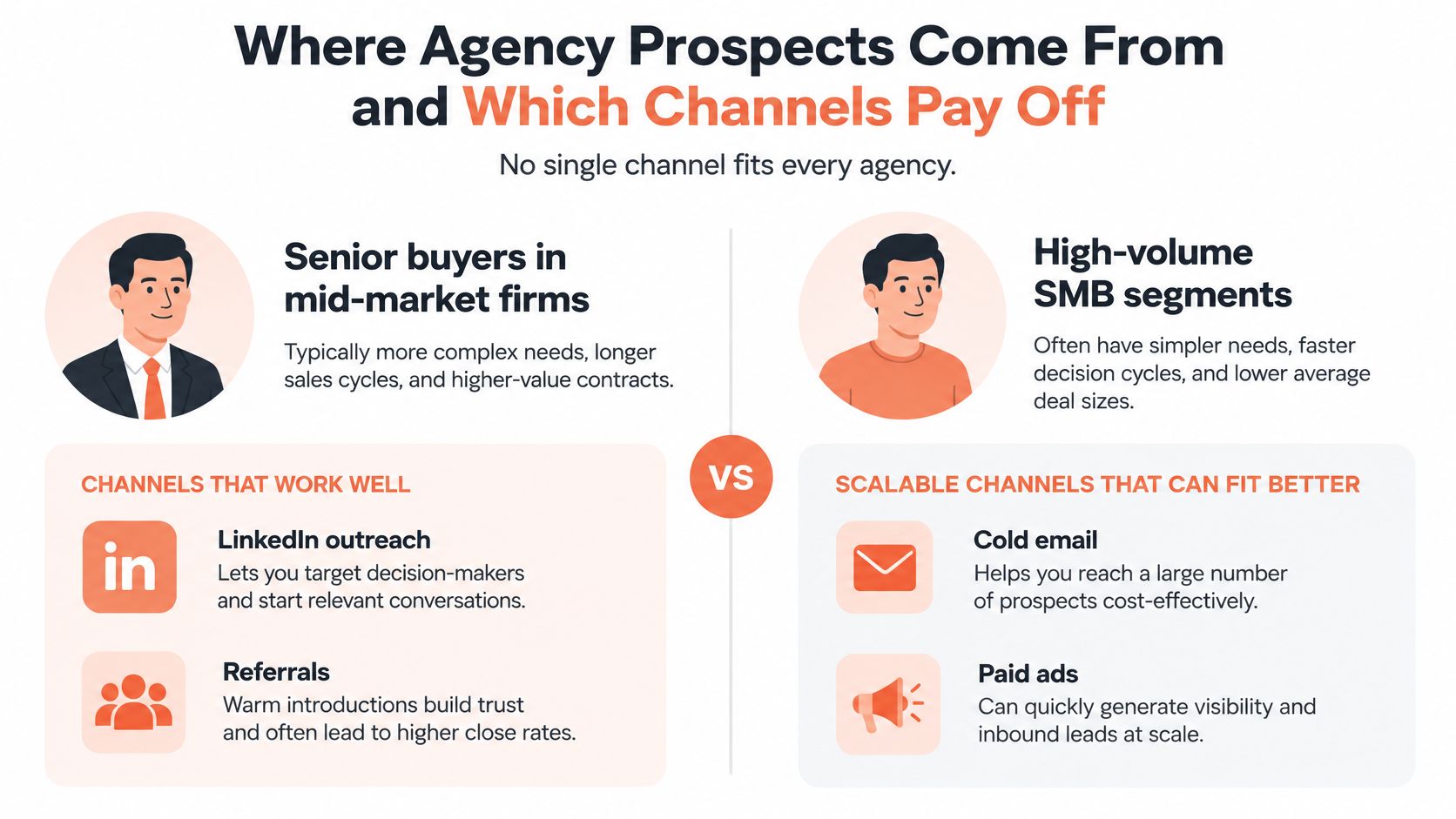
| Channel | Best for | Effort to start | Main risk |
|---|---|---|---|
| LinkedIn outreach | Senior buyers in mid-market firms | Low production; needs profile and message prep | Ignored messages or restrictions when activity outruns relevance |
| Cold email | Reachable SMB segments with a specific need | Low to medium, including authentication and verification | Spam complaints and domain damage |
| Referral partners | Niche verticals with trusted advisers | Relationship building and a clear referral arrangement | Uneven flow, little control |
| Webinars | Buyers who need education before a call | High: content, promotion, follow-up | Attendance without buying intent |
| Content and search | Long-cycle buyers researching a problem | High editorial and technical commitment | Slow payback, fuzzy attribution |
| Events | Local or vertical buyers | High planning and attendance effort | Expensive conversations with no follow-up plan |
For LinkedIn, check that your buyers are active before building sequences; a LinkedIn outreach agency can run that channel if founder time is the constraint. For referral partners, define the exact situation that should trigger an introduction. "Send anyone who needs marketing" is too vague for an accountant or complementary agency to act on.
Pair one direct-response channel with one demand-building channel. LinkedIn plus case-study content suits a specialist agency; email plus partner education suits a repeatable SMB offer.
To build the list, combine LinkedIn Sales Navigator, company websites, trade directories and association listings. Use industry, role, geography and size filters, then Boolean searches to catch title variations. Record where each account came from and why it qualifies, keep exclusions in one central place, and refresh on a set schedule. A dedicated sales prospecting process makes this auditable instead of ad hoc.
Step 3: Run outreach that reaches the buying group
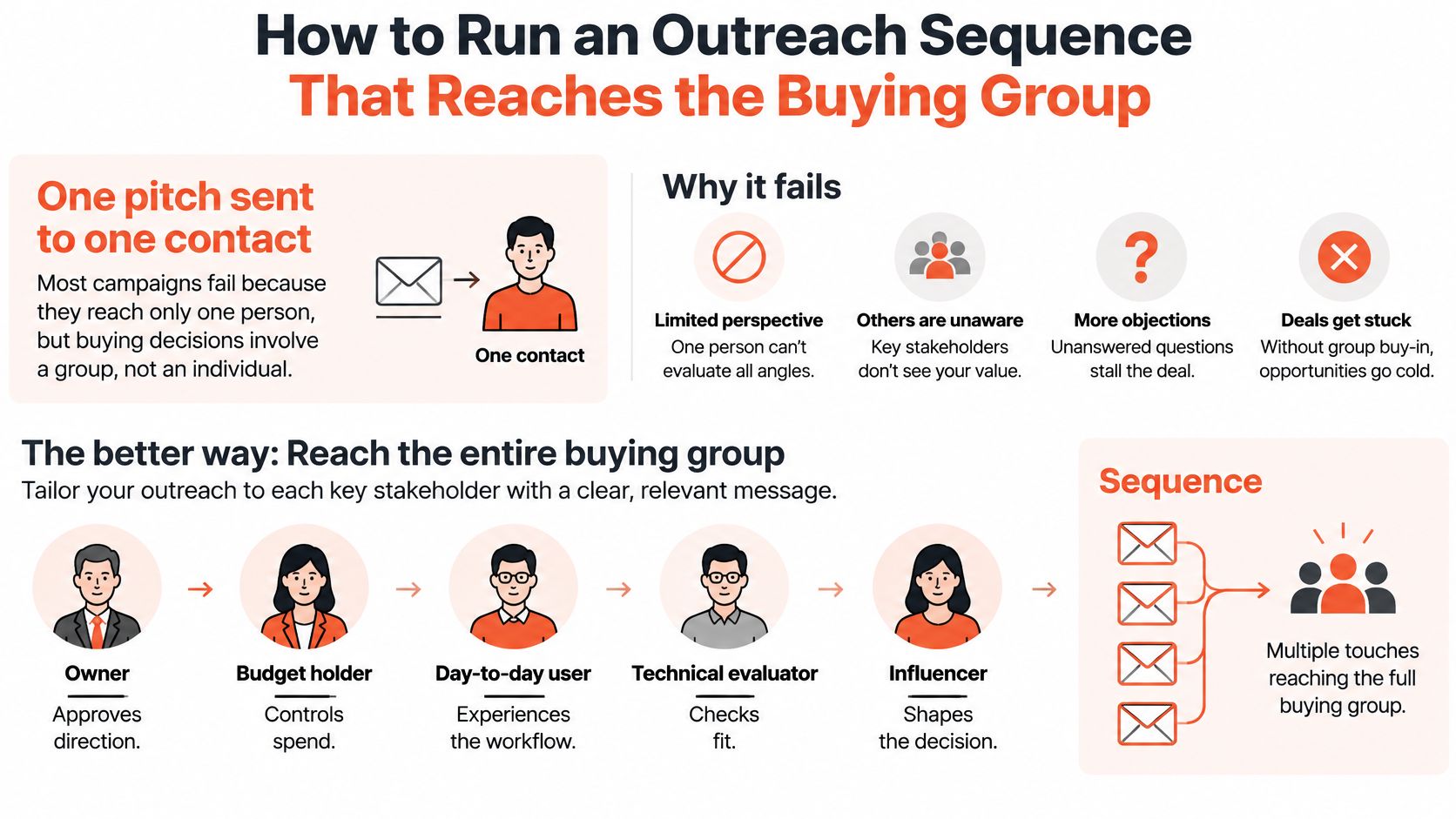
One pitch to one contact leaves too much to chance. That contact may understand the problem but lack budget, or support the purchase while someone else objects. Gartner's B2B buying report puts the average enterprise buying group at five to 11 stakeholders. A small client won't have that many, but the point holds: plan the account before writing the message.
Prepare the account and the infrastructure:
- Map responsibilities. Owner, budget holder, day-to-day user, technical evaluator, possible blocker. In a small business one person may hold several roles.
- Set up email sending. Google's email sender guidance requires bulk senders to set up both SPF and DKIM, publish a DMARC record (at least p=none), and offer one-click unsubscribe on promotional mail. It recommends keeping user-reported spam rates below 0.1% and never letting them reach 0.3% or higher. These are deliverability guardrails, not performance targets or legal compliance.
- Write distinct hypotheses per role. A marketing leader may care about pipeline quality; an operations user about approval delays. Change the evidence, not just the greeting.
Confirm the consent, identification and opt-out rules for each recipient's region before launch, and honor opt-outs across every campaign through one shared suppression list.
Give every follow-up a different job:
- Open with a relevant observation. Tie a verified trigger to a problem you solve, and ask whether it's relevant instead of asserting it.
- Provide evidence. Share a closely matched case study, including the conditions that made it work.
- Help internal evaluation. Offer a short, forwardable note on scope, dependencies or trade-offs.
- Close without pressure. Ask whether to continue, contact someone else, or stop.
For a second view on how each email moves the sequence forward, see MailAdept's Cold Email Sequence Structure. Check its assumptions against your offer before copying any template.
Test small batches per persona or trigger, and track delivery, positive replies, qualified meetings, unsubscribes and complaints by segment so a healthy average doesn't hide a weak one. If coordinators reply enthusiastically but budget owners never do, you have an access problem, not a copy problem.
Step 4: Turn replies into qualified meetings
A positive reply is permission to clarify, not a sales-qualified lead. Someone asking for a case study may be researching, comparing suppliers, or gathering ideas for an internal project.
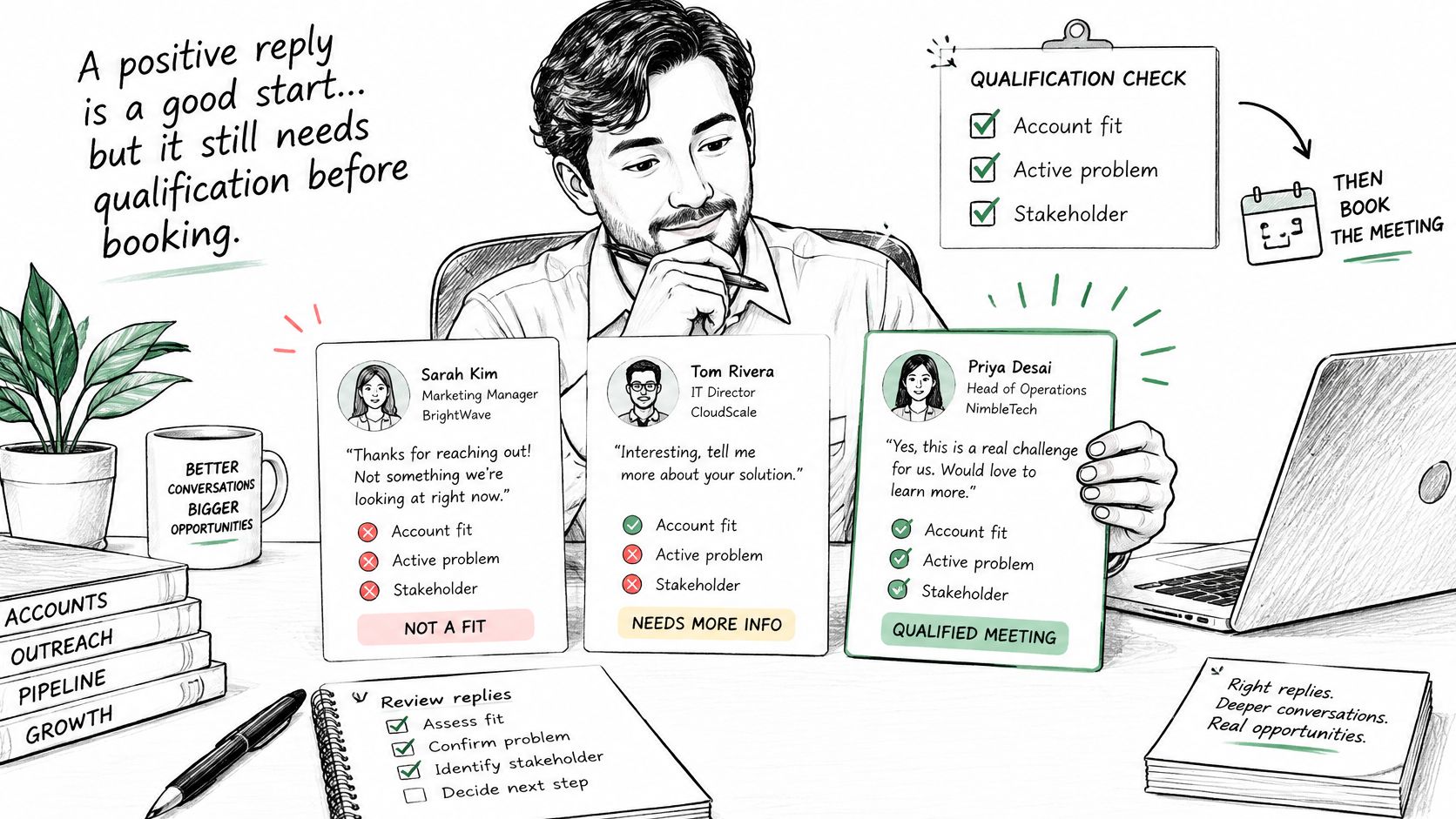
Use a shared lead qualification standard that records what is confirmed, unknown or missing:
- Account fit. Does the business match the profile with a viable requirement?
- Active problem. Did the prospect describe a real issue, or just agree with yours?
- Stakeholders. Who approves spend, uses the work, and influences selection?
- Decision process. What must happen before approval, and what drives timing?
- Concrete next step. Has the prospect agreed to an action with a clear purpose?
Answer a positive reply with a question tied to the stated problem. If a prospect mentions slow campaign launches, ask where approvals stall before offering a call about your whole service menu. For an interested non-decider, send a forwardable summary and ask for an introduction.
Mark a conversation partially qualified when budget ownership or the approval path is unknown. Requests for free work, hypothetical problems and open-ended timing go to a separate follow-up track. The handoff note should capture the problem in the prospect's words, known stakeholders, open questions and the agreed next step. The distinction between a booked meeting and a qualified one is covered in detail in what appointment setters do.
Metrics to track (and their denominators)
Buyers can research your agency without replying, filling a form, or clicking a tracked link, so reply data is an incomplete view of influence. Don't replace weak attribution with invented precision. For a broader KPI set, see these business development KPIs.
| Metric | Denominator | What it tells you | Review cadence | Warning sign |
|---|---|---|---|---|
| Complaint rate | Delivered emails | Relevance and deliverability risk | Weekly | Moving toward sender-policy thresholds |
| Positive reply rate | Delivered outreach, excluding auto-replies and polite refusals | Whether the message earns engagement | Weekly | Replies rise without qualified meetings |
| Qualified meeting rate | Positive replies (state booked vs. attended) | Whether targeting produces real conversations | Every two weeks | Meetings lack authority or process |
| Stakeholders per account | Active accounts | Buying-group coverage | Monthly | Accounts depend on one contact |
| Sales-accepted rate | Meetings handed off | Whether sales accepts the handoff | Monthly | Repeated rejection for the same gap |
| Cost per qualified meeting | Qualified meetings | Efficiency, including research, tools, labor and management time | Monthly | Cost rises without better quality |
There is no defensible universal conversion benchmark across agency niches and offers. Set a baseline per segment, then plug your real rates into the Retainer Backfill Equation each quarter.
Keep a simple account ledger: stakeholders reached, campaign exposure, reply status, sales feedback, opportunity stage and next action. In discovery, ask where the prospect first heard of you and why they reached out now, and keep their wording. Label each attribution as directly reported, supported by several signals, or uncertain.
In-house, freelancer or outsourced: which model fits
Once the equation tells you how many hours the work takes, decide who does it.
| Model | Best when | Main trade-off |
|---|---|---|
| Founder-led | The research hours fit in time the founder can protect, or the offer is still changing | Pipeline stops whenever client work spikes |
| In-house SDR | Steady volume and someone to manage and coach the rep | Hiring, ramp time and management overhead |
| Freelancer | One narrow task, such as list building | You still own the system and quality control |
| Outsourced partner | You need research, outreach and qualification running together quickly | Less direct control; requires a clear qualification standard |
For a fuller comparison, read B2B lead generation agency vs. in-house SDR team, and use these questions to ask before hiring lead generation services. Outbound Consulting reports having served 2,000+ businesses (company-reported); its sales development services cover the research-to-handoff steps described above.
Pilot one segment before you scale
Don't launch across every vertical you could serve. Start with one defined segment, one relevant offer, and enough delivery capacity to take on new work.
Pick one direct channel and one supporting channel, set a fixed pilot period, release contacts in small batches, and schedule the review before launch. Decide in advance what evidence changes the plan:
- Scale when qualified conversations become consistent and recipient feedback stays healthy.
- Revise when interest is real but qualification exposes a targeting, authority or offer gap.
- Pause when complaints, opt-outs or repeated objections signal poor relevance.
Outside help can cover research, list building, messaging and follow-up, but your team should still own the qualification standard.
FAQs
How do marketing agencies get clients without relying on referrals? They run a repeatable outbound system: a written ICP, a verified target list, multi-contact outreach on one or two channels (usually LinkedIn and email), and a qualification standard before meetings reach the calendar. Referrals then become a bonus rather than the whole pipeline.
How many leads does a marketing agency need? Work backward from clients, not leads. Add expected churn to your growth goal, then divide by your close rate, meeting rate and reply rate, as in the Retainer Backfill Equation above. With the example inputs, six new clients a year required about 3,750 contacts.
Is LinkedIn or cold email better for agency lead generation? LinkedIn tends to suit senior buyers at mid-market firms; cold email suits reachable SMB segments with a specific need. Many agencies pair both against the same accounts and compare qualified meetings per segment, not reply rates.
How much do lead generation agencies charge? Pricing depends on scope, channels and volume, and models vary (retainer, per meeting, or hybrid). Compare offers by cost per qualified meeting, not cost per lead. See Outbound Consulting's pricing page for current plans.
Is cold outreach legal for agencies? Generally yes, within rules that vary by region. In the U.S., CAN-SPAM allows commercial email if you identify yourself, avoid deceptive subject lines, include a physical address and honor opt-outs. UK and EU rules are stricter for some recipients. Check the rules for each region and get legal advice if unsure.
How long does it take for outbound to produce meetings? It depends on setup. Domain authentication, list building and message testing come first, and early batches are for learning. Judge a pilot over a fixed period by qualified meetings and recipient feedback, not by the first week's replies.
Should a marketing agency outsource lead generation? Outsource when the hours the work requires exceed the time your team can protect for it, or when you need research, outreach and qualification running together quickly. Keep ownership of the ICP and qualification standard either way.
What is the difference between a lead and a qualified meeting? A lead is a contact who fits your profile or responded. A qualified meeting has a confirmed problem, the right stakeholders, a known decision process and an agreed next step. Tracking them separately keeps reply volume from masking a weak pipeline.
Outbound Consulting helps agencies connect research, personalized outreach, nurturing and lead qualification in one managed prospecting system. Visit Outbound Consulting to talk through your target clients, team capacity and sales process.