A B2B sales process is the repeatable path a deal follows from target account to signed contract and renewal, with one named owner and one recorded exit signal at each stage. It matters because buyers move before you do: 90% of B2B buyers research before first contact, according to Responsive's Inside the B2B Buyer's Mind report (fall 2025). Below: seven stages, their owners in a small team, and simple math to find the leakiest stage.
Definition: A B2B sales process is the set of stages (target selection, outreach, qualification, discovery, proposal, close, onboarding) a business-to-business deal passes through, each with an owner and an exit signal that must be met before the deal moves on.
Table of Contents
- The Seven Stages of a B2B Sales Process and Their Owners
- Why Buyers Research You Before Your First Call
- Prospecting and Outreach That Earns a Reply
- Qualifying Deals Beyond One Enthusiastic Contact
- How to Move a Qualified Deal to a Signed Contract
- Nurturing Not-Ready Buyers and B2B Sales Cycle Timing
- The Stage Leak Finder: Fix Your Weakest Stage Before Adding Volume
- Frequently Asked Questions About the B2B Sales Process
The Seven Stages of a B2B Sales Process and Their Owners
Ask a five-person team who owns qualification and the room either goes quiet or two people answer at once. The cost is concrete: a follow-up that never gets sent because each person assumed the other already had it. A working process solves that on paper first. Seven stages, one named owner each, and one exit signal the next owner accepts before the deal moves.
The version to hand a small team on day one has four columns: the stage, the person who normally owns it, what moves a deal forward, and the proof that the handoff is ready.
Stage
Owner in a Small Team
What Moves It Forward
Exit Signal
1. Target account selection
Founder or sales lead
Fit with the ideal client profile and a clear trigger such as a hire or new funding
Approved account and buyer list
2. Prospecting and outreach
Sales developer or founder
A message that names the buyer's problem
Reply or accepted connection
3. Qualification
Sales lead
Confirmed problem, timing, budget range and decision path
Opportunity created in the CRM
4. Discovery
Account executive
Problem stated in the buyer's own words and stakeholders named
Agreed success measures and next step
5. Proposal and evaluation
Account executive with founder
Business case, scope and implementation plan
Written review by the buying group
6. Negotiation and close
Founder or sales lead
Risk controls, terms and an internal champion
Signed agreement
7. Onboarding and expansion
Delivery lead
A fast first result and a referral request
Renewal, referral or added scope
Every owner in that table is a named person. "The sales team owns it" is how a follow-up falls between two inboxes. A founder usually keeps target selection and the close, a sales lead runs qualification and discovery, and the delivery lead takes onboarding because that is where renewals are earned. One person covering two or three stages is normal at this size. A stage with two owners, or none, is the failure mode to hunt for.
Buyers cross these stages on their own schedule rather than yours. McKinsey's 2024 B2B Pulse survey of nearly 4,000 decision makers found that B2B customers use an average of ten interaction channels in their buying journey, up from five in 2016 (McKinsey, "Five fundamental truths"). A prospect may meet your website, your profile and your rep in the same week and expect one consistent story from all three. When the three tell different stories, the deal loses the internal champion who would carry it between your stages.
If titles inside your team overlap, settle the difference between an SDR and a BDR before assigning stages, because the two roles cover different halves of the funnel and a fuzzy split leaves one half unowned. Clean stage data in one place is what lets you improve revenue predictability with sales ops instead of reconstructing the quarter from memory. For a team that wants an outside read on the whole map, b2b sales consulting can test each stage's owner and exit signal against what a repeatable pipeline requires.
The handoff rule: a stage is finished when its exit signal is recorded, not when a call happens. A meeting that ends without an agreed next step has not moved the deal.
Seven stages vs. five steps vs. three
Searches for the "five steps" or "seven stages" of B2B sales describe the same path at different zoom levels. Pick the version that matches your headcount, not the one with the most boxes.
Version
Stages
Best for
What you lose
Seven stages
Target, outreach, qualify, discover, propose, close, onboard
Teams of four or more with separate roles
Nothing, but it needs more handoff discipline
Five steps
Prospect, qualify, discover and propose, close, onboard
Two or three sellers
A separate check between discovery and proposal
Three stages
Find, qualify, close
Founder-led sales
Visibility into why late-stage deals stall
Why Buyers Research You Before Your First Call
By the time your message lands, the buyer has already formed an opinion. They checked the website, skimmed two founder profiles and asked someone in their network whether your firm is any good.
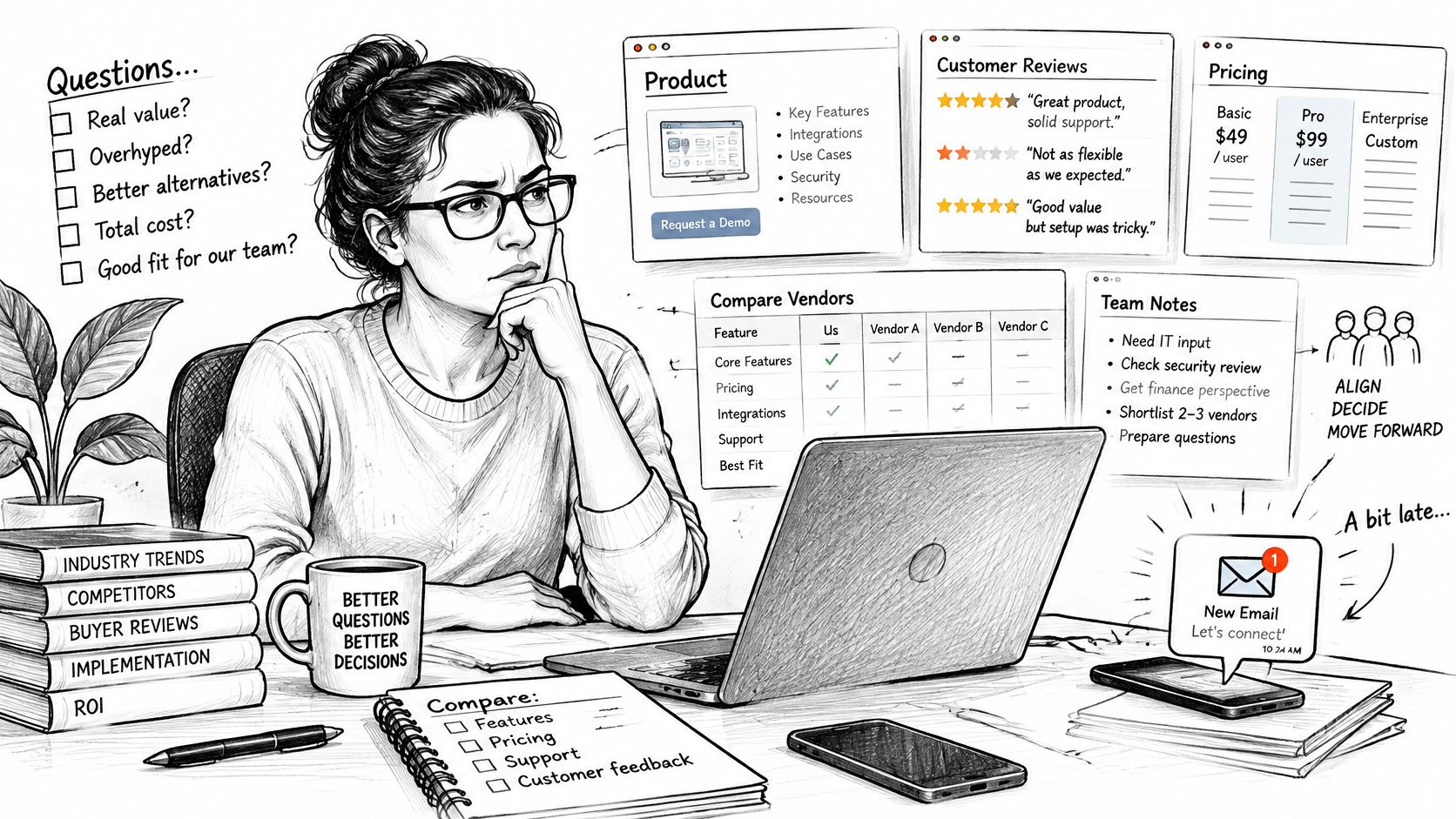
That habit is close to universal: the Responsive report cited above puts pre-contact research at 90% of buyers. Your outbound message is competing with a conclusion the buyer reached without you in the room.
Most buyers also arrive with a favourite. Forrester's 2024 Buyers' Journey Survey found that 92% of buyers start with at least one vendor in mind and 41% already have a single preferred vendor before formal evaluation begins, as Digital Commerce 360 reported. And the voices they trust most sit inside their own company: Forrester's analysis of buyer trust reports that 82% of buyers trust coworkers and management, while vendor salespeople rank lower. Adding more outreach to a firm with a vague public story just distributes the same weak impression more widely.
What a buyer checks in the first minute
- The one-line description. Can they tell who you help and with what outcome without scrolling past the fold?
- Two or three proof points tied to named industries. A case study with a number in it beats a wall of client logos.
- The founder profiles. Buyers read them to check whether you have done this before and how you write.
- Peer signals. Reviews, recognisable client names, and what a colleague says when asked.
Take a hypothetical twelve-person consulting firm with a homepage promising end-to-end growth support and an empty case studies page. A buyer arrives at a vague promise, finds no evidence, and closes the tab. The fix is narrowing, not louder: one sentence on who you help, one proof point with a number in it, and a profile that matches the offer.
Run the one-minute test as a stranger would. Open the homepage, the founder profile and the case studies page, then write down what a buyer would conclude after sixty seconds on each. If those three notes disagree, fix them before you send another message.
Prospecting and Outreach That Earns a Reply
Outreach is the stage often run as a volume exercise, which is why so much of it gets filtered before it's read. Buyers have become efficient at spotting a message that was written for anyone.
In a Gartner survey of 632 B2B buyers, conducted in August and September 2024 and published in June 2025, 61% said they preferred an overall rep-free buying experience, and 73% said they actively avoid suppliers that send irrelevant outreach, according to Gartner's sales survey on rep-free buying. Irrelevant is the operative word. A message that names a real problem in the buyer's own language doesn't trigger the same reaction as a template.
The first-touch workflow that holds up for a small team:
- Write the ideal client profile in four fields. Industry, role, company size and region, then check it against your last ten won deals and mark which ones fit. An ideal customer profile template keeps it to one page. The slip is a profile so broad it describes anyone with a budget.
- Build the list against those exact fields. Filters should mirror the profile, and list building should be a job someone owns rather than a task squeezed between calls. This is the work behind our list building services: custom B2B lead lists filtered by industry, role, geography and company size to match a client's buyer profile. The slip is skipping the review, so weak accounts enter the sequence and shape your reputation before anyone notices.
- Attach one trigger to every account. A new hire in the function you serve, a funding round, a product launch, or a job posting that names the problem you fix. Without a trigger the message reads like it was sent to a list.
- Name their problem in the first two lines and ask one question. Leave out the paragraph about your firm. The slip is a first-message pitch, which produces silence rather than a no.
- Sequence two or three touches across LinkedIn and email, then stop on a decline. Space them a few days apart and end with a close-the-loop note that leaves the door open. Treating persistence as a virtue after an explicit no costs you the relationship and the referral behind it.
Judge outreach by replies that start a conversation, not by messages sent. A reply from a list that fits is worth ten from a list that doesn't, because the second kind costs you sending reputation and teaches you nothing.
If you would rather not run the sequence yourself, managed LinkedIn outreach covers daily invitations, follow-ups and human-written messaging. Whatever the sequence, the LinkedIn connection request message is the one line that decides whether the rest gets read.
Qualifying Deals Beyond One Enthusiastic Contact
A booked meeting is not an opportunity. It's a conversation with one person, and B2B purchases get decided by several people with different priorities and different risks if the purchase goes wrong.
In the same Gartner survey of 632 B2B buyers (fielded August to September 2024, published May 2025), 74% of buying teams demonstrated unhealthy conflict during the decision process, defined as members with conflicting objectives, disagreement over the best course of action, or decisions overridden by outside parties, per Gartner's research on conflict in buying teams. Buying groups that reached consensus were 2.5 times more likely to report a high-quality deal. Your enthusiast is one vote, and often not the deciding one.
Criterion
Question to Answer
Red Flag
Specific problem
What business problem are they trying to solve?
Interest in exploring with no defined problem
Urgency
What happens if they do nothing for six months?
No date, trigger or deadline
Economic impact
What does the problem cost them today?
Cannot name a cost or outcome
Decision process
Who approves a purchase of this size, and how?
Contact does not know the process
Stakeholders
Who else must agree, and have they been met?
Single contact with no sponsor
Competing priorities
What else is on their agenda this quarter?
Budget or attention committed elsewhere
Before spending proposal time, test internal agreement with one question to your contact: would two colleagues agree this problem is worth solving this quarter? A vague answer is itself information.
The three-name rule
A deal is qualified when you can name the person who signs, the person who will champion it internally, and the date the buyer expects to decide. Miss any of the three and the deal belongs one stage earlier in the pipeline, whatever the enthusiasm level of the last call.
Say a SaaS founder has a warm contact who loves the product but has no route to the budget owner. The honest CRM stage is discovery pending, not qualified, because nothing the buying group needs to agree on has been confirmed yet. Label it qualified and the forecast absorbs a deal nobody can sign.
Qualification and handoff means identifying the relevant conversations and passing suitable prospects into the sales process rather than forwarding every polite reply. Teams that want a second pair of eyes on their criteria can use lead qualification support to test them against live conversations, and it's worth writing the lead qualification process down once, because the criteria get argued about every quarter otherwise.
Log the reason a deal didn't qualify, in the buyer's words. After twenty deals the pattern is usually one of three: no budget owner, no trigger, or a champion with no authority. Each of those is a targeting problem, not a closing problem.
How to Move a Qualified Deal to a Signed Contract
The late stages are where a qualified deal either becomes revenue or becomes a story about a buyer who went quiet. In a small team the same two people usually run all of them, so the handoffs that matter happen inside the buyer's building, not yours.
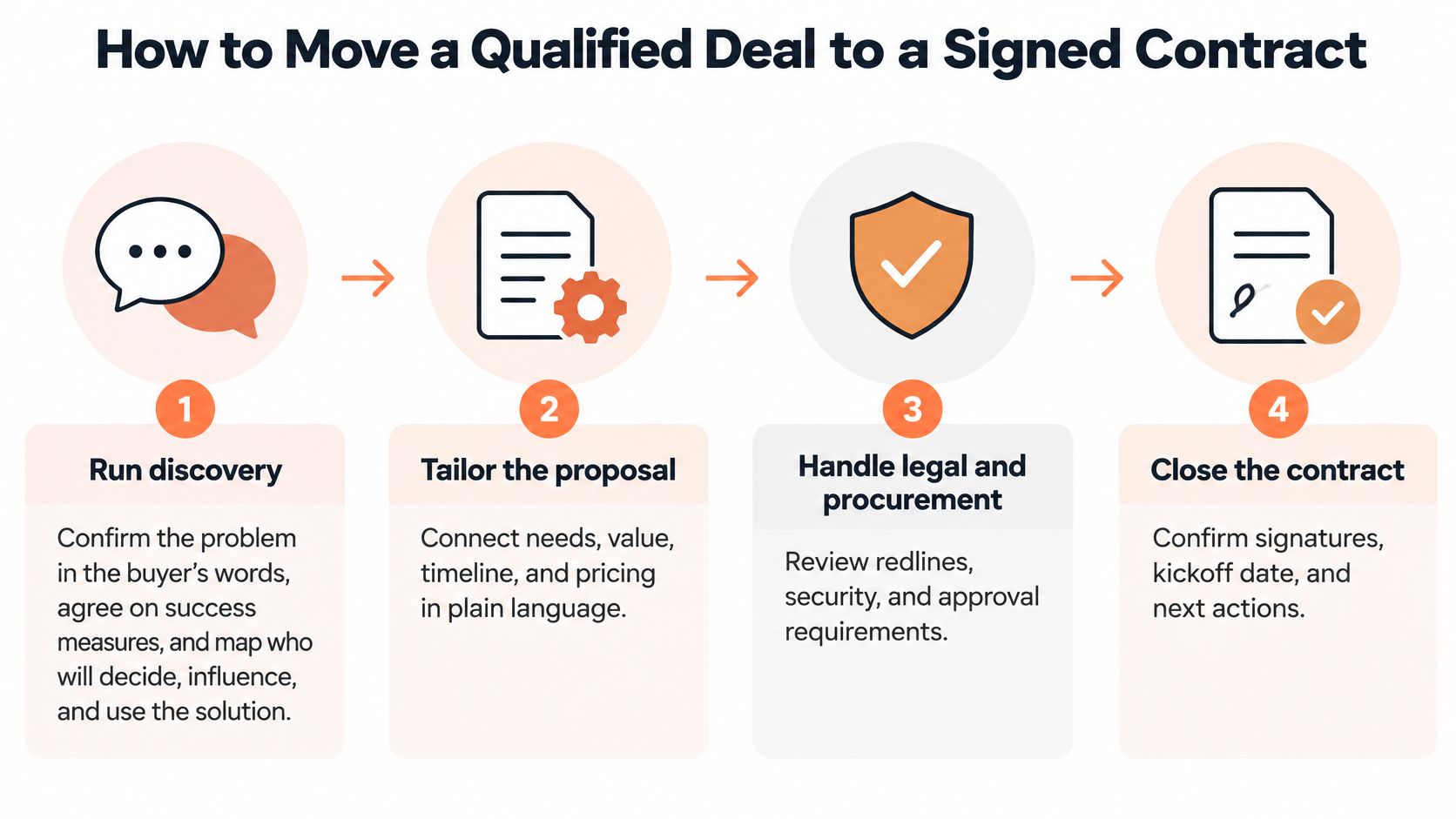
Buyers do much of this evaluation without you, and that has a cost. Gartner's B2B buying report, drawing on its 2022 B2B Buyer Survey of 441 buyers who completed a purchase, found that buyers who made a digital self-service purchase were 1.65 times more likely to regret it, and that rep-assisted digital purchasing paths cut that regret by half. Stay in the evaluation and interpret the trade-offs.
- Run discovery properly. Confirm the problem in the buyer's words and agree success measures, because a vague problem produces a vague proposal. The stakeholder names you confirmed during qualification go straight into the next document.
- Write a mutual action plan and send it to your champion. Problem statement, success measures, stakeholders, commercial path, risks and dated next steps, so the buyer has a document they can defend in a meeting you're not in.
- Send a short business case rather than a deck. Two pages the champion can forward. The champion needs something to show colleagues, and a generic deck doesn't survive that trip.
- Hold a consensus review. Bring the people who will approve or use the solution into one conversation and ask directly which objection remains, because unnamed objections return as delays during negotiation.
- Scope the proposal to what discovery confirmed. Price against outcomes and leave out the features nobody asked for, since scope creep is what makes a buyer start doubting the number.
- Negotiate on risk, implementation and terms. Answer security and legal questions early, with a named owner on each side for every open item. A question left unanswered resurfaces later as a stalled approval rather than an objection you can address.
- Close with a dated signature step and a kickoff date. Put both in the same email, because a contract with no start date invites one more round of internal review.
Two slips kill deals here more reliably than any pricing problem. Sending the proposal before consensus turns the document into a negotiation about price rather than a confirmation of fit. Offering a discount before the objection is named teaches the buyer that the first number wasn't real.
Here is a walkthrough of the same closing sequence, including the conversations that surround it.
A healthy deal has a dated next step every week, and both sides know what that date is for. When the calendar empties, the deal has stalled, and the fix usually sits two stages back.
Nurturing Not-Ready Buyers and B2B Sales Cycle Timing
A not-now reply is a timing signal. Because most buyers enter a purchase with a vendor already in mind (the Forrester figure above), the follow-up rhythm decides whether you are that vendor when the budget opens. For a small team, that makes nurturing the stage where many deals are won or lost, because it runs longer than every other stage combined.
A B2B sales cycle runs from first contact to signature, and its length depends on how many people must agree and when the buyer's budget opens. A small consulting engagement can sign in weeks. A platform purchase with four approvers can run for the better part of a year. In a two-person sales team, the person who ran discovery usually owns the nurture rhythm too, and the handoff back to active selling should happen on a trigger event or a logged date rather than a gut feeling. Plan the rhythm across the whole window, because the reply that arrives in month five is the one that pays for the program.
- Log the reason and a review date. "Budget opens in Q3" or "revisiting after the migration", plus a specific date to look again, so the contact isn't left to somebody's memory.
- Send something useful every few weeks. A short case study from their industry, a checklist, or a benchmark they can take into a planning meeting.
- Reconnect on trigger events. A new hire in the relevant team, a funding round, a role change, or the start of a budget cycle, each of which resets the timing question.
- Keep the history where anyone can see it. Notes on what they asked, what you sent and when, so a different team member doesn't reopen the conversation cold.
- Remove the contact only after an explicit no. Everything else stays on the rhythm at a lower frequency.
Picture a professional services firm that keeps a quarterly note going to a prospect who chose another provider two years earlier. When that prospect's budget reopens, nothing about the firm's offer has changed. The timing has, and only the firm still on her calendar gets the call.
If your follow-up reads like a reminder to buy, Truespeak's guide to nurturing service leads is a practical reset on structured, timed follow-up. We run this rhythm as lead nurturing for clients who lack the internal hours, keeping prospects on the radar between buying moments.
The expensive mistake is treating every slow reply as a dead lead. A good share of the buyers you'll sign this year are already sitting in your CRM, waiting for a reason and a date.
The Stage Leak Finder: Fix Your Weakest Stage Before Adding Volume
Lead counts show activity. Stage-to-stage conversion shows where deals stop. The Stage Leak Finder turns your last twenty to forty deals into one number per handoff, so you fix the leakiest stage instead of buying more volume.
Closed deals = Replies × (reply→meeting) × (meeting→qualified) × (qualified→proposal) × (proposal→close)
All inputs below are examples. Replace them with counts from your own CRM or spreadsheet.
Handoff
Example count
Example rate
Calculation
Replies that started a conversation
40 (example)
n/a
Starting volume
Reply → meeting held
20
50%
20 ÷ 40
Meeting → qualified (three names confirmed)
8
40% (weakest)
8 ÷ 20
Qualified → proposal sent
6
75%
6 ÷ 8
Proposal → signed
2
33%
2 ÷ 6
Closed deals
2
40 × 0.50 × 0.40 × 0.75 × 0.333 = 2.0
Now compare two fixes. Lift meeting-to-qualified from 40% to 55% by tightening targeting and qualification: 40 × 0.50 × 0.55 × 0.75 × 0.333 = 2.75 deals. Getting the same 2.75 deals at the old rates would take 2.75 ÷ 0.05 = 55 replies, which is 37.5% more outreach, list building and calendar time. A 15-point gain at the leakiest stage is worth more than a third more volume.
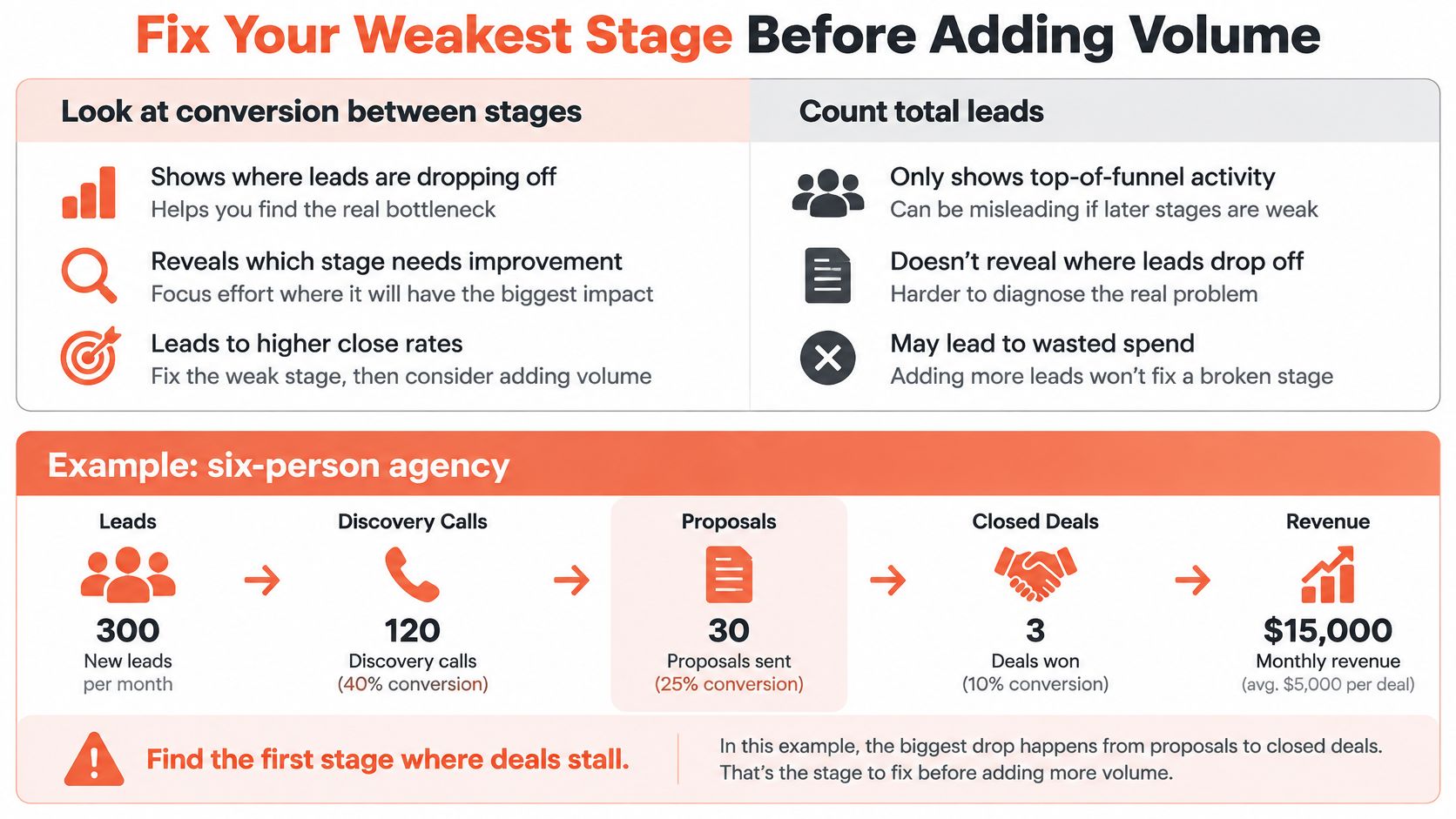
A small agency can fill its calendar with discovery calls and still send few proposals. That points to a qualification gap. More outreach would add unqualified calls, unpaid advice and calendar pressure without fixing the stalled handoff. If proposals go out but deals do not close, examine what is missing from buyer consensus before increasing lead volume.
Which fix to choose
Fix
Stages it covers
Main cost
Best when
Main risk
Founder runs the stage personally
Target selection, qualification, close
Founder hours
Small team with founder-led sales
Stage stalls when the founder is busy
Rewrite the qualification criteria
Qualification and discovery
Team time to review deals
Calls booked but few proposals sent
Fewer meetings in the short term
Add a dedicated sales developer
Prospecting and outreach
Hiring and ramp time
Outreach volume is the proven gap
Adds volume to a broken handoff
Outsource outreach and list building
Target selection, prospecting, nurturing
Managed service fees
No internal capacity for outbound
Needs a clear profile and exit signals first
Hiring a sales developer before fixing a weak handoff usually shifts the bottleneck to someone with a larger list. Use next week to make the constraint visible:
- Review the last twenty deals. Record where each stalled and, when available, the buyer's stated reason.
- Name one owner for each stage. One person can own several stages, but every handoff needs a clear owner.
- Choose one fix and run it for two weeks. Avoid changing several parts of the process at once; otherwise, it is harder to tell what improved.
Review business development KPIs for tracking stage conversion weekly, including reply-to-meeting, meeting-to-qualified and proposal-to-close rates. For teams that want help mapping owners and exit signals, b2b sales consulting can set up a repeatable prospecting and qualification process.
Frequently Asked Questions About the B2B Sales Process
What are the 7 stages of the B2B sales process?
Target account selection, prospecting and outreach, qualification, discovery, proposal and evaluation, negotiation and close, and onboarding and expansion. Each stage needs one named owner and one exit signal, such as "opportunity created in the CRM" for qualification or "signed agreement" for the close.
What are the five typical steps of a B2B sales process?
A common five-step version is prospect, qualify, discover and propose, close, and onboard. It merges the seven stages above for teams of two or three sellers. The comparison table near the top shows what each version trades away.
How long is a B2B sales cycle?
It depends on the number of approvers and the buyer's budget calendar. A small service engagement can close in weeks; a purchase that needs several departments to agree can take many months. Measure your own median from first reply to signature across your last twenty deals rather than relying on an industry average.
What is the difference between a sales process and a sales pipeline?
The process is the set of stages and rules a deal follows. The pipeline is the list of live deals sitting in those stages right now. A clear process makes the pipeline readable, because every deal's stage means the same thing to everyone.
What do I do when a buyer wants a proposal before any discovery?
Hold the quote until you've had one short call. A proposal priced against criteria you never heard usually loses to whoever asked better questions. Frame the call around how they plan to decide, then write to what you learn. If they refuse the call entirely, send a one-page scoping note with your assumptions listed, so the price has context.
Should the founder run every stage?
Early on, yes, because the founder's judgement is the process. Once a pattern repeats, hand discovery to a sales lead and keep target selection and the close, the two stages where founder involvement still changes the outcome.
Do I need a CRM before I can run this process?
No. A spreadsheet with stage, owner, exit signal and a review date holds up while volume is small, and the stage names matter more than the tool. Move to a CRM when more than one person needs to update the same deal.
How do I reopen a deal where the buyer went quiet?
Ask a question that permits a no: "Should I close this file?" A buyer who lost internal priority often answers a polite exit faster than another nudge. Either reply gives you a clean decision instead of a maybe that sits on the pipeline for months.
Outbound Consulting, founded in 2015 (company-reported), provides managed outreach, custom list building and lead qualification for small and midsize B2B firms, covering prospect research, outreach and follow-up, then qualification and handoff of suitable prospects to the client's sales process. Visit Outbound Consulting to discuss your outbound goals.