A lead qualification process is the set of decision rules that moves a new reply to a sales-accepted meeting, or out of the pipeline, with a recorded reason. It matters because buyers punish poor targeting: 73% of B2B buyers avoid suppliers that send irrelevant outreach, according to a Gartner survey of 632 B2B buyers. A small team can run it in five steps: respond and route, score fit, run discovery, hand off or nurture, and review weekly.
Definition: Lead qualification is deciding, with evidence, whether a contact fits your buyer profile and is ready for a sales conversation now, later, or never.
Most top-ranking guides stop at definitions and acronyms. This one is operational: who does what, which evidence gets recorded, and how to find the stage that is losing good leads, with the arithmetic shown.
Table of Contents
- The Five Lead Qualification Steps at a Glance
- Stage-Leak Math: Find Where Good Leads Disappear
- Step 1: Respond and Route Every New Lead
- Step 2: Score Qualified Lead Criteria Before Any Call
- BANT, CHAMP, MEDDIC or a Simple Rule Set?
- Step 3: Discovery Questions That Reveal Real Readiness
- Step 4: Hand Off Qualified Meetings and Nurture the Rest
- Step 5: Run Your First Qualification Week and Review
- Copyable Lead Qualification Checklist
- Lead Qualification FAQs
The Five Lead Qualification Steps at a Glance
Qualification connects the first reply to a meeting your salesperson agrees is worth taking. Capture starts that process; it doesn't finish it. A referral form, a downloaded resource or a friendly response gives you a contact to assess, not proof of a buying opportunity.
Lead qualification steps, questions and pass rules
Step
Question it answers
Evidence to record
Pass rule
1. Respond and route
Is someone engaging while interest is active?
Source, timestamp, owner, first-touch time
Owner assigned and first touch sent
2. Score fit and intent
Does this account and role match our buyer?
Industry, size, role, trigger event
All must-have fit rules met
3. Run discovery
Is there a problem, a reason to act now and a decision path?
Problem, urgency, decision process, timing
Problem, urgency and decision path confirmed, next step agreed
4. Hand off or nurture
Is this ready for sales or for more education?
Classification (hot, warm or nurture) with reason
Sales accepts the meeting with notes attached
5. Follow up and review
Did the lead progress, and if not, why?
Stage dates, next follow-up date, disqualification reason
Weekly stage-conversion review completed
Keep your definitions consistent. The distinction between prospects and leads stops anyone treating an untouched target account like an active sales conversation. For referral-driven firms, Recepta.ai's guide to qualifying inbound leads for service businesses provides useful context for handling enquiries before passing them to sales.
Teams considering managed b2b lead qualification should still agree internally on what sales will accept. Otherwise, outsourcing changes who handles the replies without resolving the disagreement about quality.
Stage-Leak Math: Find Where Good Leads Disappear
Stage-Leak Math is a simple way to decide which step to fix first. Count how many leads enter and leave each step in a month, divide, and look for the biggest loss among leads that already passed fit. Fit rejections are often correct; losses after fit are usually process problems.
The numbers below are example inputs only. Replace them with your own CRM counts.
Step
Leads in (example)
Pass rate (example)
Leads out
Respond and route within one business hour
50
90%
45
Pass must-have fit rules
45
60%
27
Discovery call held
27
56%
15
Sales-accepted meeting
15
60%
9
Meeting held, opportunity opened
9
78%
7
The arithmetic: 50 × 0.90 = 45; 45 × 0.60 = 27; 27 × 0.56 ≈ 15; 15 × 0.60 = 9; 9 × 0.78 ≈ 7. End to end, 9 ÷ 50 = 18% of new leads became sales-accepted meetings.
The largest raw drop is at fit (18 leads), but those are mostly the wrong accounts. The real leak is discovery: 12 leads that fit never reached a call. Lift the discovery-held rate from 56% to 70% and you get 27 × 0.70 ≈ 19 calls, then 19 × 0.60 ≈ 11 accepted meetings: about two more accepted meetings a month without a single new lead.
Operating rule: Fix the step losing the most leads that already passed fit. Don't redesign the entire process at once.
Step 1: Respond and Route Every New Lead
Treat the first hour as an operating target during business hours. The speed-to-lead benchmark review summarizes the classic Harvard Business Review audit (2011): firms that responded within an hour were about 7 times more likely to qualify a lead than those that waited even an hour longer. The study is old and the review comes from a vendor of response tools, so treat the direction as reliable and the multiplier as dated.
The routing flow should be simple enough for a backup owner to follow.
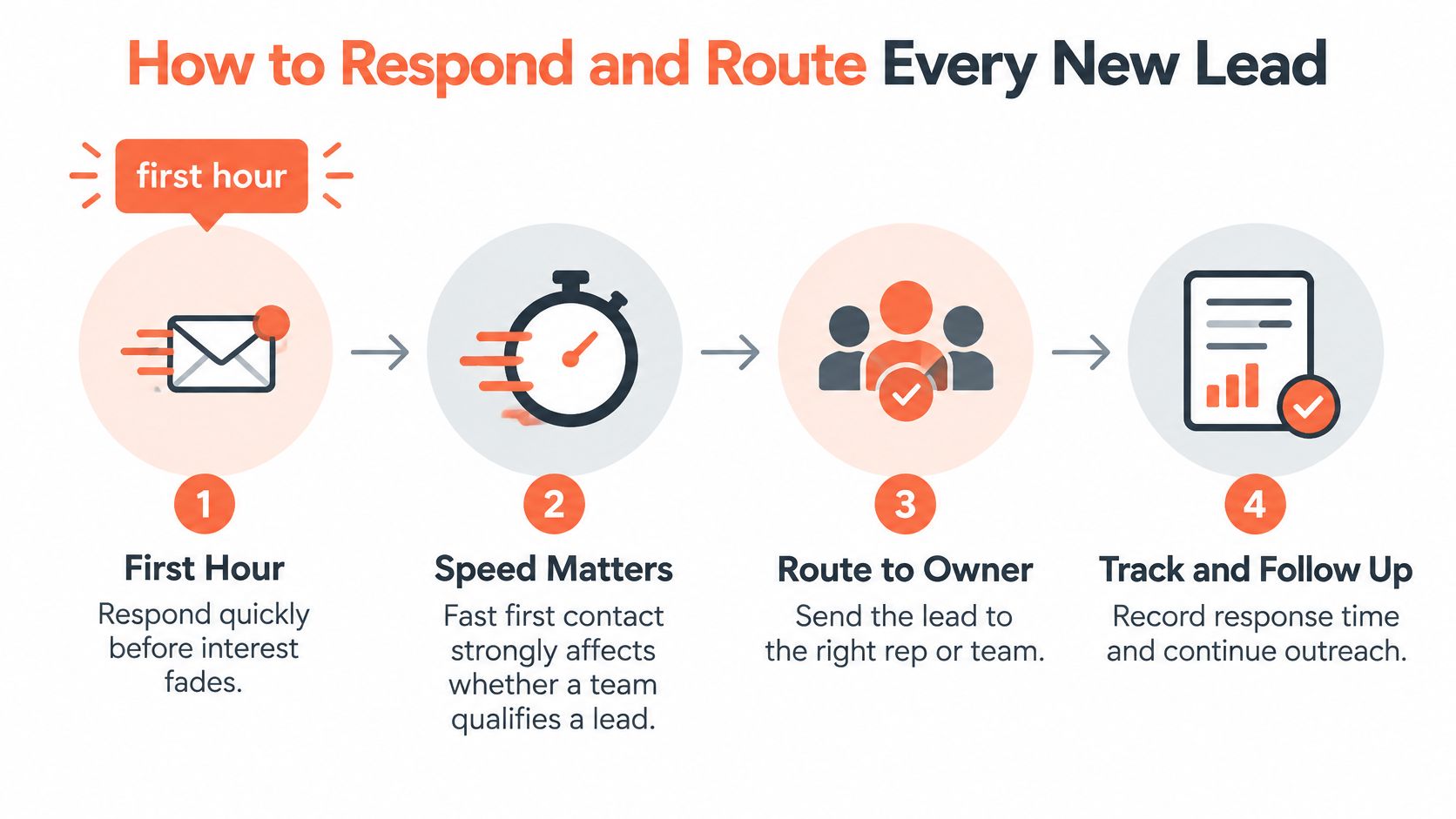
Run the same intake routine every time:
- Capture the context. Create the CRM record with the source, referring person or campaign, relevant page and arrival timestamp. Preserve the prospect's original message.
- Check for duplicates. Search the contact, company and open opportunities before creating another record. Keep the existing account owner unless there's an explicit reassignment.
- Assign one owner. Use a fixed rule such as industry, territory or round-robin. Name a backup for absences.
- Send a relevant first touch. Acknowledge the reason for the enquiry and ask the next useful question. An automated receipt isn't a qualification response.
- Record the attempt and outcome. Log when you responded and whether the prospect replied, declined or needs another touch.
- Set the next date. Don't close the record without a scheduled action or a documented closure reason.
Say a founder and an account manager receive a referral form late on Friday. Their rule assigns existing accounts to the account manager and new companies to the founder. The founder checks the account, acknowledges the referral, asks about the business problem and records a follow-up for Monday. Monday's review can then distinguish a buyer who hasn't replied from an enquiry nobody handled.
For more complex inbound queues, Docket's review of Chili Piper for inbound lead routing is a reference for scheduling and assignment requirements; it is written by a competing vendor, so weigh its verdicts accordingly. Establish the ownership rule before choosing automation.
The distinction between SDR and BDR responsibilities can clarify role design, but a small team doesn't need either title to run intake. A passing record has an owner, a timed touch and a dated next step.
Step 2: Score Qualified Lead Criteria Before Any Call
Separate must-have fit rules from signals that make a conversation timely. Industry, geography, company size and buying role determine whether you can serve the account. A new hire, location opening or tool replacement explains why the account might act now.
A trigger can't compensate for a failed must-have rule, and a perfect account profile doesn't establish urgency. Score each criterion on its own and record a pass or fail reason for every lead, so a lost prospect tells you exactly which rule it hit.
Qualified lead criteria and their decision rules
Criterion
Qualifies when
Nurture when
Disqualify when
Industry and company size
Matches a segment you have won before
Adjacent industry or size near the edge of the range
Outside every segment you serve
Role authority
Owner, partner or budget holder
Influencer who can name a champion
No buying role, such as a vendor or student
Problem or change
Stated trigger such as a new location, hire or failed tool
Interest with no visible trigger
No problem your offer addresses
Timing
Evaluation or budget window within the quarter
Window set for next year
No window and no reason to act
Data check
Contact verified and current
Role unverified, needs enrichment
Duplicate or stale record
Treat the timing entries as starting rules, not universal deadlines. Adjust them to your sales cycle, and distinguish a confirmed lack of priority from timing you haven't asked about.
Verify before scoring. Normalize company names, merge duplicates and confirm current job title, seniority and company size. Record where each signal came from and when it was checked; an inferred trigger shouldn't appear as a buyer-confirmed fact. If your list is the problem, custom list building fixes it upstream.
A consulting firm that sells implementation work to agencies gets two replies in the same week. A managing partner whose agency recently changed its CRM passes fit and trigger checks, but discovery must still establish an unresolved need. A marketing coordinator outside the firm's service region fails the account rules, regardless of enthusiasm. Only the first reply earns a call.
Use an ideal customer profile template to put those boundaries in writing.
For audits, precision is the share of leads you marked qualified that sales accepted; recall is the share of accepted-worthy leads your rules caught. Both are standard measures for classification systems, used for example in this Rochester Institute of Technology thesis (2025), which modeled won versus lost B2B opportunities on more than 78,000 records. A small team doesn't need a model to borrow the idea: check rejected leads as well as accepted ones.
BANT, CHAMP, MEDDIC or a Simple Rule Set?
Named frameworks are checklists for discovery, not a whole process. Pick the lightest one that matches your deal size.
Framework
What it checks
Best for
Watch out for
BANT
Budget, Authority, Need, Timeline
Short cycles, single decision maker
Early budget questions can stall a good conversation
CHAMP
Challenges, Authority, Money, Prioritization
Service firms that lead with the problem
Still thin on the decision process
MEDDIC
Metrics, Economic buyer, Decision criteria, Decision process, Identify pain, Champion
Larger deals with buying committees
Too heavy for a two-person team on small deals
Fit rules + evidence fields (this guide)
Must-have fit, trigger, problem, decision path, timing
Small B2B teams starting from zero
Needs a weekly review to stay honest
Whatever you choose, define "qualified" as an observable event, such as a sales-accepted discovery meeting. Reply counts and positive sentiment are inputs to that decision, not the outcome.
Step 3: Discovery Questions That Reveal Real Readiness
Begin discovery with the buyer's situation, not a presentation. Use these lead qualification questions as a conversation guide, not an interrogation script.
- Trigger: What prompted you to look at this now?
- Current approach: How is this handled today, and what breaks when volume rises?
- Decision path: Who else needs to approve it, and how do you usually decide?
- Value and urgency: What would make this worth doing this quarter?
- Commitment: If this fits, what should happen next?
Don't assume the prospect needs introductory product education. In the 2024 HubSpot buyer survey of 422 US B2B buyers, 75% said they prefer to gather product information on their own, and 54% need buy-in from one or two other people before purchasing. Ask what they still need to decide, and who else is involved.
Common discovery replies and the next move
Prospect says
What it usually means
Next move
We tried a similar tool last year
Experienced buyer who knows the problem
Ask what failed and what the new criteria are
We are just looking around
Early research with low urgency
Send a relevant resource and set a nurture date
Our team handles this in-house
Capacity gap, or satisfied with the current setup
Ask what breaks if volume doubles
Send me a proposal
Skipping discovery, or comparing prices
Ask for decision criteria before preparing it
Next quarter, once budget resets
Timing exists but the window is set
Confirm the date in the CRM and schedule follow-up
Record evidence, not impressions. Write the buyer's problem, desired outcome, approval process and next action into the CRM during the call, using the same fields as your qualified lead criteria. A note saying "interested" tells the salesperson little. A note explaining that the operations lead needs implementation support before a planned rollout gives them a starting point.
This is where appointment-setting responsibilities need clear boundaries: securing calendar time doesn't replace establishing the reason for the meeting. If a prospect asks for a proposal before the criteria are known, first ask how they'll evaluate it and who will approve it.
Step 4: Hand Off Qualified Meetings and Nurture the Rest
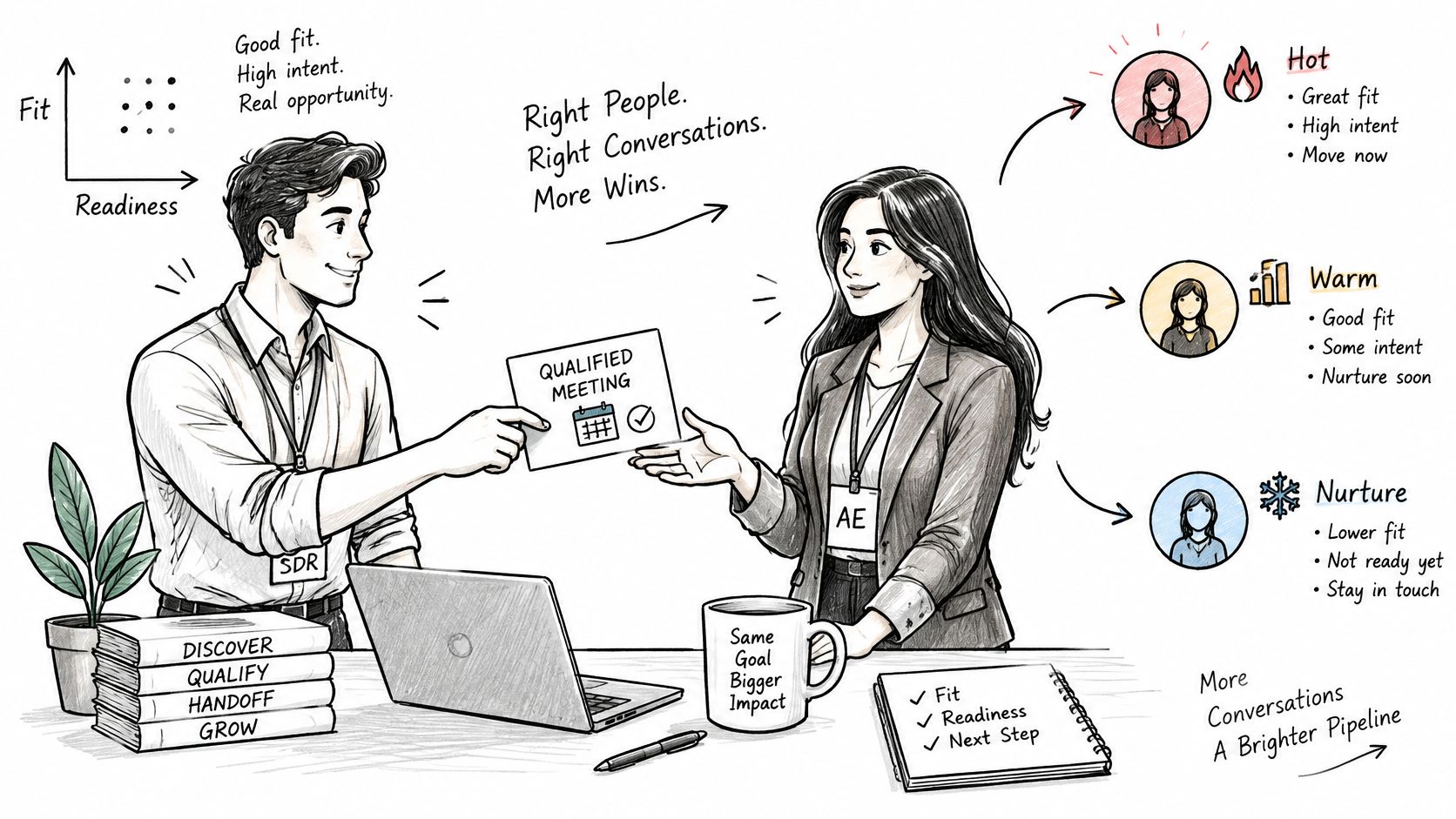
A booked meeting only counts when sales accepts it. Fit, urgency and the need for seller help are separate decisions: an ideal account may still need educational material before an account executive's time.
Gartner's buyer survey announcement found that 61% of B2B buyers prefer a rep-free buying experience overall, yet buyers still turn to sellers for tasks that need context, such as judging whether a product fits their company. The same survey found 69% see inconsistencies between a supplier's website and what sellers tell them. Ask what the prospect needs help deciding, and resolve any mismatch before advancing them.
Classify the next action with concrete meanings:
- Hot: A relevant problem, a reason to act and an agreed sales conversation. Send the handoff the same day.
- Warm: Interested, but one specific fact needs confirming. Assign that verification task rather than passing uncertainty to sales.
- Nurture: The account fits, but the buyer needs education or a later buying window.
The handoff packet should contain the stated problem, criteria answers, decision process, timing and agreed next step. If sales rejects the handoff, log the missing criterion as the fail reason and route the record back to the step that can fix it.
The example below shows the ownership step before the record moves.
For lead nurturing, set a re-contact date and send material tied to the unresolved question. Space follow-ups over several weeks, define an end point and stop repeating the original pitch. If a prospect stays unresponsive at the sequence's end, close active follow-up with a reason instead of leaving an overdue task open.
Step 5: Run Your First Qualification Week and Review
Give one person responsibility for installing the process. The sales lead approves the rules; the operating owner makes sure people use them.
- Monday: Write the must-have account and role rules. Define what sales must know before accepting a meeting and get sign-off.
- Tuesday: Set the routing rule, named owner and backup. Add CRM fields for stage, pass or fail reason, evidence source, first-touch time and next action date.
- Wednesday and Thursday: Apply the rules to every new lead. Flag uncertain information instead of filling gaps with assumptions.
- Friday: Run the Stage-Leak Math on the week's counts, then read the pass or fail reasons at the step where fit-passing leads stopped.
Audit decisions against outcomes. The Friday count shows where leads stopped moving; the audit asks whether the calls were right. Sample scored leads and compare each assessment with what sales accepted. Check rejected leads too, so strict rules don't hide viable opportunities. Track held-meeting rate by segment, not just appointments booked, alongside the other business development KPIs you already report.
If sales repeatedly rejects handoffs for unclear urgency, improve discovery before expanding the prospect list. For teams that want the operating work managed, b2b lead qualification connects response handling with sales handoff; write your acceptance criteria first, then compare options on the pricing page.
Copyable Lead Qualification Checklist
Paste this into your CRM notes or a shared doc and tick it for every lead.
Check
Done?
1
Source, timestamp and original message captured
☐
2
Duplicate check done; one owner and a backup assigned
☐
3
First relevant touch sent within one business hour
☐
4
Industry, size and region pass the must-have rules
☐
5
Contact's role verified as a buyer or named champion
☐
6
Trigger or problem recorded, with its source
☐
7
Decision path and timing confirmed in discovery
☐
8
Classified hot, warm or nurture, with a written reason
☐
9
Sales accepted the meeting, or the fail reason is logged
☐
10
Next action date set, or record closed with a reason
☐
Lead Qualification FAQs
What are the steps of the lead qualification process?
Five steps: respond and route, score fit and intent, run discovery, hand off or nurture, then follow up and review. Each step ends with a recorded pass or fail reason, and success is a sales-accepted meeting rather than a positive reply.
What makes a lead qualified in B2B?
A qualified B2B lead passes your must-have fit rules (industry, size, region, buying role) and has a confirmed problem, a reason to act and a decision path. Sales acceptance is the final test.
How long should lead qualification take?
Aim for a first touch within one business hour and a daily acceptance check, so a strong prospect never waits for a weekly pipeline meeting. Full qualification usually ends at the first discovery call.
How many touches should you make before giving up?
Use a sequence with a defined end point rather than continuing until someone remembers to stop. Close active outreach with a reason when the sequence ends, and respect any request not to be contacted. "Unresponsive" and "outside target market" are different closure reasons; keep them separate.
Who owns qualification when there's no SDR?
One named owner, usually a founder or partner, with a backup for busy days. In a two-person firm, one partner keeps the criteria and final acceptance while the other logs replies and pass or fail reasons. If volume outgrows that, look at sales development services before hiring.
Do you need a lead scoring model?
No, a clear rule set is enough to start. Add a scoring model only when you have enough completed outcomes to test whether it improves decisions. Giving points to every interaction adds complexity without resolving missing evidence.
Is BANT still useful for lead qualification?
Yes, as a discovery checklist for short, single-buyer deals. For buying committees, MEDDIC covers the decision process better. Neither replaces fit rules and a sales acceptance step.
What is the difference between an MQL and an SQL?
A marketing-qualified lead (MQL) has shown interest and fits the profile; a sales-qualified lead (SQL) has passed discovery and sales has accepted it as worth a conversation. This guide's sales-accepted meeting is the practical SQL line.
Outbound Consulting reports it has provided lead qualification services to more than 2,000 small and mid-sized businesses since 2015 (company-reported). If you'd rather have the qualification work run for you, visit Outbound Consulting to discuss your buyer profile and the evidence your sales team needs before accepting a meeting.