Lead generation for SaaS works best when a small team adds one outbound channel, LinkedIn plus email, beside the inbound it already has. McKinsey's 2024 B2B Pulse Survey of nearly 4,000 decision makers found B2B buyers use an average of ten interaction channels, so one lane rarely carries the whole pipeline. Size the gap first, run a narrow 90-day test, and judge it on qualified conversations rather than raw meeting counts.
Table of Contents
- Where Outbound Fits Beside Your Inbound Pipeline
- Size the Gap First: The Pipeline Gap Check
- Define Target Accounts and Buyers Before Outreach
- How to Run a LinkedIn and Email Sequence
- Turn Replies Into Qualified Pipeline
- Respond Fast and Track the Metrics That Matter
- In-House or Managed Outbound for SaaS
- Plan Your First 90 Days and Start One Test
- Frequently Asked Questions About SaaS Lead Generation
Where Outbound Fits Beside Your Inbound Pipeline
Picture a 3-person SaaS team whose pipeline drops by half in a slow month. Referrals are still good and content still books a few demos, but neither arrives when the forecast needs it. For a team like that, lead generation for SaaS means a steady flow of qualified sales conversations, with outbound prospecting through LinkedIn and email running beside inbound content, referrals and partners rather than instead of them. Outbound gives you control over who you approach and when. Inbound gives prospects something credible to find when they check you out after that first message.
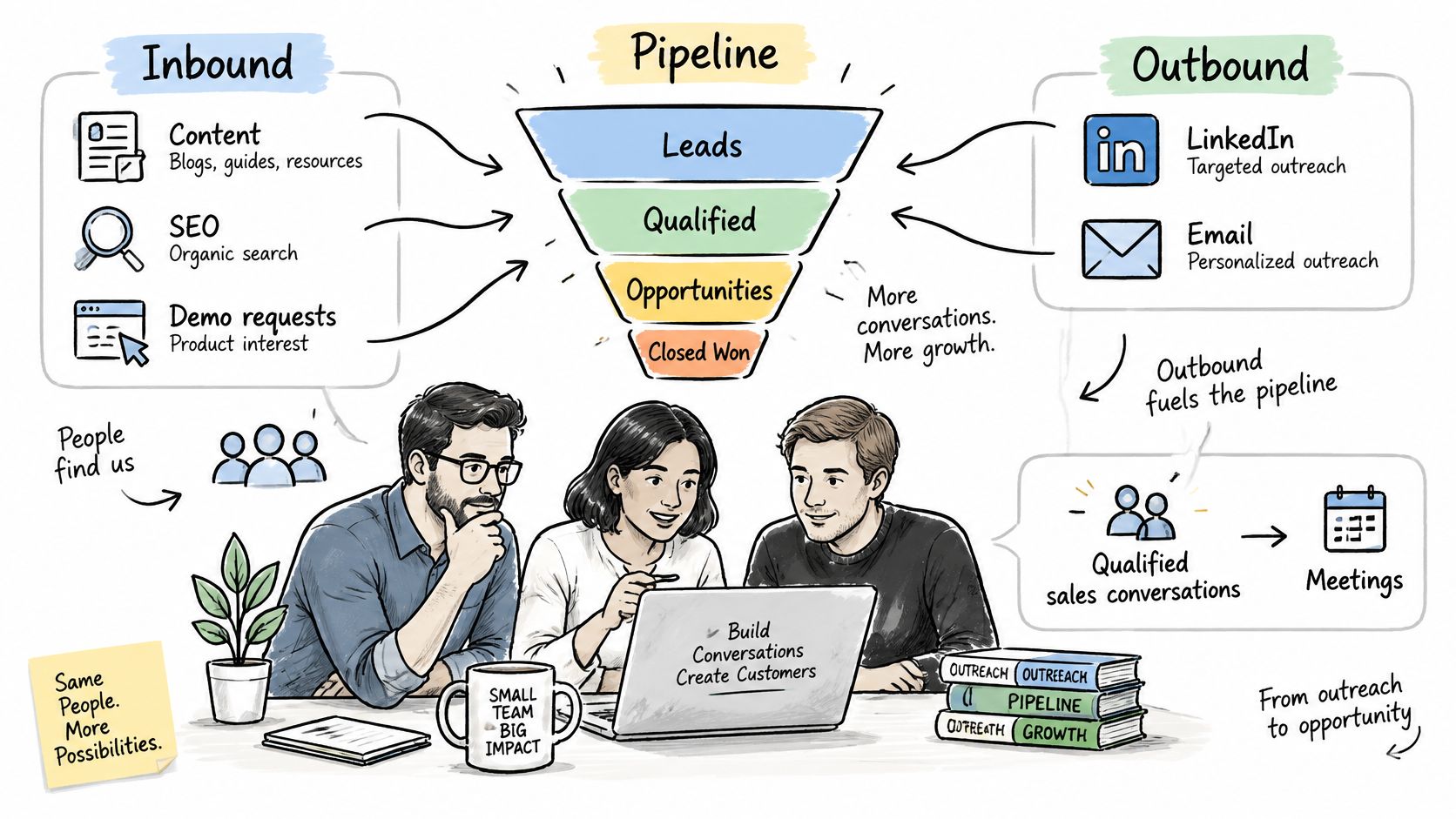
That pairing matters because buyers don't move in a single lane. In McKinsey's 2024 B2B Pulse research, published in September 2024 from a survey of nearly 4,000 B2B decision makers, buyers used an average of ten interaction channels during the buying journey, with preferences split roughly into thirds across in-person, remote and digital self-service. A prospect who ignores your message this week may read your guide, watch a short product clip and reply to a follow-up next week.
Lead Generation Channels Compared for a Small SaaS Team
Channel
Targeting control
Time to first meetings
Effort for a 2-3 person team
Inbound content and SEO
Low, reach depends on search demand
Months
Ongoing writing and editing
Referrals and partners
High, warm introductions
Weeks, depends on your network
Low, but relies on founder time
Paid search and social ads
Medium, keyword and audience settings
Days, stops when spend stops
Budget and ad management
LinkedIn outreach
High, filters by role, company size and industry
Weeks
Message writing and daily replies
Cold email
High, list-based
Weeks
Deliverability and list hygiene
No channel in that table carries a pipeline alone for long. Referrals close well but arrive on someone else's schedule. Paid ads start fast and stop the day you pause spend. Content compounds, but you can't steer it toward ten named accounts you want this quarter. Outbound for SaaS fills that specific gap: deliberate contact with companies that match your best customers.
LinkedIn is usually the first outbound channel a founder can run personally. You can filter by role, company size and industry, see a prospect's activity before writing, and keep the conversation in a place where a business message doesn't feel out of context. If you'd rather have that work managed, LinkedIn lead generation covers the prospecting and follow-up as a service.
Keep the system behind the channels simple too. If you're tightening how demand is tracked across content, ads and outbound, this guide on how to improve your B2B demand generation is a useful reference for connecting activity to pipeline.
Practical rule: Run one outbound channel and one inbound channel for 90 days before adding anything else. Two channels done consistently teach you more than five done in bursts.
Size the Gap First: The Pipeline Gap Check
Most SaaS lead generation strategies skip the arithmetic and jump straight to tactics. Before writing a single message, work out how much outbound you need. The Pipeline Gap Check works backward from the opportunities you need to the number of people you have to contact.
- Gap = opportunities you need per quarter − opportunities inbound and referrals already produce.
- Meetings needed = gap ÷ meeting-to-opportunity rate.
- Positive replies needed = meetings needed ÷ reply-to-meeting rate.
- Contacts needed = positive replies needed ÷ positive reply rate.
- Weekly contacts = contacts needed ÷ 13 weeks.
Worked example. Every input below is an illustrative assumption, not a benchmark; replace each one with your own numbers once you have a 30-day baseline.
Input (example only)
Value
Calculation
Result
Opportunities needed per quarter
12
Opportunities from inbound and referrals
8
12 − 8
Gap of 4
Meeting-to-opportunity rate
40%
4 ÷ 0.40
10 meetings
Positive reply-to-meeting rate
50%
10 ÷ 0.50
20 positive replies
Positive reply rate per contact
3%
20 ÷ 0.03
about 667 contacts
Weeks in the quarter
13
667 ÷ 13
about 51 contacts per week
About 51 well-fit contacts a week is a workload a founder plus one helper can plan around. If your own rates come in lower, the same math tells you whether to fix the list, the message or the handoff before adding volume. That's the decision most "top strategies" lists leave out.
Define Target Accounts and Buyers Before Outreach
When a campaign flops, teams often blame the copy first. The list deserves an equally careful look: if the accounts don't fit, even clear messaging has little reason to earn a reply. Define the audience before writing a sequence.
-
Write a one-page ideal customer profile. Include company size, industry, the problem your product solves, and a trigger that could make a buyer look for a solution, such as a new hire, a funding round, or a tool that no longer works as needed. Fit helps you choose accounts; timing helps you decide which ones to contact first. This ideal customer profile template can help you capture the relevant fields.
-
Define two or three buyer roles. For example, a head of revenue operations, a VP of sales or a founder may use the product, feel the cost of the problem, or approve the purchase. Those responsibilities can sit with different people, so identify each role before building the list.
-
Set list filters around the profile. Use industry, geography, headcount and role, then exclude current customers, competitors and anyone contacted recently. If you're building the list in-house, match each contact to the profile and verify addresses before sending. This guide to email validation for outbound prospecting explains why address quality matters for outbound email.
-
Review a sample before scaling. Check thirty accounts and write one sentence explaining why each fits. If the reason is unclear, refine the filters before adding more names.
A 12-person project management SaaS company targeting agencies with 20 to 80 staff has a defined starting segment. Its team can focus research on agency workflows such as client reporting and resourcing, then assess whether each account fits the profile. That gives the outreach a concrete basis without assuming every agency has the same need.
If list research is slowing the team down, list building services can support the work while your team handles sales conversations. Keep the standard clear: each contact should fit the profile and have a specific reason the product may be relevant.
How to Run a LinkedIn and Email Sequence
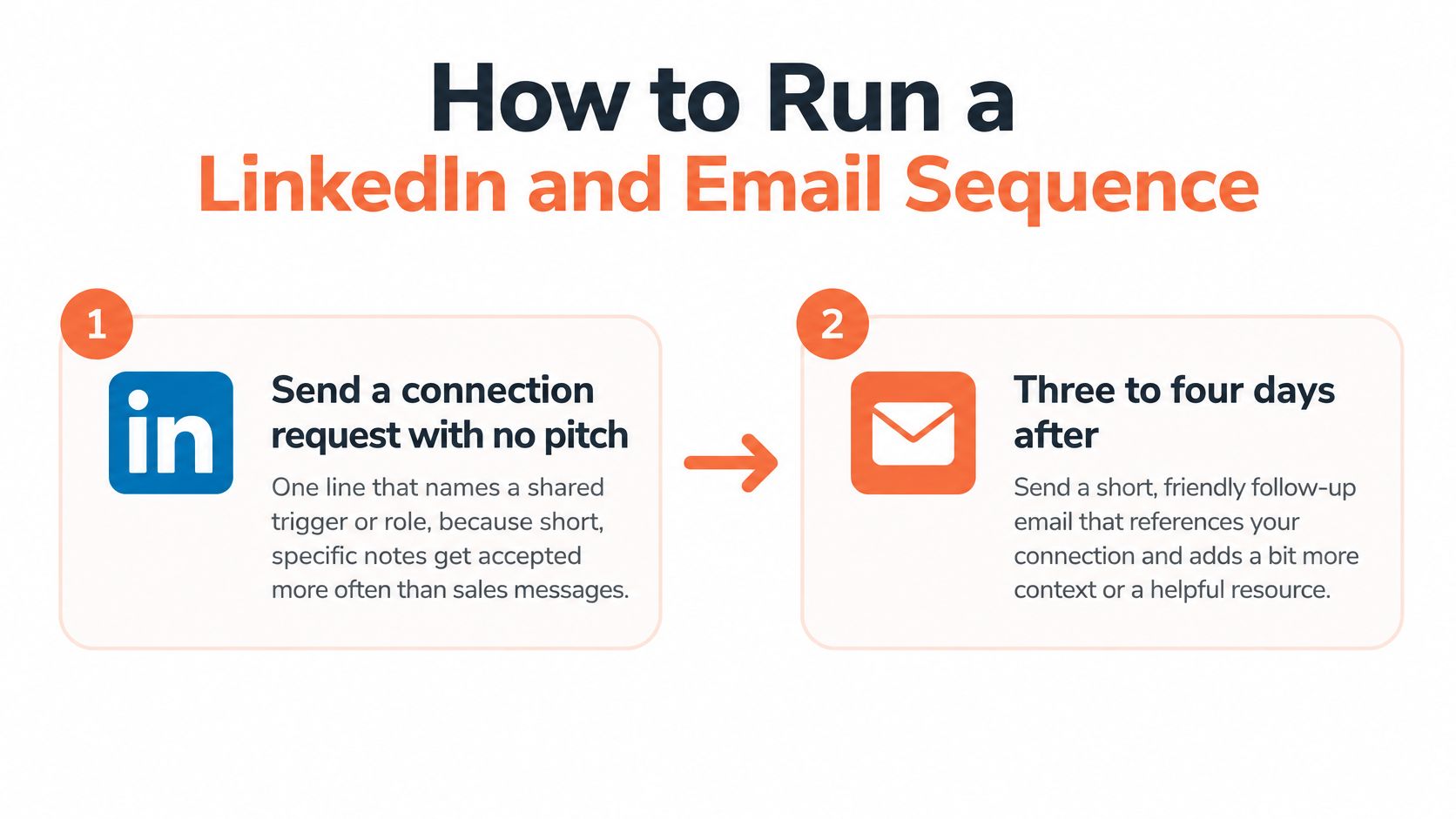
A good sequence for B2B SaaS lead generation feels like a short, reasonable conversation spread over about three weeks. It doesn't feel like a pitch repeated louder. Keep each message to one idea, write for a phone screen, and give the prospect an easy way out at every step.
-
Day one, send a connection request with no pitch. Add one line that names a shared trigger or role, so the reader can see why you chose them. This breakdown of the LinkedIn connection request message shows how little copy that note needs.
-
Three to four days after acceptance, send one message. Lead with a relevant observation about their world and ask a single question. Don't send a demo link. One question is easy to answer; three questions and a calendar link are easy to postpone.
-
Around day seven, share something useful. A short customer story, a template or a benchmark works if it connects to the problem you raised. Ask whether it fits their situation. You're testing relevance, not decorating a pitch.
-
Around day twelve, email the same contact. Reference the LinkedIn thread so it doesn't read as a second cold start, and use a different angle rather than repeating the same claim. Some buyers live in their inbox and rarely open LinkedIn messages.
-
Around day eighteen, close politely. Send a short message with an easy yes or no, such as whether this problem is worth a look this quarter or not at all. A clean no is useful data and protects your reputation with that account.
-
Move non-replies into nurture. Stop pitching and switch to occasional, relevant contact. Silence often means timing, not rejection, which is why lead nurturing belongs in the plan from day one.
What to Avoid and What to Test
Don't lead with features, don't write long multi-paragraph messages, and don't stack several links into one note. Each of those raises the effort of replying. Short messages read well on mobile, and a clear exit protects both your sender reputation and the prospect's trust.
Check acceptance and reply rates after the first 50 contacts, then change one element at a time. If you rewrite the opener, the offer and the audience in the same week, you'll learn nothing about which change worked. If you'd prefer the sequence written and run for you, a LinkedIn outreach agency is the managed version of the workflow above.
Turn Replies Into Qualified Pipeline
A reply is not pipeline. It's the start of a sorting process, and teams that skip the sorting end up with busy calendars and thin forecasts. Use fixed stages so everyone means the same thing when they say a lead is qualified.
Qualification Stages and What Must Be True at Each
Stage
What must be true
Who moves it forward
Reply
A named person answers a specific question
Sales owner, same business day
MQL
Company and role fit the ICP and the contact showed interest
Marketing or SDR
SQL
Discovery confirms problem, urgency, current solution and timing
Sales owner after a call
Opportunity
Buyer agrees to a scoped next step and names a decision path
Founder or account executive
Closed-won
Contract signed and an onboarding owner is named
Founder or account executive
Track the rate between stages by persona, market, message variant and list source, because that's where problems show up first. As a directional reference only, one benchmark compilation on lead conversion cites First Page Sage's B2B SaaS client data (2017 to 2025, sample size not disclosed): 39% lead-to-MQL, 38% MQL-to-SQL, 42% SQL-to-opportunity and 37% opportunity-to-closed-won. That's one agency's client benchmark, not a market average or a standard your team should be held to. Your own baseline, measured on your deal size and segment, is worth more.
Here's how a campaign can look successful while getting worse. Say a broader list doubles your replies, but most come from companies below your target size. Reply rate climbs, the team feels momentum, and the SQL-to-opportunity rate falls because those companies can't fund or staff the purchase. If you only report replies, you'll scale the exact list that's diluting your pipeline.
Discovery Questions That Do the Sorting
- How many people use the current tool, and who owns it internally?
- What does doing nothing cost, in time, errors or lost deals?
- Who approves the spend, and what do they need to see?
- What would make switching this quarter worth the disruption?
Four honest answers tell you whether you're holding an opportunity or a polite conversation. This walkthrough of the lead qualification process covers the handoff fields worth requiring. Teams that can't staff this stage can hand it to a lead qualification service instead of letting replies sit.
Set your own stage conversion baseline in the first month rather than borrowing someone else's numbers. Fit, price and sales cycle length vary too widely for imported targets to mean much.
Respond Fast and Track the Metrics That Matter
Every positive reply gets an owner, a same-day response, and an answer to the actual question asked. That's the handoff rule to enforce before buying any tool or rewriting any sequence. A prospect asking about pricing, integration or implementation is at peak interest, and that interest fades while your reply sits in an inbox nobody owns.
Speed has been measured on inbound leads. Workato's lead response write-up cites a Harvard Business Review study of 15,000 leads and 100,000 call attempts, but those figures come from the 2007 InsideSales.com and MIT Lead Response Management Study (James Oldroyd and Dave Elkington), which covered more than 15,000 leads and 100,000 call attempts across six companies. It found the odds of qualifying a lead fell about 4 times when the first call came at 10 minutes instead of 5. Those were web leads called by phone, not LinkedIn replies, but the direction holds: you won't always answer in minutes, and next-day replies to interested prospects shouldn't be treated as acceptable.
A Workflow a Two-Person Team Can Run
- Assign an owner immediately when a reply or demo request lands, with a named backup.
- Respond while intent is fresh, answering the question first and pitching second, if at all.
- Run a short discovery call against fit, pain, authority, timing and commercial potential.
- Move non-ready prospects into nurture with a documented next-contact date, not a vague intention.
Treat reply handling as part of the campaign, not admin after it. A shared inbox, a daily 15-minute review of new replies, and one escalation path for high-intent messages will cover most small teams.
Track median first-response time, reply-to-meeting rate, meeting show rate, SQL-to-opportunity rate and revenue by sequence. Keep inbound demo requests separate from cold outbound replies, because they carry different intent and shouldn't share one conversion number. This guide to business development KPIs is a good reference for defining each metric before you report it.
The common pitfall is reporting only acceptance or reply rate, which can hide a slow inbox that is costing you qualified meetings. Record a 30-day baseline for each metric before you change any message copy, so you're improving against evidence instead of opinion.
In-House or Managed Outbound for SaaS
Once the Pipeline Gap Check tells you the weekly volume, the next question is who does the work. Here's how the three common models compare for a small SaaS team.
Factor
Founder-led
First SDR hire
Managed outbound partner
Time to first sequence
Days
After hiring and ramp
Weeks, after onboarding
Founder hours per week
Highest
Medium, for coaching
Lowest, for reviews and calls
Product and market knowledge
Deepest
Builds over months
Needs a clear brief and ICP
List building and tooling
You choose and pay for it
You choose and pay for it
Usually included in the service
Best fit
First 50 to 100 contacts, message testing
Proven message, steady volume
Proven offer, no capacity to run it daily
Many teams start founder-led to learn which message works, then hand off the volume. If you're weighing a partner, compare scope rather than headline numbers, and check pricing against the contact volume your gap math produced.
Plan Your First 90 Days and Start One Test
Ninety days is enough to learn whether outbound fits your market. It isn't enough to judge it on closed revenue, and anyone who promises a set number of meetings in that window is guessing with your budget. Replies come before meetings, and meetings come before revenue, so measure the early months on conversion rates and meeting quality.
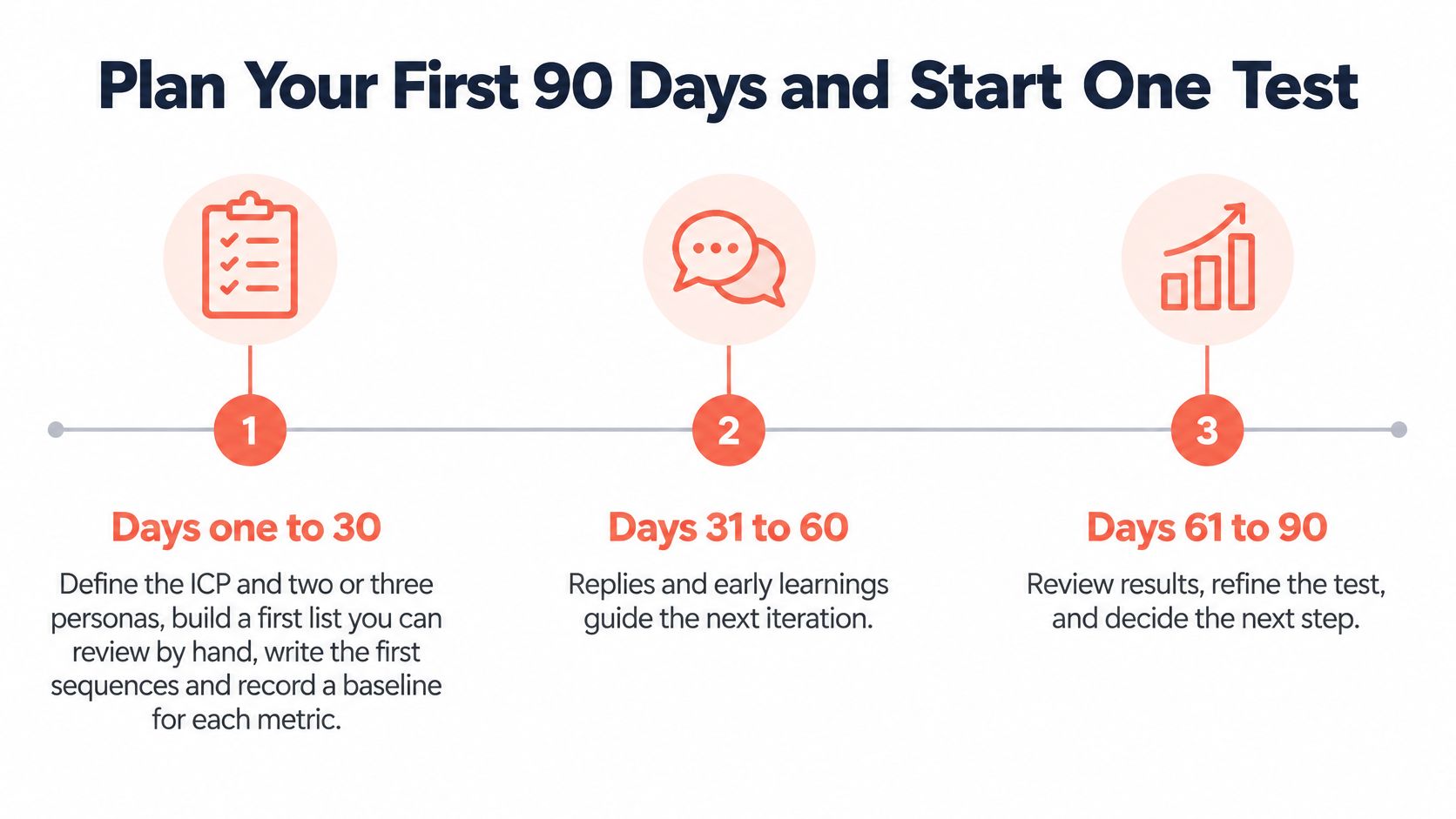
Days one to 30 are setup and baseline work. Define the ICP and two or three personas, build a first list you can review by hand, write the first LinkedIn and email sequences, and record a starting value for each metric you plan to track. Expect this month to feel slow. You're building the asset, not harvesting it.
Days 31 to 60 are when replies start teaching you things. Adjust targeting and messaging by persona based on who's responding, tighten the segments that produce fit replies, and expect the first qualified conversations to enter the pipeline. This is also when weak discovery shows up, so review call notes weekly.
Days 61 to 90 should produce the first meetings and opportunities from the outbound slice. Now you can make a real keep, change or stop decision on each test, using thresholds you agreed before launch rather than mood after a quiet week. Keep inbound and SEO running throughout, because they pay off on a slower clock and support every outbound conversation.
This short video walks through how a managed outbound campaign is structured, which is useful context if you're comparing running the test yourself against handing it over.
Keep the First Test Narrow
Start with one ICP segment, one persona, one LinkedIn plus email pair, and one offer, such as a short discovery call. Write the baseline down before launch and book reviews at day 30, 60 and 90 in the calendar now. A narrow test you can read clearly beats a broad launch you can't interpret. If you want to see how similar companies approached it, these technology and SaaS case studies show the shape of past engagements.
If daily outreach and reply handling can't be staffed in-house, compare the managed LinkedIn lead generation program, which covers audience research, a custom prospect list, a multi-step sequence written in your voice, and daily follow-ups. Outbound Consulting has run outbound for B2B companies since 2015 (company-reported), and package details are on the pricing page.
Whether you run it yourself or not, do the first piece of work this week. Write the one-page profile, run the Pipeline Gap Check, pick the single segment, and book the first review date before any message goes out.
Frequently Asked Questions About SaaS Lead Generation
What Is the Best Lead Generation Strategy for B2B SaaS?
There's no single best channel. For a small team, the most reliable B2B SaaS lead generation setup is one inbound channel you already run plus one outbound channel you control, usually LinkedIn and email, aimed at a tightly defined ICP. Size the outbound volume with the Pipeline Gap Check, then judge it on stage conversion, not activity.
Is Outbound Worth Running When We Already Have Inbound?
Yes, when it runs beside inbound. Outbound creates conversations with named accounts now, while content and SEO take months to compound. The two also reinforce each other, since prospects who receive a message often read your content before deciding whether to reply.
Do We Need LinkedIn Sales Navigator to Start?
No. Sales Navigator adds filters and saved lists, which help at scale, but many founders begin with a standard account and a careful manual search for a first test of around 50 contacts. Upgrade when list building, not messaging, becomes the bottleneck.
Is Cold Email Allowed?
Check the rules for every region you contact before you send. Identify yourself clearly, state a specific reason for reaching out, and include a working opt-out in every message. When in doubt, get advice for the markets you're mailing rather than assuming one rule covers all of them.
Does Outbound Replace Content?
No. Buyers still research vendors on their own before replying, so your pages, stories and explainers do the persuading your first message can't. Keep publishing while outbound runs, and use your best content inside the sequence.
How Many Meetings Should We Expect in 90 Days?
Don't plan around a promised volume. Set your own baseline during the first 30 days, then judge the early months on reply quality and stage conversion rates. A small number of well-fit meetings beats a larger number that never reach opportunity stage.
Should a SaaS Startup Hire an SDR or Use a Lead Generation Agency?
Start founder-led until you know which message earns fit replies. After that, hire an SDR if you have steady volume and someone to coach them, or use a SaaS lead generation agency if you need the work run daily without adding headcount. The comparison table above lays out the trade-offs.
What If Nobody Replies?
Check the connection acceptance rate first, since unaccepted requests mean your messages were never read. Then test the opening line, then the offer, changing one element at a time. Touch targeting last, because scrapping a good segment over weak copy wastes the research behind it.
If referral flow isn't giving your SaaS team enough qualified conversations, Outbound Consulting can run the LinkedIn and email outbound beside your inbound efforts, from list building through qualification and nurturing. You keep the sales conversations; the prospecting stays consistent. Start the conversation at Outbound Consulting and map out your first 90-day test.