The best in house vs outsource decision for a small B2B sales team is rarely all or nothing. In Deloitte's 2024 Global Outsourcing Survey of more than 500 executives, 70% of organizations said they had selectively insourced parts of previously outsourced work in the past five years. Keep buyer relationships and commercial judgment in house, outsource repeatable research and outreach, and compare both models by cost per sales-accepted opportunity, not salary against a monthly fee.
Table of Contents
- Which Sales Functions to Keep In House and Which to Outsource
- What an In-House Sales Function Really Costs
- Cost per Qualified Opportunity Beats Comparing Monthly Fees
- In-House vs Outsourced Sales Team: Control, Expertise and Ramp Time
- Hybrid Models and Which Model Fits Your Team
- Common Questions About In House vs Outsourced Sales
- Set Your Split Between In House and Outsourced Work
Which Sales Functions to Keep In House and Which to Outsource
Keep the decisions that define your customer relationship in house. Consider outside help for work you can specify, inspect and hand off without losing what you know about the buyer.
Most "in-house vs outsourcing" guides treat the question as one company-wide choice, usually about IT or manufacturing. Sales doesn't work that way. List building, outreach, reply screening, qualification and closing each have different economics, so decide function by function.
For a team of two to fifteen people, the split below is a starting point, not a rule that overrides your sales process.
Default in-house or outsourced split by sales function
Sales function
Default model for a small B2B team
Why
List building
Outsource, with in-house review of the ideal customer profile
Research-heavy and repeatable; easy to inspect
Prospecting and outreach
Outsource or hybrid
Repeatable touches need consistent execution and clean targeting
Reply screening
Outsource or hybrid
Agreed criteria can be applied by an outside operator
Final lead qualification
Keep in house
Judgment on fit, budget and timing belongs to you
Lead nurturing
Hybrid
Sequences can be outsourced; personal follow-up stays internal
Discovery calls and closing
Keep in house
Requires product knowledge and relationship ownership
The Keep-or-Buy Score: rate each function
The three classic make-or-buy factors from transaction-cost economics are asset specificity, uncertainty or measurement difficulty, and transaction frequency. Transaction-cost analysis by Aubert and colleagues (HICSS 2003) names all three as the main variables behind the choice. The Keep-or-Buy Score turns them into a five-minute exercise.
Rate each sales function from 1 (low) to 5 (high) on:
- S – Specificity: how much company-only knowledge the work needs (product nuance, account politics, pricing judgment).
- M – Measurement difficulty: how hard it is to define and inspect good output in advance.
- V – Volume steadiness: how steady and full-time the internal workload would be (1 = a few hours in some weeks, 5 = a full role every week).
Keep-or-Buy Score = S + M + V (range 3 to 15). Read it as: 3–7 outsource, 8–10 hybrid, 11–15 keep in house.
Function
S
M
V
Score
Suggested model
List building
2
1
2
2 + 1 + 2 = 5
Outsource
Prospecting and outreach
2
2
3
2 + 2 + 3 = 7
Outsource
Reply screening
2
2
3
2 + 2 + 3 = 7
Outsource, with escalation rules
Lead nurturing
3
3
3
3 + 3 + 3 = 9
Hybrid
Final qualification
4
4
3
4 + 4 + 3 = 11
Keep
Discovery and closing
5
4
4
5 + 4 + 4 = 13
Keep
All ratings are example inputs for a typical small B2B team. Score your own functions; a product-heavy or confidential sale will push specificity up across the board.
A borderline score (7 or 8) is the signal to run a time-boxed test rather than argue about it. Document the handoffs in your B2B sales process so a positive reply doesn't become an opportunity just because someone agreed to talk.
Insource vs outsource isn't all or nothing
The 2024 Deloitte Global Outsourcing Survey report, based on more than 500 business and technology leaders including more than 150 C-suite executives, found that 56% of organizations outsource front-office functions, 46% outsource research and development, and 70% have selectively insourced portions of previously outsourced work over the past five years.
Those are large-organization findings, not a forecast for a small agency or SaaS company. The practical takeaway is that external execution and internal ownership coexist, and the boundary moves over time.
Practical rule: Keep work that requires your product knowledge, judgment about fit and relationship with the buyer. Move research and repetition outside when you can define what acceptable output looks like.
Don't outsource an undefined process and expect the provider to resolve every strategic ambiguity. Decide whom you want to reach and why your offer matters before paying anyone to increase activity.
What an In-House Sales Function Really Costs
Salary is only the visible part of employment cost. The wage on an offer letter misses what the employer pays on top: legally required programs, leave, insurance and retirement contributions. Those costs run whether or not the hire produces pipeline.
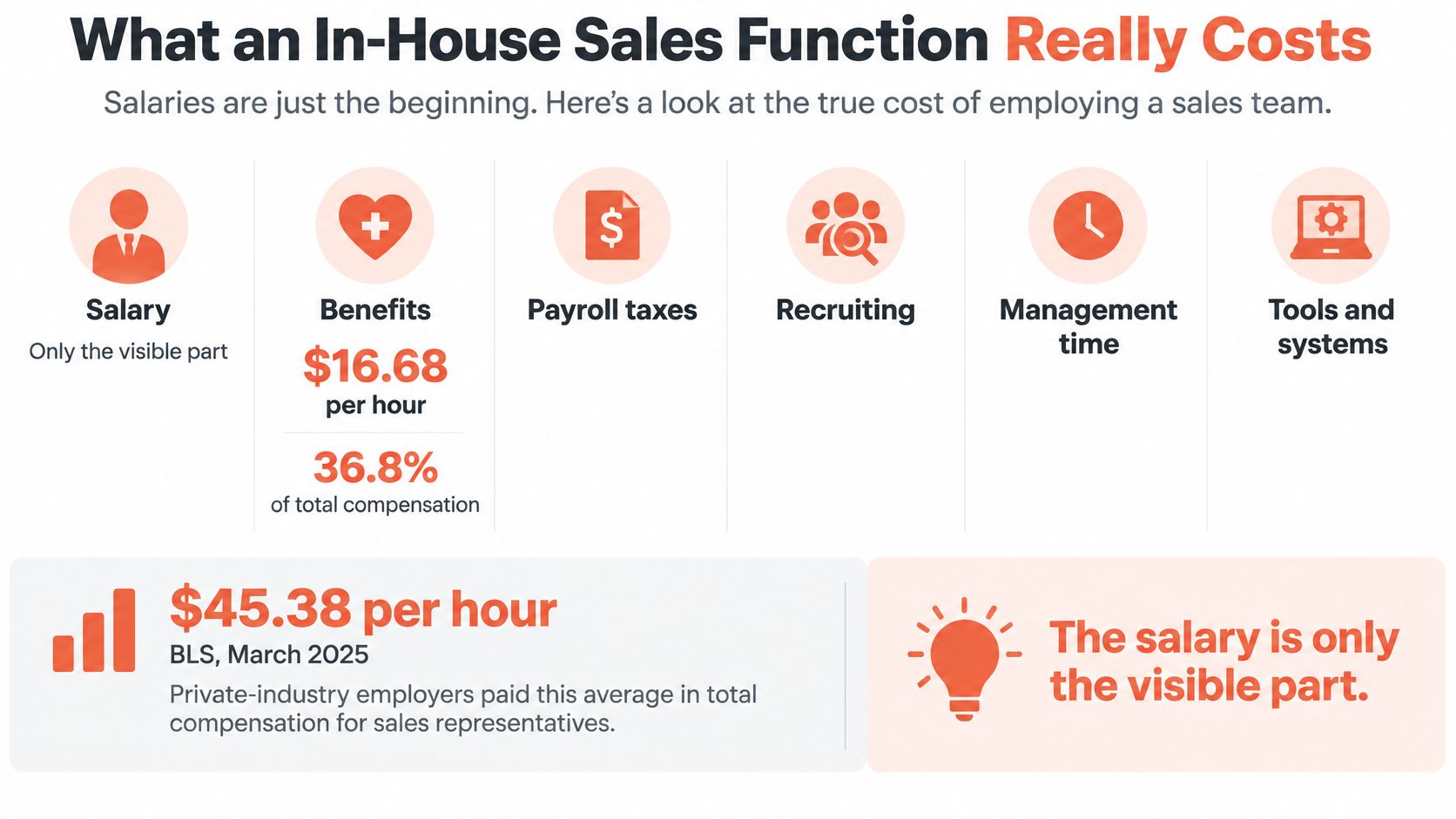
Per the U.S. Bureau of Labor Statistics, employer costs for private industry workers in March 2025 averaged $45.38 per hour worked: $31.89 in wages and salaries (70.3%) and $13.49 in benefits (29.7%). That is an all-occupation average, not a sales salary; treat it as a baseline and replace it with your own numbers.
Cost component
In house
Outsourced
Wages and salaries
$31.89 per hour average, private industry, March 2025
Provider staffing covered by the contracted fee
Employer-paid benefits
$13.49 per hour, 29.7% of total compensation
Provider employment costs covered by its fee
Recruiting and onboarding
Interview hours, recruitment fees and internal onboarding
Provider recruits its staff; you still brief the team
Manager time
Coaching, review, prioritization and quality checks
Briefing, approvals and performance review
Sales tools and data
Seat licences, research access and administration
Confirm included access and additional charges
Ramp time before useful output
Recruiting, training and supervised execution
Briefing, targeting approval and campaign preparation
Underutilization in slow months
Employment cost continues regardless of pipeline
Capacity follows contracted scope and notice terms
Build an annual operating cost, not a salary estimate
For an illustrative full-time assumption of 2,080 paid hours a year, the BLS hourly total gives $45.38 × 2,080 = $94,390 in annual compensation. That covers wages and benefits only. Recruiting, tools and management time sit on top.
The line teams undercount most is management time. Write down the founder's interview hours, the sales lead's coaching time and whoever maintains prospect data. Those costs don't disappear because nobody sends an invoice for them.
Include training, equipment and workspace where they apply, and don't double count payroll costs already inside the compensation figure.
Account for unused capacity
An employee stays on payroll when the pipeline slows or the founder pauses prospecting to deliver client work. Outsourced capacity can be easier to adjust, but only within the agreement's scope, minimum commitment and notice period.
A provider also needs management. Budget for briefing, reviewing targeting, approving messages and correcting misread replies rather than assuming the relationship runs unattended.
Total each line across a full year before comparing employment with a quote. Review pricing alongside scope, because a lower fee for less work isn't a like-for-like saving.
Cost per Qualified Opportunity Beats Comparing Monthly Fees
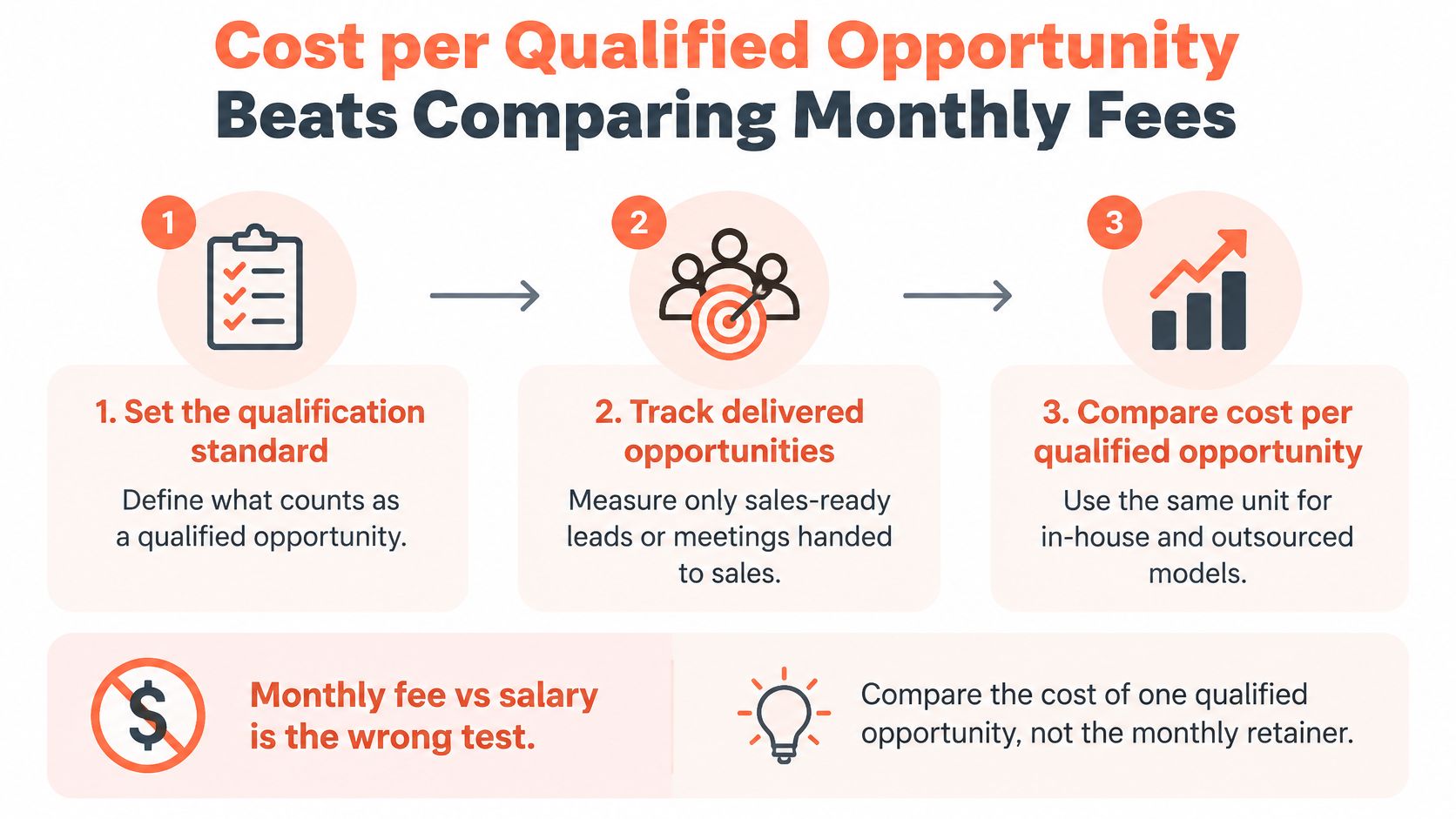
Comparing a salary with a retainer compares two ways of paying, not two ways of producing pipeline. Cost per qualified opportunity gives both models the same denominator: opportunities your sales owner accepts under a written qualification standard covering buyer fit, a relevant need and an agreed reason to continue.
Rebuild the comparison with your own assumptions
The following is a hypothetical annual calculation built on example inputs, not a market price or an expected performance level.
Example input
In-house example
Outsourced example
Annual compensation or service fee
$94,390
Your annual quote: F
Management or client-review time
240 hours × $75 = $18,000
60 hours × $75 = $4,500
Additional tools
$6,000
Included by assumption
Setup fee
None assumed
None assumed
Total cost
$118,390
F + $4,500
Sales-accepted opportunities
30
24
Cost per accepted opportunity
$118,390 ÷ 30 = $3,946
(F + $4,500) ÷ 24
Break-even fee. The outsourced model is cheaper per opportunity when (F + $4,500) ÷ 24 is below $3,946.33. Solve for F:
- $3,946.33 × 24 = $94,712
- $94,712 − $4,500 = $90,212
So, with these example inputs, any annual fee below about $90,212 wins on unit cost; any fee above it loses to the in-house hire. If the provider delivered 18 accepted opportunities instead of 24, the break-even would drop to $3,946.33 × 18 − $4,500 = $66,534.
That is the point of the exercise: the fee alone decides nothing. The fee relative to accepted output decides everything, and a cheaper contract that produces fewer qualified conversations can lose to a payroll that looks expensive on paper.
Run both models through the same steps:
- Total annual employment cost, including benefits and recruitment.
- Add manager hours at your own internal hourly cost.
- Include tools, onboarding and setup, without counting an item twice.
- Count opportunities accepted by sales during the same measurement period.
- Divide each model's total cost by its accepted-opportunity count.
Your business development KPIs should separate positive replies, qualified conversations and sales-accepted opportunities. Merging them hides weak handoffs, and a provider that reports activity while your sales owner rejects the meetings will make the outsourced column look better than it is.
Include the cost of coordination
Aubert and colleagues also note that internal organization tends to be efficient only for recurrent transactions, and that measurement problems make market contracts harder. Applied here: how specific is the knowledge to your company, how easily can you inspect performance, and how regularly does the work recur?
Outsourcing is more defensible when the work recurs and its output is observable. In-house execution gets stronger when proprietary knowledge, daily reprioritization or hard-to-specify judgment dominates.
A low fee loses its advantage when your team spends its saved hours correcting targeting, rewriting messages and rebuilding missing reports.
In-House vs Outsourced Sales Team: Control, Expertise and Ramp Time
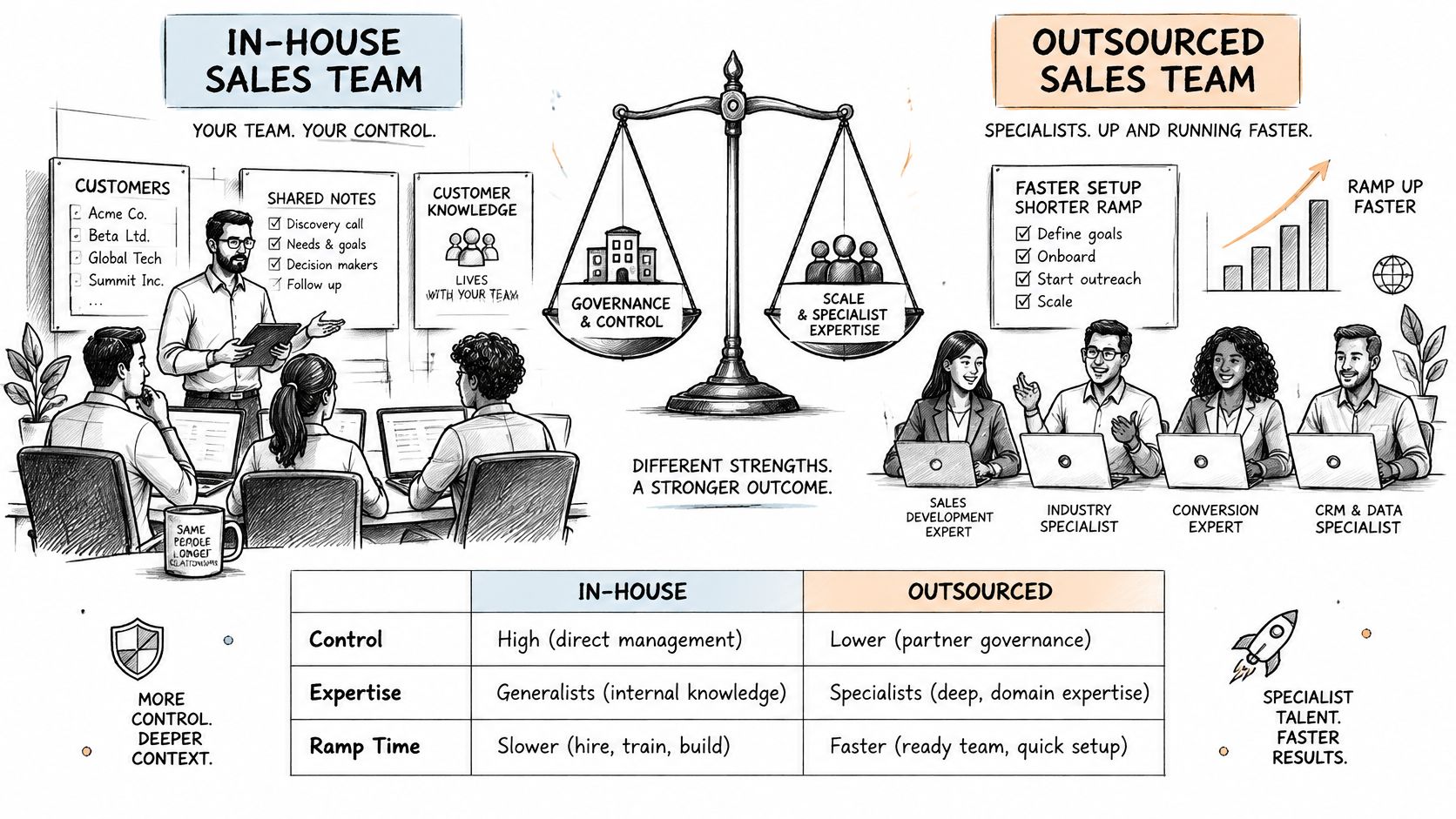
Control comes from decision rights and visibility, not from the payroll. An employee can drift when priorities are vague, while an outside team can work to tight standards when approval rights, escalation paths and reporting cadence are written down.
A meta-analysis published in the Academy of Management Journal (Geyskens, Steenkamp and Kumar, 2006, "Make, Buy, or Ally") pooled transaction-cost studies linking governance choices to factors such as asset specificity and uncertainty. For a small company, the practical test is how often the work changes and how much judgment each task needs.
Factor
In-house sales team
Outsourced sales team
Hybrid
Control
Direct reporting lines
Contract, approvals and reporting
You own decisions; provider owns execution
Product and buyer knowledge
Deepest over time
Needs a clear brief and examples
Kept inside; shared through the brief
Time to first outreach
After hiring and ramp
After onboarding and targeting approval
After onboarding
Fixed cost
High; continues in slow months
Contracted fee within notice terms
Lower fixed cost than a full team
Scaling up or down
Hiring lead time or severance
Changes per the agreement
Adjust the outsourced slice
Main risk
Weak supervision, vacancy gaps
Misaligned targeting, activity without acceptance
Unclear handoff ownership
Define who can change what
You keep the ideal customer profile and exclusions, positioning and message approval, qualification standards, sales conversations and proposals, plus ownership of lists, messaging assets and reporting data.
An internal team gives you direct reporting lines and accumulated account knowledge. You still have to recruit, coach and manage it, and weak supervision shows up as vague target lists and inconsistent follow-up.
An external specialist brings established research methods and execution systems. It can't know on day one which accounts are politically sensitive, which claims your offer can't support, or which apparently good prospect should stay excluded. Write those down before launch, and set screening criteria your lead qualification handoff can follow.
Compare readiness and ramp time
For hiring, define the role before opening recruitment. TekRecruiter's go to market recruiting explained covers how revenue-role hiring differs from general recruiting, and the split between SDR and BDR responsibilities helps prevent an overloaded job description.
A new hire needs recruiting, onboarding and supervised practice before the work is reliable. A provider may already have execution infrastructure but still needs offer training, approved targeting and examples of replies you consider useful. Judge both on the same clock: time to clean targeting, time to consistent execution and time to sales-accepted opportunities.
Review the operating scorecard quarterly, separating execution quality from commercial outcomes:
- Targeting quality: target-account precision and profile-data completeness.
- Execution discipline: completed outreach, positive-reply classification and response time.
- Commercial acceptance: qualified-lead acceptance and conversion from qualified conversation to a client-owned opportunity.
Ownership should survive the relationship. Keep list, message and reporting rights explicit so your pipeline history stays retrievable if you change the split later.
Hybrid Models and Which Model Fits Your Team
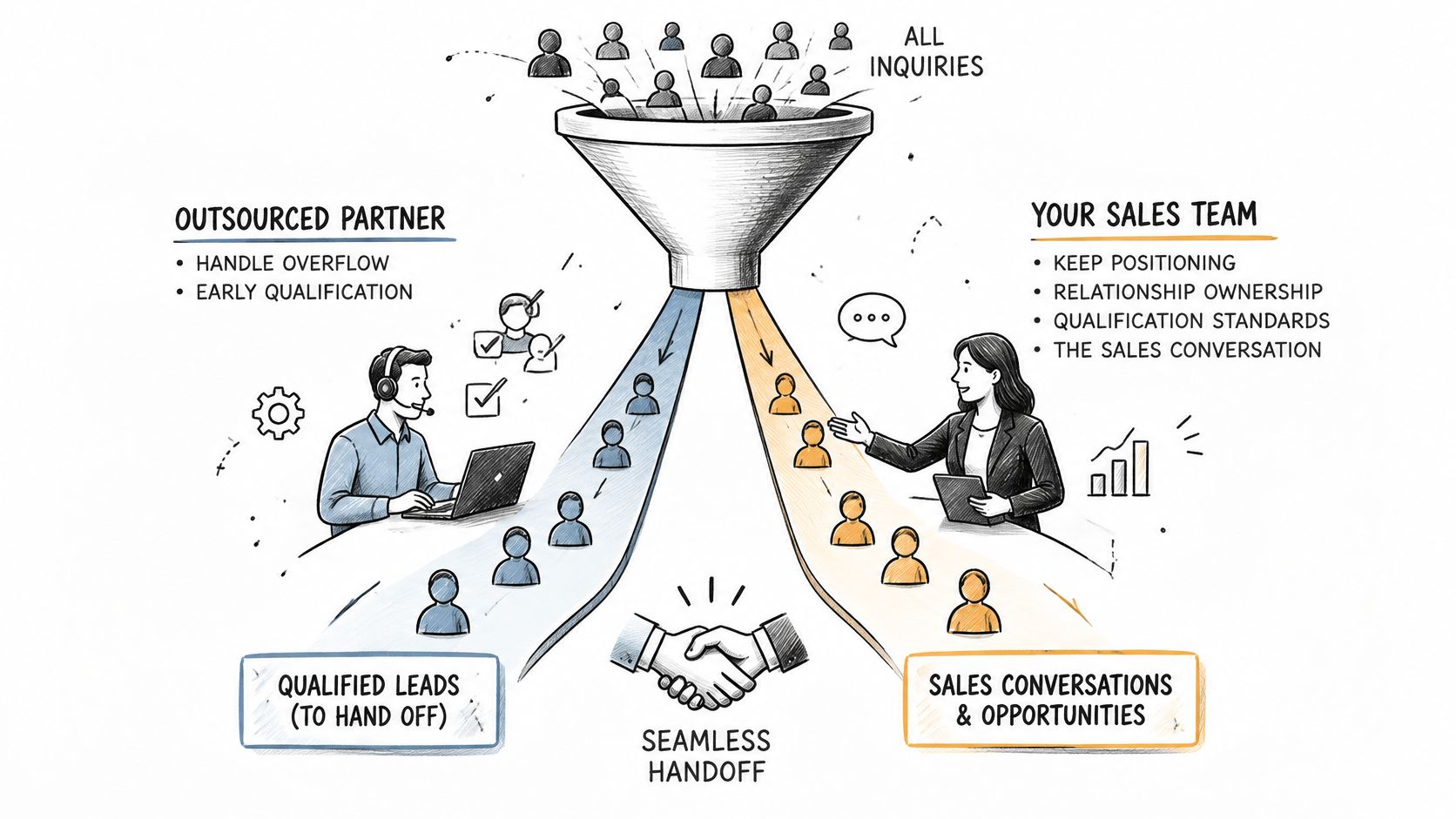
Choose the model around the bottleneck, not the headcount. A founder who can sell but never prospects needs a different answer from a trained SDR buried in research.
Deloitte's report also shows the motive shifting: four years earlier, 70% of organizations cited cost savings as the main reason to outsource; in the 2024 survey that figure was 34%, with more weight on talent, capabilities and outcome-based services. For a lean business, the application is to buy missing execution capacity while keeping commercial ownership inside the company.
Recommended model by team situation
Team situation
Likely model
Reason
Founder sells alone, no sales hire
Outsource list building and outreach; keep calls
Founder time is the bottleneck; the founder keeps closing conversations
Small team with a sales lead
Hybrid
The sales lead owns qualification and calls; a provider adds capacity
Team with an experienced in-house SDR
Keep prospecting in house; outsource list building
The team owns the process; buy research and data
Seasonal or volatile pipeline
Outsource most prospecting
Contracted capacity can adjust without changing headcount
Product-heavy or confidential sales cycle
Keep in house
Knowledge-transfer and confidentiality risks are higher
Referral-heavy firm with little outbound experience
Test outsourced outreach for 90 days
Compare measured results with a baseline before committing longer
What the split looks like in practice
Three example arrangements cover the common cases:
- A founder with two closers outsources prospect research and outreach. The closers handle discovery, while the founder approves positioning and reviews rejected opportunities.
- A six-person agency has a partner who runs discovery. External support manages LinkedIn outreach and reply screening, with ambiguous questions routed to the partner.
- A SaaS company with a trained SDR buys list building and reply review. The SDR spends more time in buyer conversations instead of assembling prospect records.
A written lead qualification process makes each arrangement workable. Record what can be screened externally and what needs your decision.
Scale only after the handoff works
For a referral-heavy firm, pick one segment and hold outreach volume steady during the test. Establish baseline reply and qualified-conversation rates, record accepted opportunities, and adjust capacity from observed results rather than a vendor pitch.
Growing an internal team takes hiring lead time; shrinking it can involve redeployment or severance. Contracted capacity changes according to the agreement.
If nobody can own sales decisions, outsourcing execution leaves the leadership gap untouched. Shiny's discussion of full-time vs fractional sales leadership addresses that separate choice, and B2B sales consulting is the route when strategy, not capacity, is the gap.
Common Questions About In House vs Outsourced Sales
Is outsourcing sales always cheaper than hiring?
No. An internal rep tends to win when three things line up: steady volume to keep them busy, a manager who can coach the work, and niche knowledge an outside operator would take months to absorb. Outsourcing tends to win when the work is intermittent or needs process and tooling you haven't built. Run the break-even fee calculation above with your own numbers.
What is the difference between insourcing and outsourcing?
Outsourcing hands a function to an outside provider under contract. Insourcing does the work with your own employees, either from the start or by bringing back work that was previously outsourced. Many companies do both at once, function by function.
Can I keep sales calls in house and outsource prospecting?
Yes, and it's a natural split for a small team. Keep positioning, qualification standards, discovery and proposals while delegating research and outreach execution. The handoff needs a written rule for when the outside operator stops replying and routes the conversation to you.
What does an outsourced sales team do?
Scope varies by provider. Common work includes building target lists, running LinkedIn or email outreach, screening replies against agreed criteria, booking calls and reporting results. Some providers also take discovery calls or closing; for a small B2B company, those usually stay in house.
How long before outsourced results are clear?
Judge targeting and reply quality inside a fixed test window, on one agreed segment and scope, before expecting closed revenue. Long sales cycles make early silence uninformative. The useful signal is whether relevant buyers moved into conversations your team accepted.
What should I own in the contract?
Exportable prospect lists, messaging, account history and reporting data, plus notice periods and a transfer plan for live conversations.
When should a function move back in house?
When daily execution depends on proprietary knowledge, coordination overhead outweighs the benefit, or internal cost per accepted opportunity stays lower over a sustained period. Confirm a named manager, enough workload to justify the hire, and a transition that carries over targeting decisions, reply categories and buyer history.
What are the three types of outsourcing?
By location, outsourcing is usually grouped as onshore (a provider in your own country), nearshore (a nearby country, often in a similar time zone) and offshore (a distant country, often at lower cost but with more coordination). For sales outreach, language, time zone and market knowledge usually matter more than the label.
Set Your Split Between In House and Outsourced Work
Write the split down before you hire or sign a contract. Give each sales function a row, its Keep-or-Buy Score, a named owner and a measurable standard for what counts as an opportunity your team will act on.
Hybrid fails when it means shared responsibility without accountability. Someone inside your business must judge whether the work is commercially useful.
- Score each function. Rate S, M and V, add them, and mark the function keep, outsource or hybrid.
- Price both sides. Calculate fully loaded internal cost, cost per accepted opportunity and the break-even fee.
- Document the operating agreement. Record the scorecard, asset ownership, reporting format and exit terms.
- Test one segment. Run a focused test, then continue, adjust or stop based on opportunity quality and unit economics.
For the narrower staffing question, read our comparison of a lead generation agency vs an in-house SDR. If the scores point to outsourcing research, outreach and screening, sales development services cover that managed execution while you keep the sales conversation; Outbound Consulting reports having worked with 2,000+ businesses across 25+ industries (company-reported).
Start with the function that currently blocks consistent prospecting. A research, writing or follow-up blocker calls for a different fix than a closing blocker. Visit Outbound Consulting to talk through which functions belong inside your business and which could use managed support.