Outbound lead generation means the company finds and contacts prospects first, then qualifies which of those replies deserve a sales conversation. It's measured by qualified conversations and accepted meetings, not by message volume.
A four-person consulting firm lives this pattern every quarter. January and February are full because a former client passed a name to a CFO she trusts. March is empty, and nothing about the quality of the work changed. Only the number of people who happened to think of the firm that month changed.
Referrals respond to timing the firm doesn't set. Outbound responds to a list and a calendar the firm does control, which is why the two belong side by side rather than in competition. The practical question is never whether outbound works in general. It's which stage of your own process is leaking meetings, and what you're willing to fix first.
Table of Contents
- What Outbound Lead Generation Means for B2B Sales
- The Outbound Lead Generation Process from List to Handoff
- Building a Target List That Stays Current
- Outreach on LinkedIn That Earns Replies
- Qualifying Replies Before a Sales Call
- Measuring Outbound by Accepted Meetings Not Activity
- Deciding Whether Outbound Fits Your Small Team
- Frequently Asked Questions About Outbound Lead Generation
What Outbound Lead Generation Means for B2B Sales
The motion is simple to describe. The company picks the accounts, starts the contact, qualifies what comes back, and hands the qualified conversations to its own sales team. The output isn't a list of names or a count of messages sent. It's the sales calls the client holds.
Three motions look similar from the outside and behave nothing alike. Referrals are a pantry that is well stocked until the week it isn't, and nobody can restock it on request. Inbound is a shop window that depends on foot traffic the business doesn't control. Outbound is a shopping list taken to market on a schedule, which is why it belongs alongside the other two rather than replacing them.
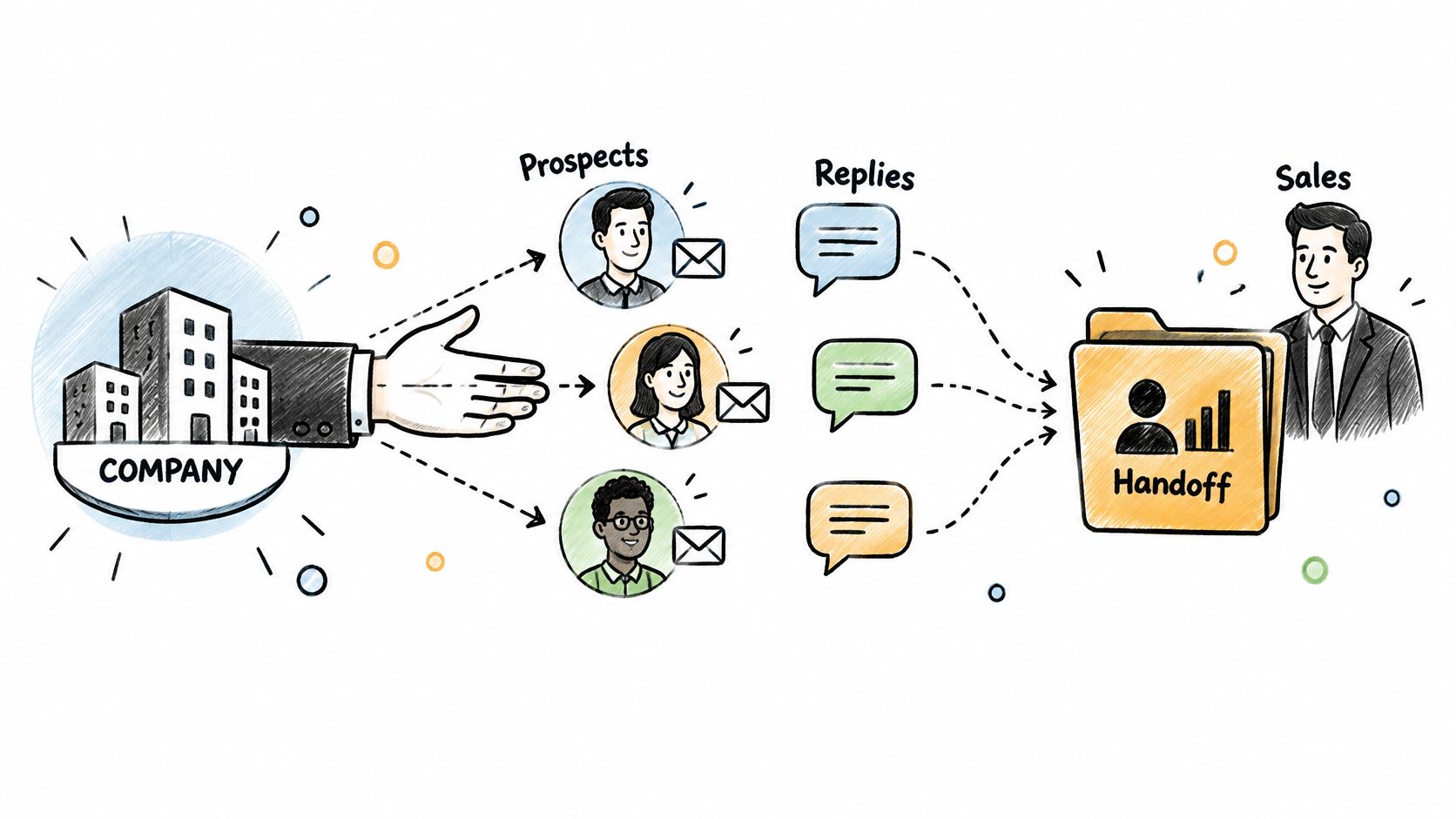
One definition carries the whole process. An accepted sales call is a call the prospect agreed to and the client held. Both halves matter. A prospect who agrees on Tuesday and cancels on Thursday produced nothing, and neither did the client who rescheduled twice.
The addressable market keeps refilling, which is why a list built once goes stale. The U.S. Census Bureau's Business Formation Statistics lists 578,735 business applications in January 2024 alone. The series counts applications for federal tax identification numbers through IRS Form SS-4 filings, so it captures organizations entering the formal business pipeline, not only established employers. Every one of those new firms eventually buys services from somebody.
Outbound also still gets budget. In Sopro's Outbound Pulse 2025 survey of 300 senior B2B sales and marketing decision-makers in the United Kingdom and United States, 78% said outbound sales outreach was essential to their growth strategy. That's a statement about intent, not results. It does tell you the channel isn't a fringe bet for a small firm with a narrow market.
The Outbound Lead Generation Process from List to Handoff
Six stages stand between a blank page and a held sales call, and each one produces something the next stage consumes. Skip a stage and the one after it improvises. That improvisation is where pipeline disappears.
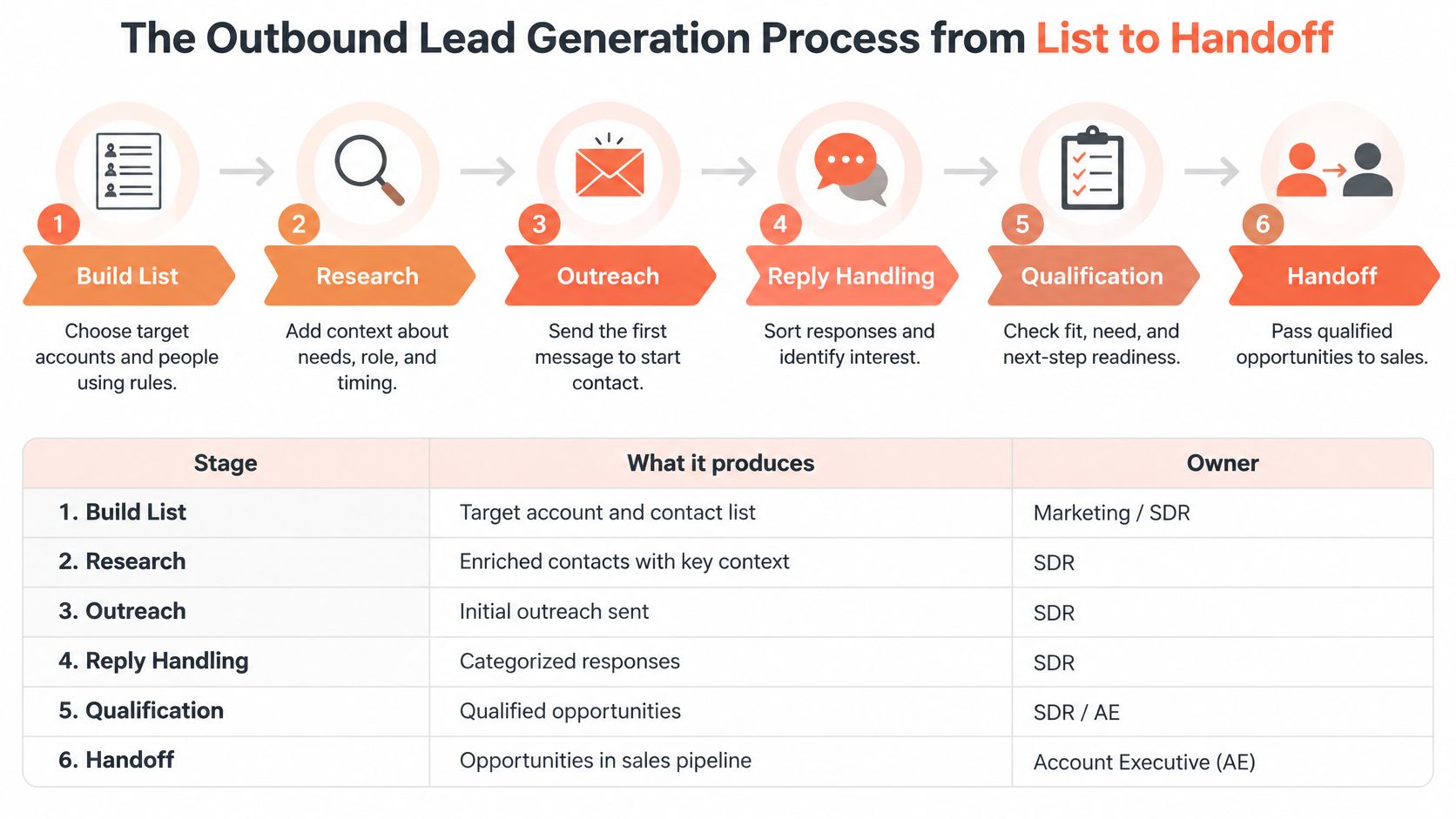
The table below is the version I would give a team of four, because it names an output and an owner for every stage. Ambiguity about ownership costs more time than any amount of message rewriting.
Stage
What Happens
Output
Typical Owner
Strategy and positioning
Name the offer and the buyer role; segment rules are set in the list section
Offer statement and buyer role
Founder or sales lead
Prospect research
Build account and contact lists, verify role and company fit
Target list with source, segment and verification date
Researcher or list builder
Outreach and follow-up
Send connection requests, first messages and sequenced follow-ups
Connection acceptances and replies
Sender with a strategist reviewing copy
Lead qualification
Classify each reply for fit, need and timing
Qualified, nurture or disqualified tag with notes
Qualifier
Handoff
Pass the qualified lead with context and call talking points
Agreed sales call with prepared notes
Client's sales lead takes the call
Reporting and optimization
Review stage-to-stage conversion and change list or message at the largest drop
Revised targeting and message variants
Shared between strategist and client
Where Small Teams Lose the Handoff
The handoff breaks more often than any other stage, and it breaks. A prospect replies with a real problem, the reply sits in an inbox for three days, nobody wrote down what was promised, and the call opens with the client asking questions the prospect already answered.
The repair is a written note with four fields. What the prospect said in their own words, what they want next, the first question the client should ask, and who owns follow-up within 24 hours. Without the note, the sales call restarts the qualification work the campaign already did.
What the Client Still Owns
A managed provider can run research, outreach and lead qualification. The business still takes the sales call and writes the proposal, and that division is deliberate rather than a limitation. Clients keep their prospect lists, their messaging and the connections they build.
Replies get tagged qualified, nurture or disqualified at this stage. The checks behind those tags belong to qualification, so treat the tags here as labels on a process, not as a verdict.
Reporting That Changes Something
A weekly review should answer one question: which stage lost the most ground since last week, and what changed because of it. Reporting that lists activity totals teaches nobody anything.
One trap deserves its own line. When a sequence runs on email alongside LinkedIn, deliverability failures read exactly like copy failures, so test your email deliverability before rewriting a message that may never have arrived.
Building a Target List That Stays Current
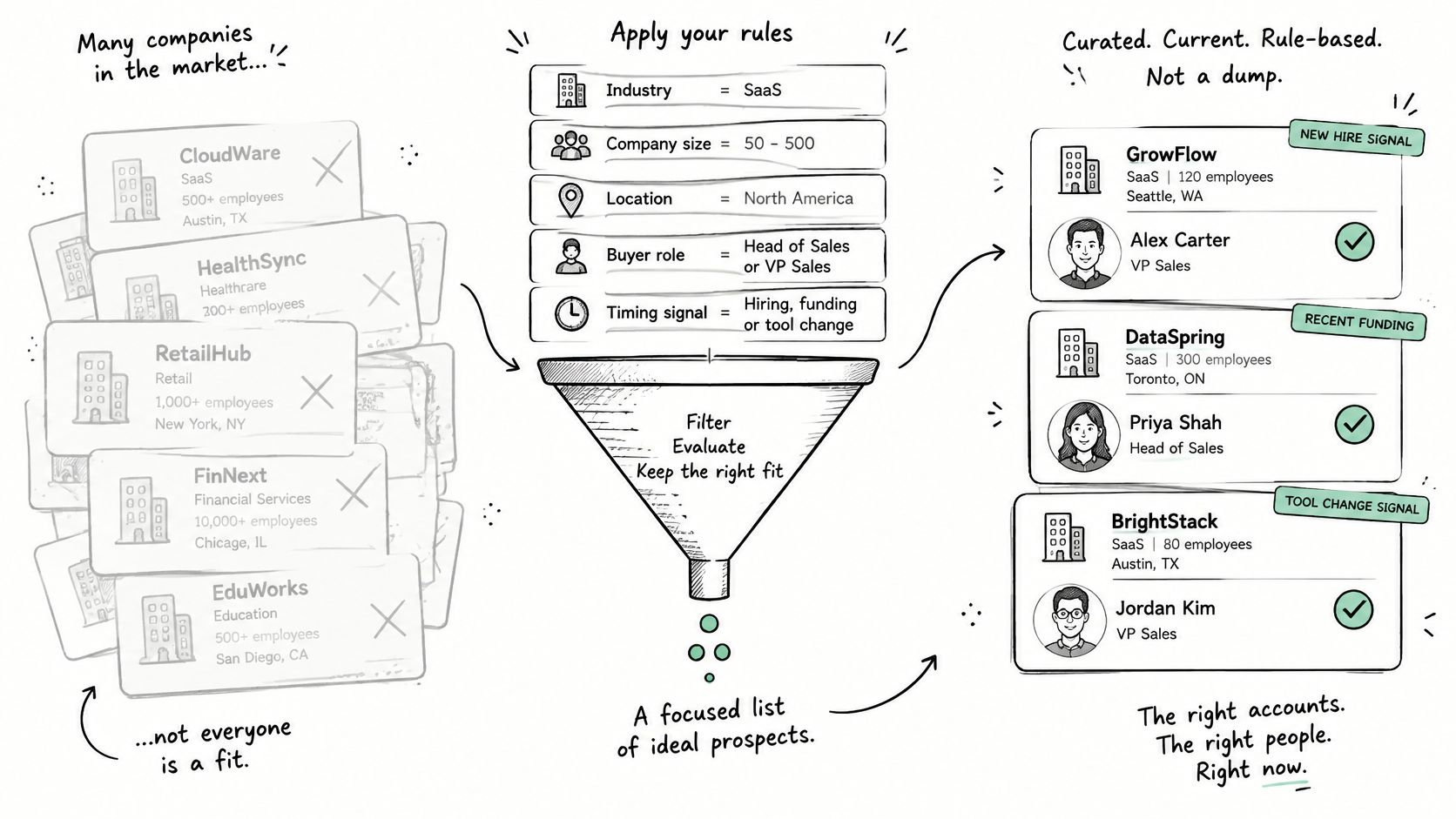
A target list is a set of accounts and people chosen by written rules, not a download of everyone who shares an industry code on a directory.
The Rules to Write Down First
Five filters decide who can enter the list, and each one needs a sentence explaining why:
- Industry and sub-industry: the verticals where the offer has already produced results, not every sector that could theoretically buy.
- Company size band: a range narrow enough that the same message works at both ends of it.
- Location: driven by time zone, travel or regulation, never by ambition.
- Buyer role: the person who feels the problem, plus the person who signs.
- Trigger: a new finance hire, a new office, a funding round, a failed audit. Something that makes this quarter different from last.
Exclusions matter as much as inclusions, and they belong in the same document: current clients, referral partners, competitors, and any account already in an active deal. Firms that skip exclusions end up pitching a partner who then mentions it to a mutual client.
How to Build It Without Drowning
Combine Sales Navigator filters with Boolean keyword searches, then check company fit by hand before any row earns a place. The one internal link worth bookmarking is this ideal customer profile template, because the rules above are only as good as the profile behind them.
Take the consultancy that starts with 400 accounts across two segments, not 4,000 across six. Two segments produce a qualified-reply rate the team can explain, and one good segment funds the next experiment.
Here's a walkthrough of the research stage in practice:
Refresh on a Calendar
Every row should carry a source and a verification date, so a researcher can tell which entries predate a merger or a departure. Review the list each quarter, remove accounts that no longer fit, and add a segment only after the first two show a rate you can defend. This is the discipline behind custom list building services, and it's where positioning stops being a slide and becomes a set of names.
We analyze a client's target market to refine messaging so each message reaches the prospects most likely to convert. That analysis happens before the first connection request, not after a campaign underperforms.
Outreach on LinkedIn That Earns Replies
A prospect decides whether to answer in the time it takes to read a name, a headline and two lines of text. In a 2020 LinkedIn survey of 1,500 B2B purchasers and influencers, only 17% of buyers said they engaged with representatives who reached out cold, while 88% engaged with someone already in their professional network, 86% engaged when the representative offered insights about their business, and 92% engaged with a representative they recognized as an industry thought leader, LinkedIn reported in its write-up of the results. Those figures date from 2020, so read the percentages as directional. The pattern they describe is what any sequence has to work against.
Buyers also run their checks in public. In a 2025 global survey of 7,000 B2B marketing leaders across the United States, Europe, Asia-Pacific, the Middle East and Brazil, 77% said audiences rely on professional networks, not only company-controlled channels, to evaluate brands, LinkedIn reported. That is reported perception rather than audited conversion, and what a profile view does to reply odds is an open measurement question. It still tells you where the background check happens the moment your message lands.
For a small team, the practical consequence is that the profile and the first two messages carry the campaign. Pipeline is usually lost in two places: between acceptance and the first real reply, where a generic opener kills the thread, and between a warm reply and a held call, where slow follow-up lets interest cool.
A Five-Touch Sequence That Fits a Small Team
- Connection request, one reason. Name the role change, the market they just entered, or the mutual context. A blank request still gets accepted on LinkedIn, but the note costs ten seconds and sets up the first message.
- First message on the day of acceptance. One observation about their business and a question answerable in a single line. No attachments, no calendar link, no "quick call?".
- Day four, a different angle. Bring a second observation, ideally a case type from their industry. Resending the first message with softer words reads as automation.
- Day nine, one question. Short enough to answer from a phone. Whether consolidation is on their list this year or parked until next, either answer moves things forward.
- A closing note that gives a clear way out. Say it is the last message and what happens to the account next. Pressure produces silence. An exit produces replies.
If you pair LinkedIn with email, this targeting plus email follow-up workflow shows how to sequence the two without the prospect receiving the same pitch twice. For the connection request itself, this guide to the LinkedIn connection request message covers the wording in detail.
Writing Rules That Survive a Busy Week
- One idea per message. Two asks get the easier one answered and the harder one ignored.
- A named reason for contact. If you cannot say why this person, this week, the message is not ready.
- No attachments on the first touch. Links and files on a first message read as marketing.
- A question with a one-line answer. Every extra sentence in the question lowers the reply rate.
Automation belongs in research support, list maintenance and reporting. The message itself should come from someone who read the prospect's context. Teams without the hours to run that in-house can hand it to managed LinkedIn outreach, which works the same way: human-led outreach, industry-aware messaging, and a repeatable system built for long sales cycles and compliance-conscious firms.
Score the sequence stage by stage: requests sent, accepted, replied, qualified, calls accepted and calls held. A sender who reports 60 acceptances and two conversations has activity numbers, not a verdict on the list or the messaging.
Qualifying Replies Before a Sales Call
A positive reply is not a qualified lead. "Sounds interesting, tell me more" costs the prospect nothing and costs the client a call slot, a prep hour and a follow-up that goes nowhere.
Buyers are specific about why they walk away. In the same 2020 LinkedIn survey of 1,500 B2B purchasers and influencers, 89% turned away when the seller lacked knowledge about their business, 71% rejected an approach because it wasn't the right time, and 50% did not engage because the person contacted wasn't the decision-maker, LinkedIn reported. Read backwards, those three reasons are the checks.
Four Checks Every Reply Should Pass
- Fit. The company matches the profile and the person holds a role the offer serves.
- Need. The prospect described a problem the offer solves, in their own words, not a category they recognize.
- Timing. There's a reason to act this quarter: a deadline, a hire, a renewal, a failed process.
- Authority. The person can take the call or can bring in whoever can, and says who that is.
A reply that fails two checks isn't a lead. It's a polite conversation.
Five Categories to Tag in the CRM
- Qualified now. Book the call within two business days. This maps to the qualified tag.
- Qualified later with a date. Set the follow-up date the prospect named, and map it to nurture.
- Referral to another person. Ask for the introduction by name. The record stays in nurture until the new contact passes the same checks.
- Not a fit. Close the record with a written reason, so the list rules learn something.
- Unsubscribe. Remove the contact and record it. Both of the last two are disqualified.
Tracking interaction signals is worth doing. We track prospect responses and engagement signals and surface opportunities based on real engagement, without forcing appointments or assuming readiness. A profile view or a second reply is a hint about interest, not proof of a buying decision, and the two should never share a column in the CRM.
Every handoff note carries three lines: what the prospect said, what they need, and what the client should ask first on the call. Our lead qualification process applies the same four checks before a conversation reaches the calendar.
Measuring Outbound by Accepted Meetings Not Activity
A calendar full of calls can hide weak targeting, sloppy qualification, and calls that never move. Volume feels like progress because it's the easiest thing to count.
Read the funnel as a ladder, where each rung only means something once the rung below it is stable.
Metric
Question It Answers
Common Trap
Connection acceptance rate
Is the targeting reaching the right people?
High acceptance with no qualified replies means the audience is wrong or the message is not relevant
Qualified-reply rate
Do the right people respond with fit and need?
Counting all replies, including polite declines, inflates results
Client-taken sales calls
Did prospects agree to talk and did the client show up?
Booked calls that never happen are not accepted meetings
Proposal rate
Does the call lead to a scoped next step?
Proposals sent to unqualified prospects dilute the number
Win rate
Do proposals become signed work?
Small samples swing widely; read it as a range over several cycles
Revenue or payback period
Does outbound pay back its cost?
Attribution is hard when buying cycles are long, so track cohorts
What Each Metric Can't Tell You
Acceptance can climb while replies stay unqualified, usually because the list drifted toward people who accept everything. Replies can look healthy while the call never happens, because the prospect was never the decision-maker or the client rescheduled twice. Win rate on five proposals is noise wearing a percentage sign.
Fix the Earliest Drop First
Find the earliest stage with the largest drop before adding volume. More prospects will not repair a broken handoff, and more messages will not fix a list that targets the wrong role. Adding volume on top of a leak just moves more prospects through a process that loses them.
Measurement difficulty is the norm, not a sign of a broken campaign. In 2025, 87% of surveyed B2B marketers found it increasingly difficult to measure long-term campaign impact, and 78% considered proving campaign return on investment more important than two years earlier, LinkedIn reported, based on a study of more than 1,000 senior B2B marketers across the United States, United Kingdom, France and India. That study measures how hard attribution is. It does not hand you a conversion benchmark, so build a baseline across several buying cycles and report a range rather than a promise.
Record each held call with the segment and message variant that produced it, then read the cohort rather than the week. The business development KPIs that survive a quarterly review are the ones tied to calls the client attended, not to activity the sender logged.
Deciding Whether Outbound Fits Your Small Team
Founder hours decide this more often than market fit. A founder already spending two hours a day on referrals, delivery and admin will not build a steady pipeline from occasional outreach, and pretending otherwise wastes a quarter. Judge each model by accepted sales calls the client holds; sends, connection requests and logged activity are diagnostics.
Model
Founder Hours Per Week
Skills Required
Who Owns List and Messages
Best Fit
Founder-led prospecting
Whatever the week leaves; prospecting pauses when delivery spikes
Writing, research, sales conversation
Founder
Founder has spare time and a narrow, known buyer
Hired sales development representative
Coaching, review and the management load nobody budgets for
Prospecting, CRM discipline, coaching
Company, with a manager
Team can fund a full role and manage it
Managed outbound provider
A weekly strategy call, plus the sales calls you take
Offer clarity, sales call and proposal skills
Shared; client keeps the list and messages
Team needs steady pipeline without building an internal function
The build-versus-buy choice is mostly a workload choice. Founder-led keeps cash cost low and makes every weak stage visible, but the pipeline stalls the first time delivery gets busy. A hired role can create consistency when someone has time to coach list quality, reply handling and CRM hygiene. A managed provider shifts research, outreach and follow-up outside the company while the client still owns positioning and closes the held calls. The in-house versus outsourced comparison covers that trade-off in more depth.
One effect stays open. 6sense's Science of B2B research found 91.4% of buyers rank vendors before contacting a seller, and 76.6% begin with their preferred vendor. I read those results as consistent with outreach shaping a shortlist before a reply; they do not prove that effect for a small firm. Track referral paths and repeat qualified replies as the closest honest proxy, and keep that effect out of the revenue forecast.
When you are ready, contact Outbound Consulting to discuss your outbound sales goals and whether its LinkedIn lead generation campaigns fit the way your team sells. Current terms are listed at outbound.consulting/pricing.
Frequently Asked Questions About Outbound Lead Generation
What should a founder have ready before outreach starts?
A defined buyer, a clear offer and blocked hours for sales conversations. Persona selection, positioning and list research can be built during the research phase, but the founder has to supply the knowledge of who buys and why. Capacity matters as much as targeting: qualified replies become sales calls only if someone on the team can hold them, so protect that time before the first message goes out.
How many prospects should the list hold?
Start narrow, the way the consultancy example did with about 400 accounts across two segments. Add a third segment only when the qualified-reply rate on the first two can be explained.
How long before accepted meetings appear?
Longer than the campaign setup. A LinkedIn build can go live within about a week of the kickoff call, but accepted meetings track the buying cycle, not the launch date. Read results across several cycles rather than one month. Anyone quoting a fixed timeline for your market is guessing.
What counts as a qualified reply?
Three tests: fit, need and timing. Fit means the prospect matches the profile the list was built around. Need means a live problem the offer addresses. Timing means they can act inside a window that matters to the business. A warm but vague reply is engagement worth tracking, not a conversation to escalate yet.
What happens to replies that fit but are not ready?
Keep them in follow-up rotation. Responses and interaction signals get tracked, and the opportunity resurfaces when engagement shows real movement. Pushing for a meeting before the prospect is ready burns the thread. Letting it die wastes the targeting work. The middle path is a nurture cadence tied to what the prospect does.
Who takes the sales call?
The client's team does, in every model worth paying for. Research, outreach, follow-up and qualification can be delegated. The closing conversation cannot, because the firm selling the work owns the credibility in the room. Real support looks like talking points drafted for each call and a strategist reviewing the proposal afterward.
Can a founder run it alone?
Yes, when the founder has spare hours and a narrow, known buyer. The hidden cost is the weekly workload: prospect research, message writing, daily follow-ups, reply qualification. Once those hours start displacing delivery or closing work, the comparison shifts toward a hired role or a managed provider, which is the trade-off the table above maps out.
Outbound Consulting is a U.S.-based B2B lead generation and sales consulting agency that has run managed LinkedIn outreach, custom list building, lead qualification and nurturing for small and midsize businesses since 2015. If your pipeline depends on referrals arriving on someone else's schedule, we can map the six stages above onto your market and show you where the meetings are leaking before you spend another quarter guessing. Start with a conversation about your outbound goals at Outbound Consulting.