B2B lead generation is the work of finding companies that fit your offer, reaching the people who shape the purchase, and turning their replies into qualified sales conversations. It matters because buyers no longer arrive through one door: in McKinsey's November 2021 B2B Pulse survey of hundreds of U.S. decision-makers, buyers used ten or more channels to deal with suppliers, up from five in 2016. For a firm living on referrals, it's the deliberate way to keep the calendar full.
Definition: B2B lead generation is the process of identifying businesses that could buy from you, starting relevant conversations with their decision-makers, and qualifying those conversations before a salesperson spends time on them.
The top-ranking guides on this topic list fifteen tactics and stop there. This one shows how the pieces connect for a small team: what counts as a lead, the six stages of a working program, examples by channel, and the arithmetic to work out how much outreach you need for the meetings you want.
Table of Contents
- What B2B Lead Generation Means in Plain Terms
- How B2B Lead Generation Works: Six Connected Stages
- B2B Lead Generation Examples by Channel
- The Reverse Pipeline Count: How Much Outreach You Need
- How to Qualify Replies Before Sales Time Is Spent
- Metrics That Show Where Your Pipeline Breaks
- Common Misconceptions and the Limits of Automation
- B2B Lead Generation FAQs
- Confirm Your Pipeline Plan Before You Spend
What B2B Lead Generation Means in Plain Terms
A founder can stay busy delivering client work while the sales pipeline empties. Lead generation means assigning someone to identify future buyers, approach them with a relevant reason to talk, and assess their interest before the founder spends time selling.
A useful B2B lead generation definition separates attention from commercial interest. A website visitor is like someone passing a shop window. A lead is an identifiable shopper who walks in and asks a question that suggests buying interest.
A name in a database is a prospect in the loose sense, not proof of demand. Likewise, accepting a connection request creates access, but doesn't establish a need. If your team argues about these labels, our guide to prospects vs. leads sets out one consistent set of definitions.
The funnel illustrates how a broad audience becomes a smaller set of potential deals.
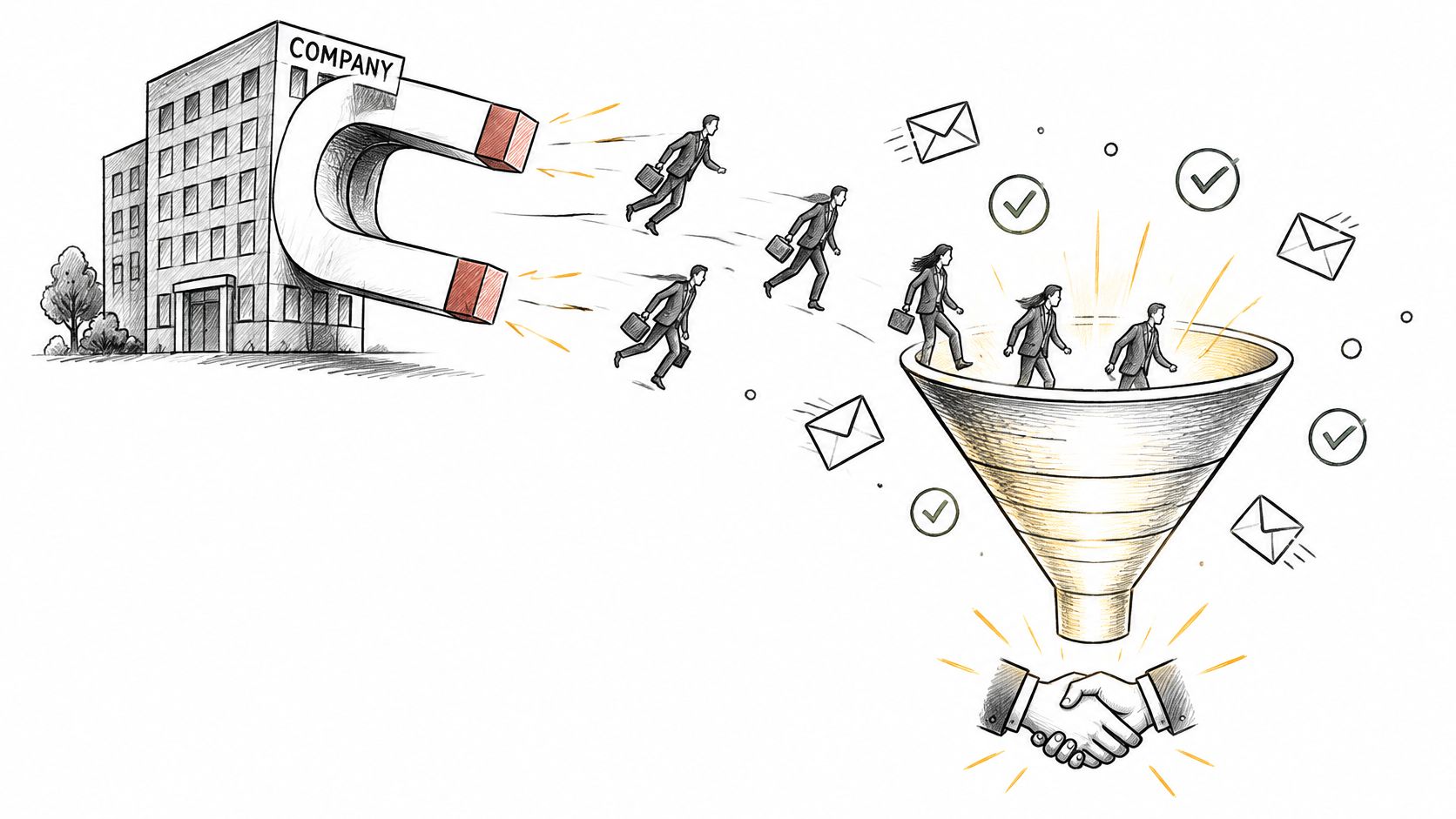
Every program contains these connected activities:
- Target definition: Decide which companies have a problem your offer can solve.
- Prospect research: Find the relevant companies and the people involved in purchasing.
- Personalized outreach: Explain why you're contacting them in business terms.
- Response qualification: Separate genuine buying interest from politeness or curiosity.
Referrals, trade shows and sales calls can all contribute, but with buyers spread across ten or more channels, relying on any single source leaves gaps.
Program test: Can you name your target account types, the buyer roles inside them, and the reply that counts as a real conversation?
If you can't, you have outreach activity rather than a defined program.
B2B vs. B2C lead generation
The mechanics look similar on paper. In practice, B2B lead generation deals with fewer, larger decisions made by groups.
B2B lead generation
B2C lead generation
Who decides
A buying group: user, budget owner, technical evaluator, sponsor
Usually one person or a household
Size of the market
Hundreds or thousands of named accounts
Often millions of possible buyers
Typical first touch
Researched outreach, referral, search, events
Ads, social, search, promotions
What a "lead" is
A named person at a fitting company who shows interest
A contact who opts in or clicks
Sales cycle
Weeks to months, with several conversations
Minutes to days
What success looks like
Qualified conversations and opportunities
Sign-ups and purchases
That buying-group row is why the rest of this guide focuses on roles and qualification rather than raw lead counts.
How B2B Lead Generation Works: Six Connected Stages
Buying-group access matters more than access to a single contact. Back in 2018, Gartner's analysis of enterprise personas already argued that committee-based buying decisions make single-contact personas a weak basis for prospecting, and the buying groups have only grown since.
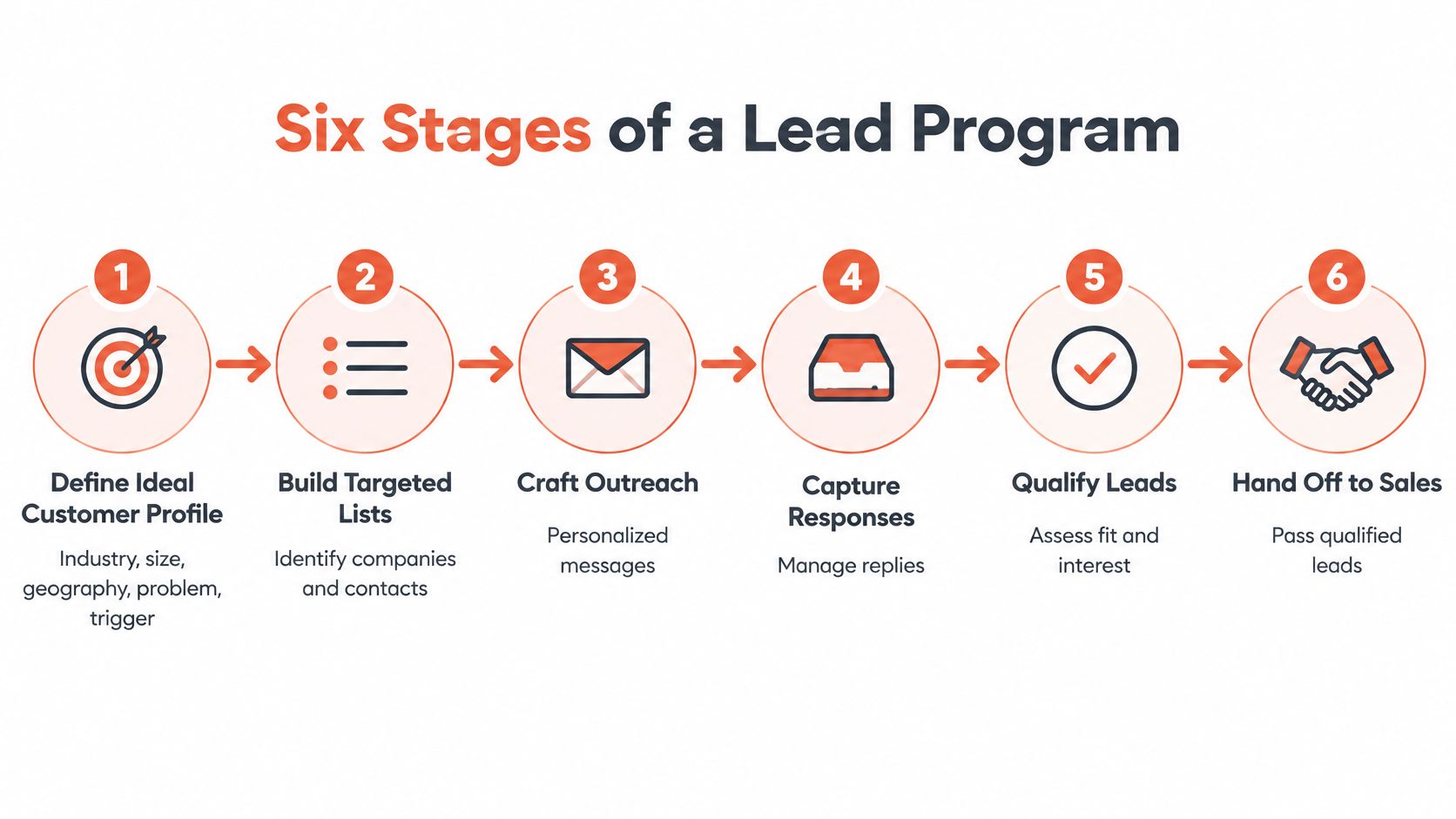
This diagram shows the path from targeting through qualification and handoff.
-
Define the ideal customer profile. Specify industry, company size, geography, operating problem and buying trigger. These criteria become the filters for list creation; a broad label such as professional services doesn't explain who needs your help. An ideal customer profile template keeps those criteria written down and scored.
-
Map the buying group. Identify the operational user, budget owner, technical evaluator and executive sponsor. Don't assume an enthusiastic department manager can approve the purchase or persuade everyone else.
-
Build and check the list. Use role, industry, location and company-size filters, then remove existing clients, duplicates and poor fits. Disciplined B2B list building keeps research tied to the intended audience instead of whoever is easiest to find.
-
Research the account and write the message. Connect a credible business trigger to a problem your service addresses. For an operations consultant, expansion into another location might justify a question about keeping processes consistent, not an unsupported claim that the company is struggling.
-
Run outreach and follow-up. Add useful context rather than repeatedly asking whether the prospect saw your message. Whether the founder handles it or hands it to a partner, someone must own reply review and stop inappropriate follow-ups.
-
Qualify and hand off. Record fit, stated need, timing and the people involved before passing the conversation to sales. Forwarding a reply without context makes the buyer repeat themselves and leaves sales guessing.
Make the handoffs visible
Keep a shared record of each stage, its owner and the information required to advance. Tools for business workflow automation can connect routing, reminders and record updates, but define the decisions before automating them.
Use a documented B2B sales process to connect the prospecting handoff to discovery and proposal work. Check that every stage has an owner and a record someone else can understand.
For a visual walkthrough of the mechanics, this video provides another format.
B2B Lead Generation Examples by Channel
Lead sources compared by speed and ongoing effort
Channel
How leads arrive
Speed to first conversations
Main ongoing effort
Referrals and partner introductions
Warm introductions from clients and partners
Fast when relationships exist, hard to scale
Relationship maintenance
LinkedIn outreach
Targeted connection requests and messages to buyer roles
First replies can arrive within days once prepared
Writing, follow-up and reply review
Email sequences to researched contacts
Emails to named contacts in a target list
First replies can arrive within days
List hygiene and message testing
Search and paid ads
Buyers who search or click an ad
Paid traffic starts quickly, conversations require conversion
Budget management and landing-page tests
Content and SEO
Search visitors who read or download a resource
Slow, builds over months
Regular publishing and updating
Events and webinars
Attendees who register and engage
Episodic, tied to the event calendar
Planning, promotion and follow-up
Short-form video
Viewers who recognize the company before outreach
Gradual familiarity rather than immediate conversations
Consistent posting and reuse
These are planning expectations, not delivery promises. Paid ads buy distribution while spending continues; content and organic search can keep attracting visitors after publication, although neither guarantees enquiries.
What each channel looks like for a small firm
Say a small consulting firm wants to reach operations directors in a narrow industry. Its partners could choose among these approaches:
- Referrals: Ask past clients for introductions to operations leaders facing a similar delivery problem.
- LinkedIn: Use targeted LinkedIn lead generation to approach a named list, add useful follow-ups and review replies each morning.
- Email: Send researched contacts a sequence in which each message contributes a relevant insight.
- Paid search: Direct a fixed budget to a focused service page with a clear enquiry option.
- Content and SEO: Publish an article answering a recurring buyer question, then update it when the answer changes.
- Events: Run a practical webinar and follow up around attendees' questions rather than registration alone.
- Short-form video: Explain an operational mistake in a short clip and reuse it as context in outreach.
In LinkedIn-commissioned GWI research published in 2024, 63% of more than 1,700 B2B buyers surveyed in the United States, United Kingdom and India said short-form social video helped inform buying decisions. Read that figure carefully: the respondents bought IT, telecom and technology products, the survey ran from May to June 2024, and the 63% was measured among the buyers who use industry influencers in their purchase journey (91% of the sample), not the whole group. It supports video as a familiarity builder, not a substitute for qualification.
Start with one primary conversation channel and one supporting credibility channel, then judge them by pipeline progression rather than publishing or sending volume.
The Reverse Pipeline Count: How Much Outreach You Need
Most owners set outreach volume by gut feel. The Reverse Pipeline Count starts from the number of qualified conversations you want each month and works backwards through each conversion rate. All inputs below are examples; replace them with your own numbers after the first month.
Input
Example value
G: qualified conversations wanted per month
4
Q: share of positive replies that pass qualification
50%
P: share of replies that are positive (interested in talking)
25%
R: share of contacted prospects who reply
10%
Step 1: positive replies needed. G ÷ Q = 4 ÷ 0.50 = 8 positive replies
Step 2: total replies needed. 8 ÷ P = 8 ÷ 0.25 = 32 replies
Step 3: prospects to contact. 32 ÷ R = 32 ÷ 0.10 = 320 prospects contacted per month
In one line: contacts = G ÷ (Q × P × R) = 4 ÷ (0.50 × 0.25 × 0.10) = 4 ÷ 0.0125 = 320.
The count tells you two things. First, whether your list is big enough: 320 a month is 960 a quarter, so a target market of 500 accounts with two roles each runs out in about three months. Second, where effort pays most. With these example inputs, lifting the reply rate R from 10% to 12.5% cuts the contacts needed from 320 to 256 (4 ÷ 0.015625), which is usually cheaper than finding 64 more good-fit names every month.
How to Qualify Replies Before Sales Time Is Spent
Stage rules turn a vague sense of progress into a set of tests. Each stage below has an entry condition and an exit condition, and a conversation only advances once the exit evidence exists in writing.
Entry and exit rules for each pipeline stage
Stage
Entry rule
Exit rule
Lead
Replied, accepted a request or opted in
Fit with the ideal customer profile confirmed
Marketing-qualified lead
Fits the profile and shows a defined interest
Stated need, role and timing recorded
Sales-qualified lead
Buyer confirmed a need and a purchase window
Buyer agrees to a discovery conversation
Opportunity
Discovery conversation held and the problem confirmed
Proposal sent or next step agreed in writing
Won customer
Proposal accepted and contract signed
Revenue and original source recorded
Adapt these working rules to your own sales process. An accepted request sits in an early review queue and stays out of your qualified-lead total. An opportunity also remains open after a proposal goes out, right up until the buyer decides.
Qualification assesses distinct questions: Does the account fit? Is there buying intent? Can a purchase realistically happen within the relevant timeframe? A consultant asking for educational material may fit your audience without having an active project. Each question is a separate test, and a reply can pass one while failing another.
In Gartner's survey of 632 B2B buyers conducted in August and September 2024 and reported in 2025, 61% preferred an overall representative-free buying experience. The same survey found that 73% actively avoid suppliers who send irrelevant outreach. Give prospects relevant context and useful information before pressing for a call.
Capture the evidence in the record
Replace a note such as "interested" with the buyer's stated problem, role in the decision and timing. When a reply names other stakeholders, record who they are, since access to the buying group is part of what you are qualifying. Add a disqualification reason field that separates poor fit from a suitable buyer who is not ready yet. Over time those reasons reveal patterns: repeated exits on budget point at targeting, while repeated exits on timing suggest the trigger arrived too early.
A clean handoff identifies relevant conversations and passes suitable prospects into the sales process. Structured lead qualification protects selling time without treating every early-stage buyer as a rejection.
A documented lead qualification process keeps those judgments consistent across the team. If you are considering scoring tools, SupportGPT's overview of qualification metrics that lift conversions covers routing accuracy, response speed and rep acceptance as review measures.
Which stage holds the most replies that never advance, and what evidence explains why?
Metrics That Show Where Your Pipeline Breaks
Pipeline metrics and what a weak result signals
Metric
What it measures
Weak result points to
Reply rate
Share of contacted prospects responding to the first touch
Targeting or first-message mismatch
Positive reply rate
Share of replies expressing interest in a conversation
Unclear offer or weak business trigger
Qualified conversations
Replies passing fit, need and timing checks
Weak profile or loose qualification criteria
Opportunities created
Qualified conversations reaching discovery with a confirmed problem
First-call handling or an unclear next step
Win rate
Share of opportunities becoming paying customers
Proposal quality or sales execution
Time between stages
Elapsed time from stage entry to advancement
Slow follow-up or handoff delays
Total lead volume doesn't tell you whether the program works. A team can receive plenty of replies while creating little sales-ready pipeline.
Stalling is the norm, not the exception. Forrester's State of Business Buying report, released in December 2024, found that 86% of B2B purchases stall during the buying process and that an average of 13 people are involved in a purchase decision. Your own stage records should show whether buyers lose momentum before discovery, during evaluation or after the proposal.
Diagnose from the first meaningful drop
Start with the earliest weak conversion. If few prospects respond, inspect account selection and the opening message before rewriting the proposal.
If replies sound positive but don't pass qualification, check whether your offer attracts curiosity rather than a buying need. If buyers reach discovery but don't progress, review the questions asked, stakeholder access and the agreed next step.
When opportunities don't become customers, inspect proposal relevance and the buyer's approval path. Don't automatically blame prospecting for a problem that emerges after qualification.
Use consistent definitions and assign an owner to each metric. Record stage-entry dates and compare prospects contacted during the same period, so older opportunities don't distort the latest campaign's results. A focused business development KPI review connects activity to commercial progress.
Operating rule: Repair the first meaningful conversion problem before increasing outreach volume.
For a founder's monthly review, prioritize qualified conversations, opportunities created and win rate. Use elapsed time to investigate delays behind those outcomes.
Common Misconceptions and the Limits of Automation
The most expensive mistake is scaling a message before confirming that the right buyers find it relevant. Automation can repeat an error much faster than a founder can spot it.
- More messages create more leads: Higher sending volume can produce extra replies without improving access to the people who must approve a purchase.
- A long contact list is a pipeline: A list is an input. It doesn't establish a business problem, purchase intent or an agreed next step.
- A positive reply proves an opportunity: Interest doesn't establish authority, available resources or internal agreement.
- AI can run prospecting alone: Drafting and sorting are different from judging whether a claim is accurate or a conversation deserves a salesperson's attention.
Automate preparation, retain judgment
Adobe's B2B digital trends report (a survey of nearly 800 B2B organizations run with Oxford Economics in October and November 2025) shows the gap between enthusiasm and trust: 69% expect agentic AI to manage at least half of customer sales interactions within 18 months, yet only 30% foresee customers letting their own AI agents handle research, negotiation and the final decision on large or complex purchases. Automating routine interactions and automating a high-consideration buying decision are not the same thing.
Use AI to summarize public account information, suggest segmentation and draft message alternatives. Have a person verify the facts, assess whether the reason for contact is credible and decide how to respond to an unfamiliar business problem.
Workflow rules can route replies and create reminders. Human judgment remains necessary when a buyer raises implementation risk, introduces a skeptical stakeholder or challenges the proposed business case.
Lead generation also can't repair an offer that doesn't solve a sufficiently important problem. The distinction between demand generation and lead generation matters when prospects don't yet understand the category or recognize the need.
Allow a sustained test across a full quarter as a planning discipline, not a promise of results. Stop obvious targeting errors promptly rather than waiting for the review date.
B2B Lead Generation FAQs
What is B2B lead generation in simple words?
It's how a business finds other businesses that might buy from it and starts a conversation with the right person there. The output isn't a list of names; it's a set of replies from people at fitting companies who have a reason to talk.
What is the difference between a lead and a qualified lead?
A lead has shown some interest: a reply, an accepted request, a download. A qualified lead has also passed checks on fit, need, authority and timing, so a sales conversation is worth both sides' time. The stage table above sets out the evidence each step needs.
How is B2B lead generation different from demand generation?
Demand generation builds awareness and preference across a market, while lead generation seeks identifiable buyer engagement. They support each other: useful educational material gives a targeted approach more credibility.
What are examples of B2B lead generation?
Asking clients for introductions, sending researched LinkedIn messages to operations directors, emailing a named list, running a webinar for a narrow audience, publishing an article that answers a buyer question, and buying search ads that point to a focused service page. The channel table above compares speed and effort for each.
How long before lead generation produces results?
Prepared outreach can receive initial replies within days, but replies aren't qualified opportunities or revenue. Content and search generally require a longer build, so judge progress through stage conversion over a full quarter rather than an isolated week of activity.
How many prospects do I need to contact each month?
Work backwards from the qualified conversations you want. With the example rates in the Reverse Pipeline Count (10% reply, 25% positive, 50% qualified), four qualified conversations need about 320 contacts. Replace the rates with your own after the first month.
Is LinkedIn enough on its own?
LinkedIn can serve as a primary channel where professional roles are visible, but pairing it with referrals and useful content reduces reliance on a single source.
Who should run B2B lead generation in a small company?
A founder can start with a clear message, a researched list and a routine for reviewing replies. Delegating research, writing and administration becomes useful when delivery work prevents consistent execution. Either way, the business still needs someone capable of diagnosing the buyer's problem and agreeing on a credible next step. Outsourcing prospecting doesn't remove responsibility for the sales conversation.
Confirm Your Pipeline Plan Before You Spend
Before committing budget, make these decisions explicit:
- Name the account types: Describe the businesses you can help and the conditions that make them suitable.
- Map purchasing roles: Identify who experiences the problem, approves spending and can block implementation.
- Write stage rules: Define what evidence allows a reply to enter, advance through or leave your pipeline.
- Run the Reverse Pipeline Count: Check that your target market can supply the contacts the plan needs.
Choose a primary channel for a full-quarter test and select qualified opportunities created as the continuation measure. Review the economics alongside that measure, rather than rewarding cheap contacts that never progress.
Outbound Consulting's LinkedIn lead generation service covers ICP-based list building, outreach sequences, reply handling and reporting, while your own team takes the sales calls; the company reports having worked with 2,000+ clients. The deeper B2B lead generation services breakdown explains the work involved, and the pricing page shows how the plans are structured.
Outbound Consulting helps small and midsize B2B companies build targeted outreach, qualify relevant replies and develop a more deliberate pipeline beyond referrals. Visit Outbound Consulting to discuss your buyer profile, the roles you need to reach and whether managed LinkedIn prospecting fits your sales process.