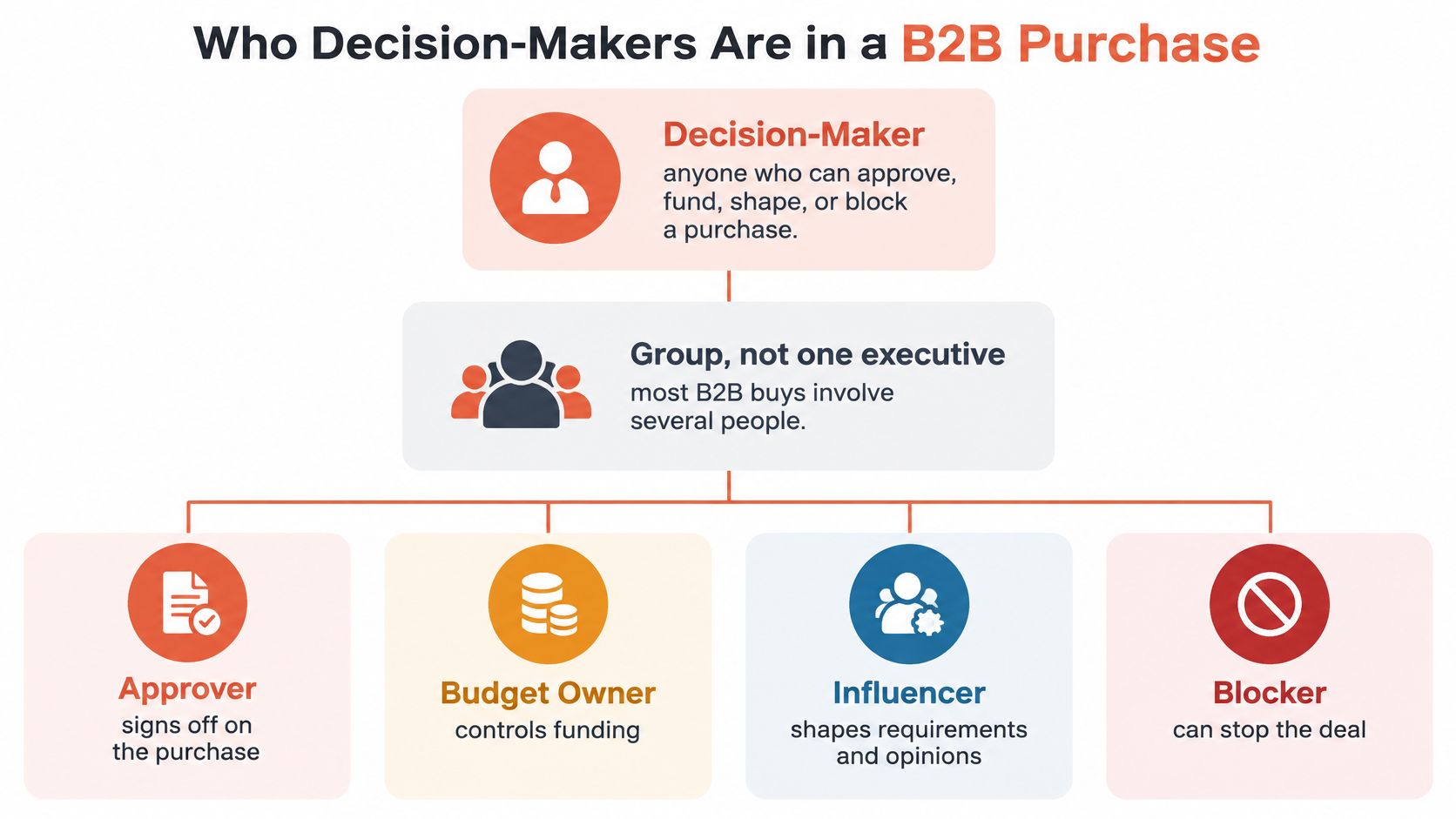
Who are the decision makers in a B2B purchase? They are the people who can approve the spend, own the problem, or veto the deal, and LinkedIn, in its release on LinkedIn research conducted with Bain & Company and NewtonX, says B2B buying typically involves 6 to 10 stakeholders. At small and midsize firms those seats rarely match the most senior title on a list. Name and confirm each seat before the first message.
Definition: A B2B decision maker is anyone who can approve, fund or veto a purchase. That includes the economic buyer who signs, plus the reviewers and blockers whose "no" ends the deal.
Table of Contents
- Who the Decision Makers Are in a B2B Purchase
- Why Job Titles and Positive Replies Mislead You
- B2B Decision Maker Titles by Company Size
- How to Identify Decision Makers Before Outreach
- The Seat Coverage Score: Is the Account Ready for Outreach?
- Hidden Blockers That Stall Deals
- Frequently Asked Questions About Decision Makers
- Build the Buying-Group Map Before the First Message
Who the Decision Makers Are in a B2B Purchase
Several kinds of people show up in a B2B purchase, and only some of them can close or kill it. Stakeholders have an interest in the outcome. Influencers shape the requirements. Users run the product day to day. The decision makers are the contacts holding approval, budget, or a real veto, and at a small firm those seats rarely match the titles a list search returns.
The same LinkedIn release describes a survey of more than 500 senior B2B buyers in the US, UK, France, Germany and Spain, run in March and April 2024: 81% said the product they eventually bought was known by everyone in the buying group on day one, and only 4% said a purchase was made when the product was known by just a few decision makers in the group. Reaching one senior name is rarely enough.
Company size decides who fills those seats. At a firm of 15, the founder often signs, an operations lead decides whether the workflow survives, and a finance reviewer decides whether the invoice gets paid. At 200 people, those three jobs usually sit with three different people in three different departments. Searching only for the most senior title misses the ones who write requirements, test risk, and build agreement before the signature.
Large companies sometimes invent new seats for that work. The Fortune 500 chief AI officer census from ProfessionLens counted 24 Fortune 500 companies with a current enterprise-wide Chief AI Officer and 54 more using fused titles such as Chief Data and AI Officer. A 40-person company will not have that seat. You will meet the same functions under plainer labels, often stacked on one or two people.
Seven buying roles worth naming
Role
What they decide
How to spot them
Economic buyer
Controls the budget and signs the contract
Named on the budget line or holds approval rights
End-user champion
Pushes for the purchase in daily work
Leads the team that will use the process
Technical validator
Checks fit, security, and integration
IT, security, or data lead
Financial reviewer
Tests the business case and commercial terms
Finance lead or controller
Procurement
Enforces the vendor process and contract terms
Purchasing or procurement manager
Executive sponsor
Authorizes strategic change
Senior leader tied to the goal the purchase serves
Blocker
Can veto or delay the decision
Legal, compliance, or the team absorbing the change
One contact can hold several of these roles. A 15-person agency might have the founder as economic buyer, executive sponsor, and blocker if the purchase touches client data. A larger firm splits those seats.
Decision maker vs influencer vs user vs stakeholder
Contact type
Can approve or veto?
What they bring
How to treat them in outreach
Decision maker
Yes
Budget, signature, or veto
Business case, cost of waiting, decision needed
Influencer
No, but shapes the criteria
Requirements and vendor shortlist
Proof the offer meets their criteria
User
Rarely
Daily workflow knowledge
Workflow detail; often the future champion
Stakeholder
Sometimes, indirectly
Interest in the outcome
Keep informed; ask what would worry them
Practical rule: Map every role that could say yes, no, or not yet before you write the first message, even when you only have one named contact.
That map is the front half of a workable B2B sales process. Without it, outreach talks to a title and hopes the rest of the room agrees.
Why Job Titles and Positive Replies Mislead You
A CEO may approve a purchase while a department lead defines what the solution must do and a finance reviewer checks the terms. Treat each title as a starting clue, then confirm the person's role in this specific purchase.
A 2015 global study of 6,375 B2B buyers, marketers, and salespeople at mid-sized and enterprise companies (surveyed July to August 2015, most of them at firms with 1,000+ employees) found that 64% of buyers were involved in setting purchasing strategy and 44% in authorizing purchases. Beyond the primary buyer, the average number of additional internal groups influencing a purchase ranged from 3.1 in services to 4.6 in manufacturing. The data is old and skews large, but the pattern holds: a title alone rarely shows which part a person plays.
Three mistakes waste a list:
- Targeting senior titles alone. Contacting the founder without reaching the person responsible for the workflow leaves practical requirements unaddressed.
- Treating a positive reply as buying authority. Interest is a signal to qualify, not proof the person controls the decision.
- Leaving out the team that absorbs the change. People who must adjust their daily work can delay a purchase without any senior title.
The distinction between prospects and leads matters here: a name belongs on a working list only when its relevance to the purchase is clear. Before outreach, answer five questions for each account:
- Who supplies the data the offer depends on?
- Who uses the output in daily work?
- Who carries the operational risk if it fails?
- Who approves the spend?
- Who owns the result after go-live?
B2B Decision Maker Titles by Company Size
Size is the fastest filter for guessing who signs. Treat these bands as a working hypothesis, not a rule: under about 20 employees the founder or owner signs; from 20 to 100 a CEO or managing director works with one department head; past that, a VP or director of the affected function carries the deal while a CFO or COO holds the budget. Single accounts break the pattern often, so confirm each seat before writing.
Company size
Usually signs off
Often validates
Confirm before outreach
1-20 employees
Founder, owner, or managing partner
Operations lead or owner of the affected process
Whether the founder holds the budget and who runs the workflow
21-100 employees
CEO or managing director with one department head
Finance lead, controller, or operations manager
Who owns the budget line versus who sponsors the change
101-500 employees
VP or director of the affected function
CFO or COO on budget, plus IT or security on fit
Whether procurement or legal must review before a signature
How each size band actually buys
1-20 employees. The founder signs and often runs delivery too. A second person still matters: the senior hire who owns intake, scheduling, or invoicing can kill a purchase that adds work to their week. Write two different notes. The founder gets the business case; the operator gets the workflow detail.
21-100 employees. The CEO still appears on the website, but a department head usually feels the pain and a finance lead tests payback. At a 60-person services firm, the controller may hold the budget line even though the operations director sponsors the change. Message the department head as the process owner, loop in the controller on terms, and keep the CEO as the sponsor you may need later.
101-500 employees. Directors and VPs of the affected function carry the business case. The CFO or COO often holds the money, and IT or security reviews fit even when the company has no formal procurement department. Skip the CEO unless the purchase changes strategy for the whole firm.
Add a timing signal when you can see one, such as a recent hire in the affected function or a funding announcement, because those moments change who is willing to look.
Titles to include and exclude
Include founder, owner, managing partner, CEO, managing director, COO, CFO, VP or director of operations, head of finance, controller, and the functional lead whose team would use the offer. Unusual labels still count when the person holds the budget, such as "head of client delivery" at a consultancy.
Exclude recruiters, interns, students, assistants without budget rights, and individual contributors who use a tool but cannot sponsor a change. A coordinator can be a useful user later. They are a poor first target.
A tighter way to build those title filters is covered in how to find B2B prospects on LinkedIn.
How to Identify Decision Makers Before Outreach
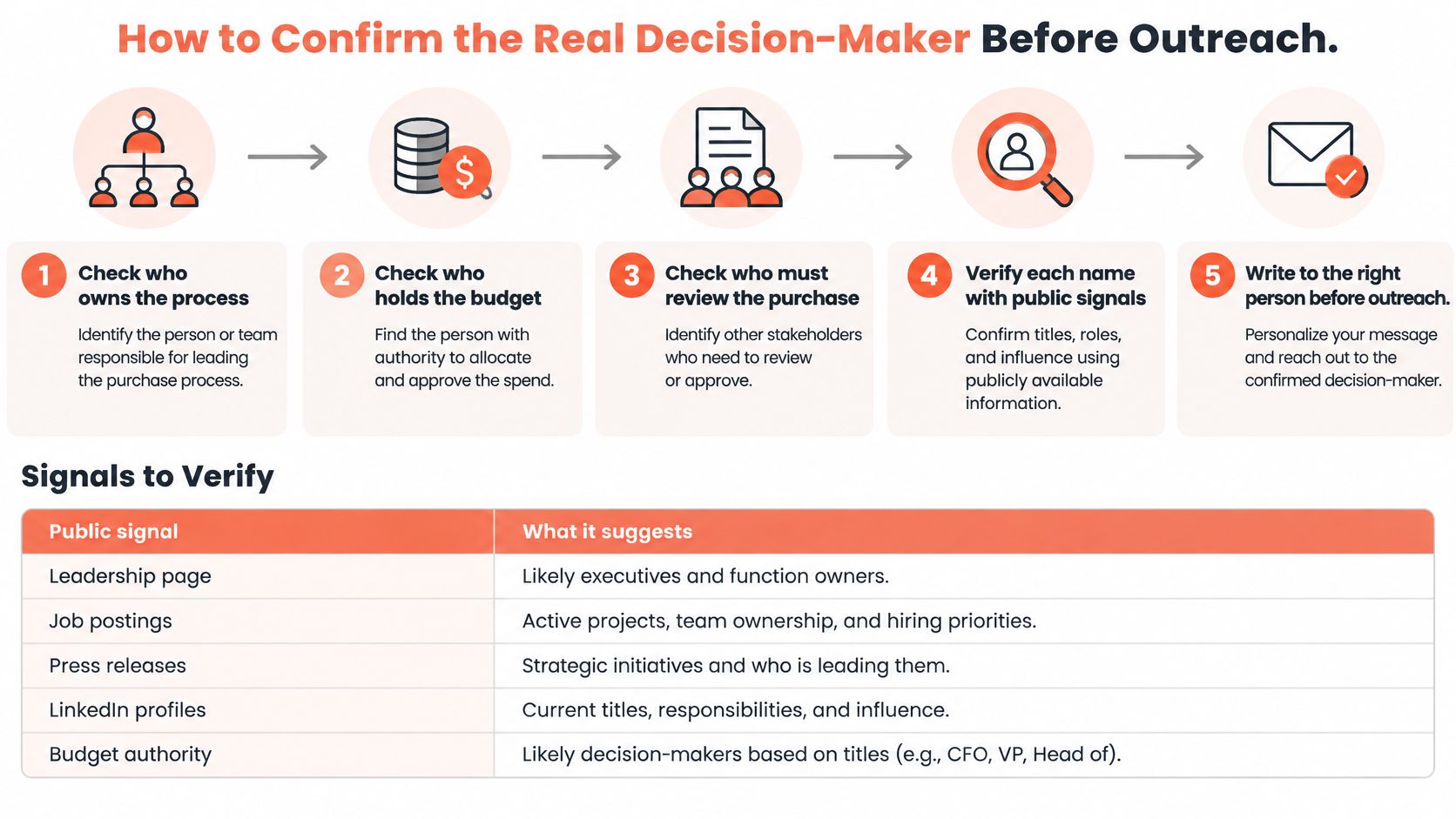
Identify the decision makers by checking who owns the process, who controls the budget, and who must review the purchase, then verify each name with public signals before you write. A title that looks right in search often carries neither the money nor a veto.
Six checks before the first note
- Start with the problem owner. Name the role whose daily workflow the offer changes, and write one line on why they feel the pain. If you cannot phrase the pain in their words, you are guessing at the champion.
- Find the budget holder. Read the company page, leadership announcements, and titles tied to spend. At a small firm the founder usually signs. At a midsize firm the budget more often sits with a finance or operations lead.
- Verify the role with recent signals. Check job postings for that function, new hires, public posts, and announcements about the initiative. Silence is also a clue, so do not invent a committee the company has not staffed.
- Build the list with Boolean searches. Combine title, industry, company size, and region, then cut the people who fail the checks above. That filtered, approved set is what custom list building is for.
- Put likely reviewers on the map before you send. Legal, IT, security, and the team that must absorb the change are worth naming even if you never message them first.
- After the first positive reply, ask who else must review the proposal. Ask before you send pricing or a long deck. Our lead qualification process treats that question as part of fit, not a follow-up courtesy.
Illustrative example (a hypothetical 40-person SaaS company). The first name from the title filter is an operations director. The company page shows a finance controller hired four months ago, so the budget holder goes on the map. A fresh posting for an information-security analyst, plus a line on the operations director's profile about a vendor review for data access, surfaces a third name no title search returned. Three people, three different risks, one map instead of a single "decision maker" field.
The Seat Coverage Score: Is the Account Ready for Outreach?
The top results for "decision makers" mostly define the word or sort personality styles. What a small team needs is a way to decide whether an account is mapped well enough to contact. The Seat Coverage Score does that in a minute per account.
Score four seats, each from 0 to 2:
- Signer (economic buyer)
- Process owner (champion or end-user lead)
- Reviewer (finance, IT or security)
- Blocker (legal, compliance or the team absorbing the change)
Score
Meaning
0
Seat unknown
1
Name guessed from title only
2
Name confirmed by a signal (posting, announcement, profile, reply)
Seat Coverage Score = points earned ÷ 8 × 100.
Worked example, using the illustrative SaaS account above (example inputs, not client data):
Seat
Evidence
Points
Signer
Controller hire announced on company page
2
Process owner
Operations director's profile mentions the vendor review
2
Reviewer
Security analyst posting, no named person yet
1
Blocker
Unknown
0
Total
5 of 8 = 62.5%
Pick a threshold and stick to it. With an example threshold of 75% (6 of 8 points), this account is not ready: one more confirmed seat, such as naming the security reviewer, lifts it to 6 ÷ 8 = 75%. Accounts below the line go back to research instead of into a sequence, which keeps the first wave aimed at people who can move the deal.
Hidden Blockers That Stall Deals
Hidden blockers sit outside the visible conversation and can delay, redirect, or veto a purchase. In smaller firms they rarely appear as a formal buying committee. The person who stops progress may be the founder protecting cash, a finance reviewer testing payback, or an operations lead weighing how much work the change creates.
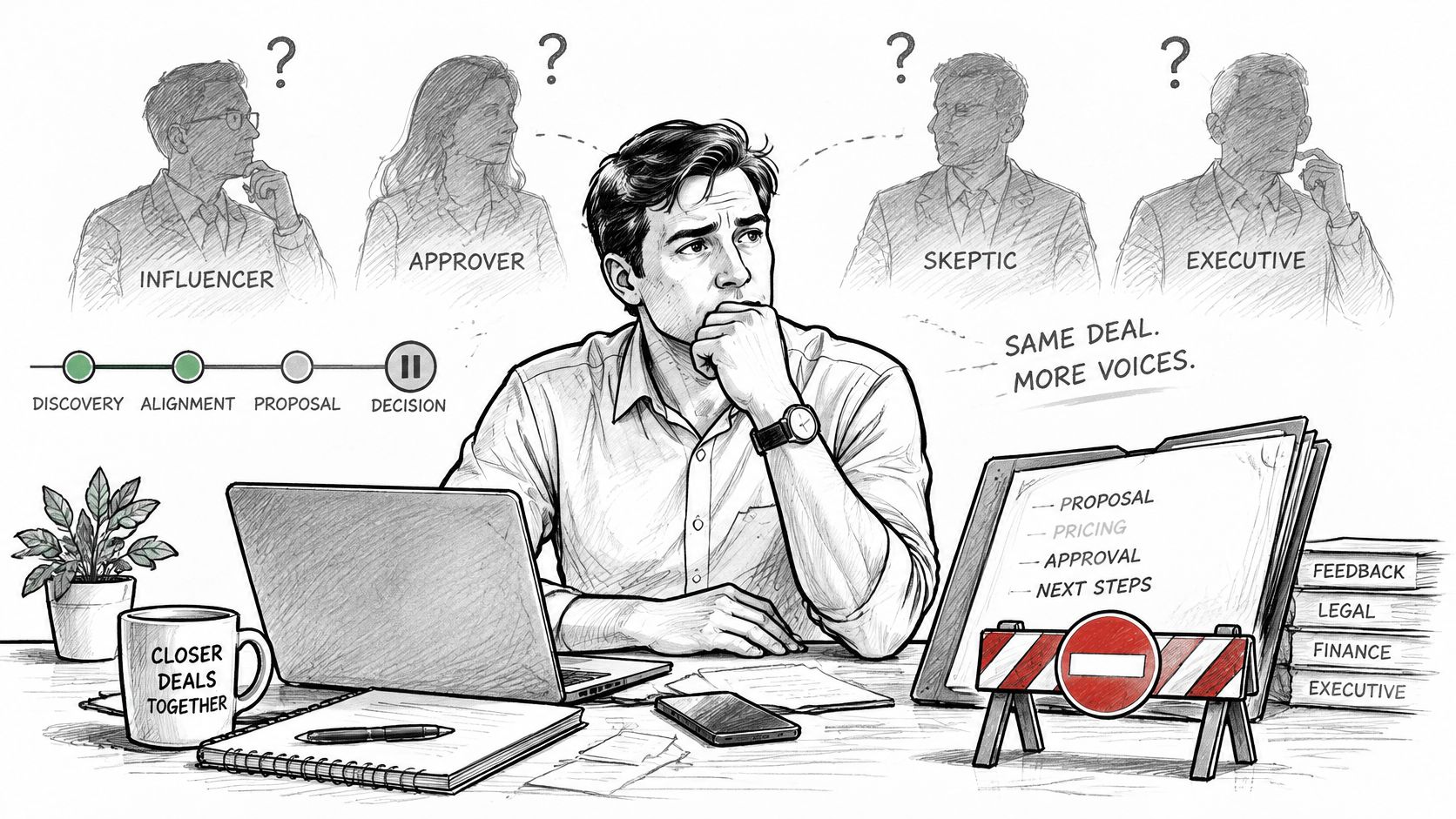
The 2025 Edelman-LinkedIn B2B Thought Leadership Impact Report, which draws on nearly 2,000 global professionals, cites Matt Dixon's 2022 book The JOLT Effect for the finding that more than 40% of B2B deals stall because of internal misalignment within buying groups. That pattern shows up in small firms under ordinary titles.
Look for blockers by the risk they protect rather than by seniority:
- Money: whether the return justifies the amount and outranks other priorities.
- Terms: vendor obligations, contract language, data access, or risk.
- Implementation: the systems, process, or weekly workload that will change.
- Credibility: who must defend this vendor and this timing if a peer questions it.
Give the champion a one-page case they can forward: the problem, the cost of waiting, the people affected, and the decision needed. If a senior sponsor exists, ask the champion to bring that person into the next conversation once they agree the case is fair.
A vague answer is still useful. If the champion cannot say who reviews money, terms, implementation, and internal credibility, keep the opportunity in qualification before sending pricing. When replies come in, a structured lead qualification step keeps that check consistent.
Frequently Asked Questions About Decision Makers
Who are the decision makers in a company?
They are the people who can approve, fund, or veto a specific purchase. In a small firm that is often the founder plus one operator; in a midsize firm it is usually a department head, a finance reviewer and, for anything touching data, IT or security. The answer changes with each purchase, so map it per deal.
What is a B2B buying committee?
A buying committee (or buying group) is the set of people who shape and approve a purchase: economic buyer, champion, technical and financial reviewers, procurement, executive sponsor, and blockers. Small firms rarely call it a committee, but the roles still exist, often stacked on two or three people.
What titles count as B2B decision makers?
Founder, owner, managing partner, CEO, managing director, COO, CFO, controller, VP or director of the affected function, and the functional lead whose team will use the offer. Which of them signs depends on company size; see the table above.
When should the CEO be the first contact?
In a very small firm when the founder still owns the problem and approves spending. As specialized roles appear, begin with the person closest to the problem and ask where the CEO enters the approval path.
How do you find decision makers on LinkedIn?
Filter by title, industry, company size and region, then check each name against recent signals: job postings in the function, new hires, and profile activity about the initiative. Our LinkedIn lead generation work starts from that filtered list.
What should I ask instead of "who decides?"
Ask what has to happen before the purchase is approved: "Who owns this problem?", "Who reviews new spending?", and "Whose schedule or system changes if we move forward?" The answers name the economic buyer, the process owner, and anyone who can slow implementation.
Does a bigger buying group mean a bigger deal?
Not necessarily. More people enter when the purchase crosses departments, affects data or client delivery, or changes established work. A modest purchase can draw extra review because it creates more operational risk.
When is a contact without approval power worth pursuing?
When they can shorten the route to authority: explain who owns the process, who reviews spending, and which objection is likely, then make the next introduction. If they can only offer encouragement, keep the opportunity in qualification.
Build the Buying-Group Map Before the First Message
Before the first message, write a one-page map with four columns: role, named person, evidence, and open gap. In a hypothetical 25-person marketing agency, the managing partner goes down as economic buyer because she signs vendor contracts, the head of client services as process owner because the offer changes her team's workflow, and the financial reviewer stays an open gap until a reply reveals whether a bookkeeper or outside accountant signs off. Run the Seat Coverage Score on the map and contact the account only once it clears your threshold.
Strong sales prospecting best practices start from an account map like this rather than a dump of senior titles. Pair the map with a clear ideal customer profile template so company fit and person fit get decided together.
If you want the map turned into a working prospect list, our team builds it from those roles through custom list building: a Sales Navigator specialist runs Boolean searches by industry, title, company size and location, and you approve the list before it is uploaded for outreach. Outbound Consulting reports that more than 2,000 clients have outsourced list building to it since 2015 (company-reported). For ongoing outreach, see sales prospecting services and our LinkedIn outreach agency page, and compare scope on the pricing page.
Outbound Consulting helps small and midsize B2B teams find the people who can approve, fund, or block a purchase, then reach them with managed LinkedIn outreach. If referral flow is uneven and your list still starts with job titles alone, map the buying group first and build the outreach around those roles.