A lead qualification framework is a written set of tests that decides which replies earn a sales call, and for B2B deals it has to cover the whole buying group, not just the person who answered. In a Gartner survey of 632 B2B buyers, groups that reached consensus were 2.5 times more likely to call their deal high quality (Gartner, 2025). For small teams, the answer is four gates scored before any call: fit, problem, access, timing.
Definition: A lead qualification framework is a short, written list of criteria (such as BANT, MEDDIC or fit-and-intent gates) that sorts leads into "worth a sales conversation", "nurture" and "disqualified".
Most BANT and MEDDIC guides assume a sales operations team, a CRM admin and enough deal volume to train a scoring model. None of that helps on the morning your inbox holds eleven LinkedIn replies and one of them says "interesting, tell me more." This guide compares the main sales qualification frameworks in one table, then gives you a copyable scoring template built for outbound replies.
Table of Contents
- Compare Sales Qualification Frameworks Side by Side
- What MQL and SQL Gates Really Mean
- How the BANT Framework Works in an Outbound Reply
- Lead Qualification Criteria and Scoring Rules
- The Reply Gate Score: A Copyable Template
- Sorting Outbound Replies Into Hot, Warm and Nurture
- Qualifying the Buying Group Behind a Reply
- Confirm Your Framework Before the Next Call
- Frequently Asked Questions About Lead Qualification
Compare Sales Qualification Frameworks Side by Side
The main options are BANT for a quick checklist, MQL and SQL gates for teams handing leads from marketing to sales, fit and intent gates for outbound replies, a buying-group account model for multi-stakeholder deals, and MEDDIC for long enterprise cycles.
Framework
Core Questions
Best Fit
Main Weakness
BANT
Budget, authority, need and timeline
Small teams needing a quick, repeatable checklist
Budget is hard to confirm early, and a single-contact focus misses buying groups
MQL and SQL gates
Customer fit plus engagement threshold, then sales review
Teams with separate marketing and sales handoffs
Needs shared definitions and service-level agreements, and can reward downloads
Fit and intent gates
ICP fit, business problem with a decision path, timing and next action
Outbound teams qualifying replies
Needs written criteria and periodic calibration
Buying-group account model
Account fit, contact role, influence and consensus status
Complex deals with several stakeholders
Heavier to run and needs more CRM records
MEDDIC
Metrics, economic buyer, decision criteria and process, pain, champion
Long enterprise sales cycles
Too heavy for a small outbound team without a sales operations role
Reply Gate Score (recommended)
Four criteria: fit, problem, access to the decision-maker, timing; then one client-owned next step
Small teams qualifying LinkedIn replies
Needs a monthly review against won and lost deals to stay accurate
Read the table row by row and a pattern appears: the heavier the framework, the more it assumes someone owns it. MEDDIC earns its keep when a deal involves formal procurement, a champion you have to build and a decision-criteria document you'll be measured against. It's overkill for a 15-person consultancy deciding whether to reply to a partner at a 40-person agency.
BANT survives because four questions fit on a sticky note. Its weakness isn't the questions, it's the order and the timing. Asked in the first message, "what's your budget" kills more conversations than it opens.
The MQL and SQL pair solves an organisational problem, not a qualification problem. It tells marketing and sales where the handoff sits. If one person does both jobs, you don't need the language.
The verdict: for a team of one to ten people qualifying LinkedIn replies, start with fit, problem, access to the decision-maker, timing, and once those four hold, a client-owned next step (a call the client takes, a question the client answers, a document the client sends). Review the criteria monthly against won and lost deals, because a first version is a hypothesis, not a finished rulebook.
One condition decides whether any of this works: the criteria have to be written down before the first reply arrives, not invented while you're reading it. Teams that want the gate run for them can look at outbound lead qualification rather than building it from scratch.
What MQL and SQL Gates Really Mean
One gate is crossed by a score. The other is crossed by a person.
A marketing-qualified lead (MQL) has met a predefined threshold for customer fit and observable engagement. A sales-qualified lead (SQL) has been reviewed through research or two-way dialogue and judged ready for a sales conversation. The difference lies in who did the judging and on what evidence.
The distinction exists so that a download, a reply and a demo request are never treated as equivalent buying intent. A 2023 exploratory study by Terho, Salonen and Yrjänen (Journal of Business & Industrial Marketing), based on 13 interviewees across eight B2B firms (nine interviews and a seven-person focus group), found the same three-step sales development process in every firm, as the MQL and SQL framework explainer summarises: research the lead against ideal-customer-profile fit and pain points, engage the prospect, then qualify and hand over to sales.
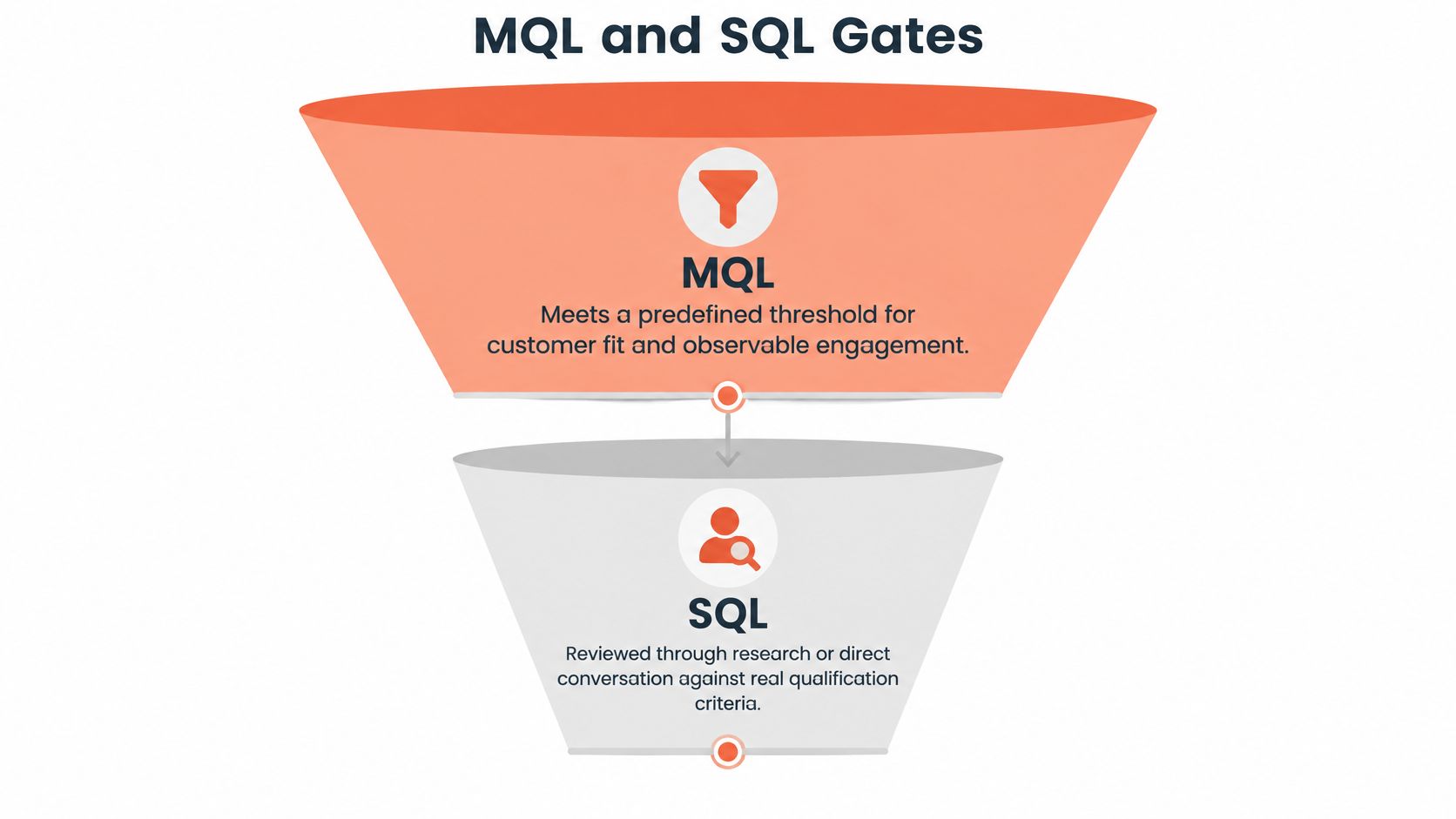
The gate that keeps getting skipped
The research step. When outbound replies are qualified by hand, the leak usually sits between "they replied" and "book the call". Skip the research and the sales call becomes the research, with discovery questions spent on a prospect who was never going to buy. The video below covers the same handoff in more depth.
A reply is not a sales-qualified lead by default. It's a person who read a message and typed something back.
For a small team, the fix is modest: one shared definition of each gate, a written reason every time a contact crosses it, and a named owner for the handoff. Take a week with twelve replies. Three match the profile. One describes a live problem with a cost attached. Only that one earns a sales call. The other two get a reason code and a follow-up date, which keeps them warm without forcing an appointment onto a prospect who is not ready. It is a discipline you can learn to tell prospects apart from leads, not an instinct you either have or don't. The full step-by-step routine is in our lead qualification process guide.
How the BANT Framework Works in an Outbound Reply
BANT covers budget, authority, need and timeline: whether the prospect can fund the purchase, whether your contact makes or influences the decision, whether a business problem exists that you solve, and when the prospect plans to buy. HubSpot's guide to sales qualification positions it for early-stage qualification and shorter, transactional cycles, and warns that strict BANT can push reps to drop a lead who simply isn't ready until next year. On outbound, that means spreading the four questions across a conversation instead of demanding them in the first reply.
Here's how each letter looks in a real LinkedIn thread, with the signal that counts as a pass.
Budget. The reply mentions a spend range, references an existing vendor line, or names an approved budget owner. Ask about budget only after the problem is confirmed. A prospect saying "we've been paying an agency for this and it's not working" is a budget signal without a number.
Authority. The contact names who signs off, or confirms they can approve it themselves. "I'd need to run this past our MD" is not a pass, but it tells you who to ask about next.
Need. A specific business problem with a visible cost: proposals lost to larger competitors, hours spent each week assembling reports, a pipeline that dries up every February.
Timeline. A date or event that matters: a pitch cycle, a contract renewal, a new hire starting in six weeks. "Sometime this year" is not a timeline. "Before we renew in October" is.
One reply, worked through
The owner of a 40-person marketing agency replies that they keep losing pitches to larger competitors, even when they know the work better.
- Need: clear, and it has a cost. Pass.
- Timeline: unknown. No renewal, event or date mentioned.
- Authority: unconfirmed. The owner probably can approve, but that's an assumption.
- Budget: not discussed, and shouldn't be yet.
That's a warm lead with two lead qualification questions for the next message: what's driving the pitching push right now, and who else would weigh in on working with an outside partner.
Advancement rule: move a lead only when all four answers are known. Record every unknown as a question for the next message, never as an assumption in your notes.
Lead Qualification Criteria and Scoring Rules
Fit and intent are scored on separate axes, and intent never rescues bad fit: in the fit-and-intent gate model, a low-fit, high-intent lead is disqualified however enthusiastic it is, and an SQL needs a real problem, someone with authority or influence over the purchase, and a timeframe that is not "someday".
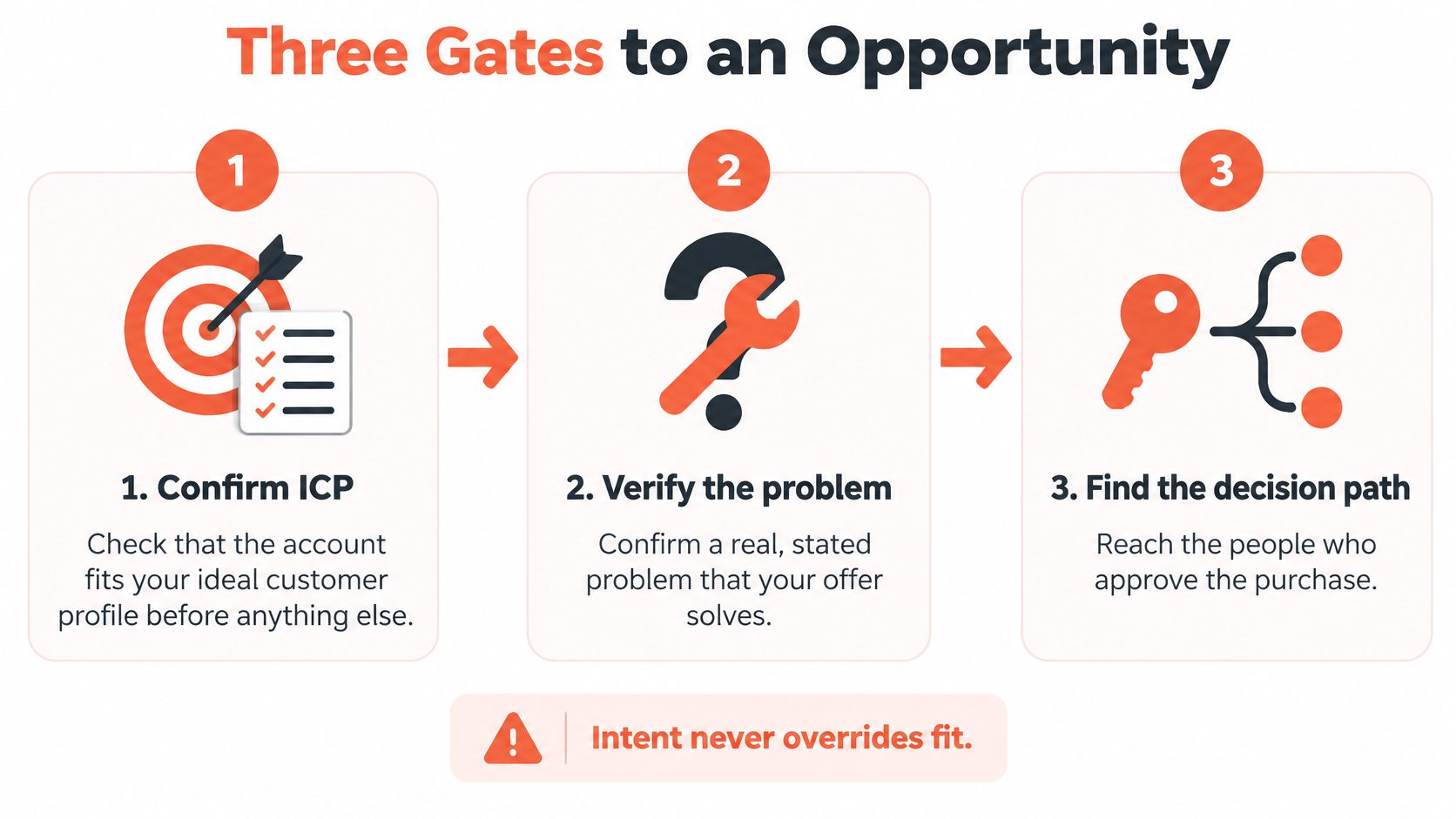
Three gates, in order
- Confirm ICP fit. Industry, company size, geography, role, and your exclusion criteria. Write the exclusions down. "Agencies under 20 people" belongs on the list as much as the positive criteria do. If the profile itself isn't written yet, start with this ideal customer profile template.
- Verify the problem and the decision path. What's broken, what it costs, and who can approve, influence or block the purchase.
- Set timing and one explicit next action. A window, however loose, plus something the client can do: send a case study, propose a 20-minute call, answer a pricing question.
Run them out of sequence and you get the classic failure: a perfectly qualified company with no way in.
Fit is not intent
Fit describes the organisation: industry, headcount, geography, technology, exclusions. Intent describes observable action: a pricing inquiry, a demo request, a repeated visit to the same page. Passive activity, like downloading a generic guide, should never qualify a lead on its own.
Scoring sits on top of that, not in place of it. A points model weights fit attributes and actions, then routes the contact when the total crosses a threshold. HubSpot's inbound lead generation guide uses "say, 50 points" as an illustrative threshold for promoting a lead to MQL. That fifty is an example, not a standard; set your own by working backwards from accepted and rejected leads. For a fuller treatment of how weighting works, LeadBeast's lead scoring explainer walks through the mechanics without overcomplicating it.
Two design rules keep scoring honest. Cap passive points so a stack of downloads can't drag a bad-fit contact over the line. And run the gates before the points, so points only rank accounts that already passed.
Worked example and the record you keep
A 15-person consultancy gets a warm, detailed reply from a partner at a large firm outside their target geography. Strong engagement, real problem, wrong market. Disqualified, with the reason recorded. That single record saves a future argument about whether the lead "felt" qualified.
Every disposition needs the same fields: fit status, problem evidence, stakeholder roles, timing, next action, reason code (qualified, nurture or disqualified). Without a written agreement naming who reviews replies and how fast hot ones get human follow-up, the framework decays into opinion.
The Reply Gate Score: A Copyable Template
The Reply Gate Score is our lightweight lead qualification framework for outbound replies. Score each of the four criteria 0, 1 or 2. Fit is a hard gate: anything below 2 stops the score. Then add the other three.
Criterion
0 points
1 point
2 points
Fit (gate)
Outside ICP or on the exclusion list
Partly matches (e.g. right industry, wrong size)
Matches every ICP field
Problem
No problem stated
Problem described in adjectives
Problem with a cost, deadline or number
Access
Contact can't name the approver
Contact influences, approver named
Contact approves, or approver already in the thread
Timing
"Someday" or no answer
Window within 6-12 months
Date or trigger event within 90 days
Total (Fit = 2)
Class
Next step
7-8
Hot
Client takes the call this week
5-6
Warm
Ask the missing question in the next message
3-4
Nurture-ready
Add to a nurture sequence with a re-check date
Fit below 2, or total 2
Disqualified
Log the reason code and stop
The arithmetic, with example inputs. Say a month brings 40 replies (example). The fit gate removes 24, leaving 16. Scored on the other three criteria, 4 reach 7-8 (hot), 7 land at 5-6 (warm) and 5 at 3-4 (nurture). Your calls this month: 4, not 16. If a discovery call takes 45 minutes including prep (example), that's 4 × 45 = 180 minutes instead of 16 × 45 = 720 minutes, which frees 9 hours to work the seven warm threads by message. Swap in your own numbers; the point is to see how much calendar the gate protects.
Sorting Outbound Replies Into Hot, Warm and Nurture
Each reply lands in exactly one class, and the class decides the next action. Engagement earns research or a follow-up question; only verified fit and buying conditions earn opportunity status, which is why HubSpot's described sales process lists prospecting and the connect-and-qualify stage as separate steps.
Reply Pattern
Classification
Next Step
Asks about timing, scope or next steps for a stated problem
Hot
Client takes the sales call
Interested and names a problem, but cannot approve
Warm
Ask who else is involved, then keep qualifying
Relevant problem, but no decision window yet
Nurture-ready
Add to a nurture sequence until a trigger appears
Curious question with no problem or budget signal
Not qualified
Reply once, no escalation
Outside the target profile, or a clear decline
Disqualified
Log the reason code and stop
Nurture-ready is the class many teams mishandle. It's a real problem with no decision window, so the lead goes into a sequence and comes out when something changes: a funding round, a new hire, a competitor failing. If you're managing this yourself, lead nurturing is where the third class goes. If you're handling a high volume of replies, an AI email organizer helps keep threads and follow-ups in one place so nothing hot sits unanswered over a weekend.
Say a design studio gets four replies in a week. One asks for pricing and mentions a rebrand starting after their financial year: hot. One says the problem sounds familiar, "but I'd need to talk to my co-founder": warm. One is interested but revisiting tools in about nine months: nurture-ready. One asks whether you work with clients in Germany: not qualified. Four replies, four different actions, no calls booked on autopilot.
One-line rule: log the reason code on every reply, including the ones you close. Six months of reason codes is the most honest calibration data you'll have.
Qualifying the Buying Group Behind a Reply
One positive reply isn't enough when several people approve a purchase. Gartner's buying-journey research, cited in this analysis of lead quality by motion, puts the typical buying group for a complex B2B solution at 6 to 10 decision-makers, and Gartner's 2025 survey of 632 buyers found that groups reaching consensus were 2.5 times more likely to report a high-quality deal.
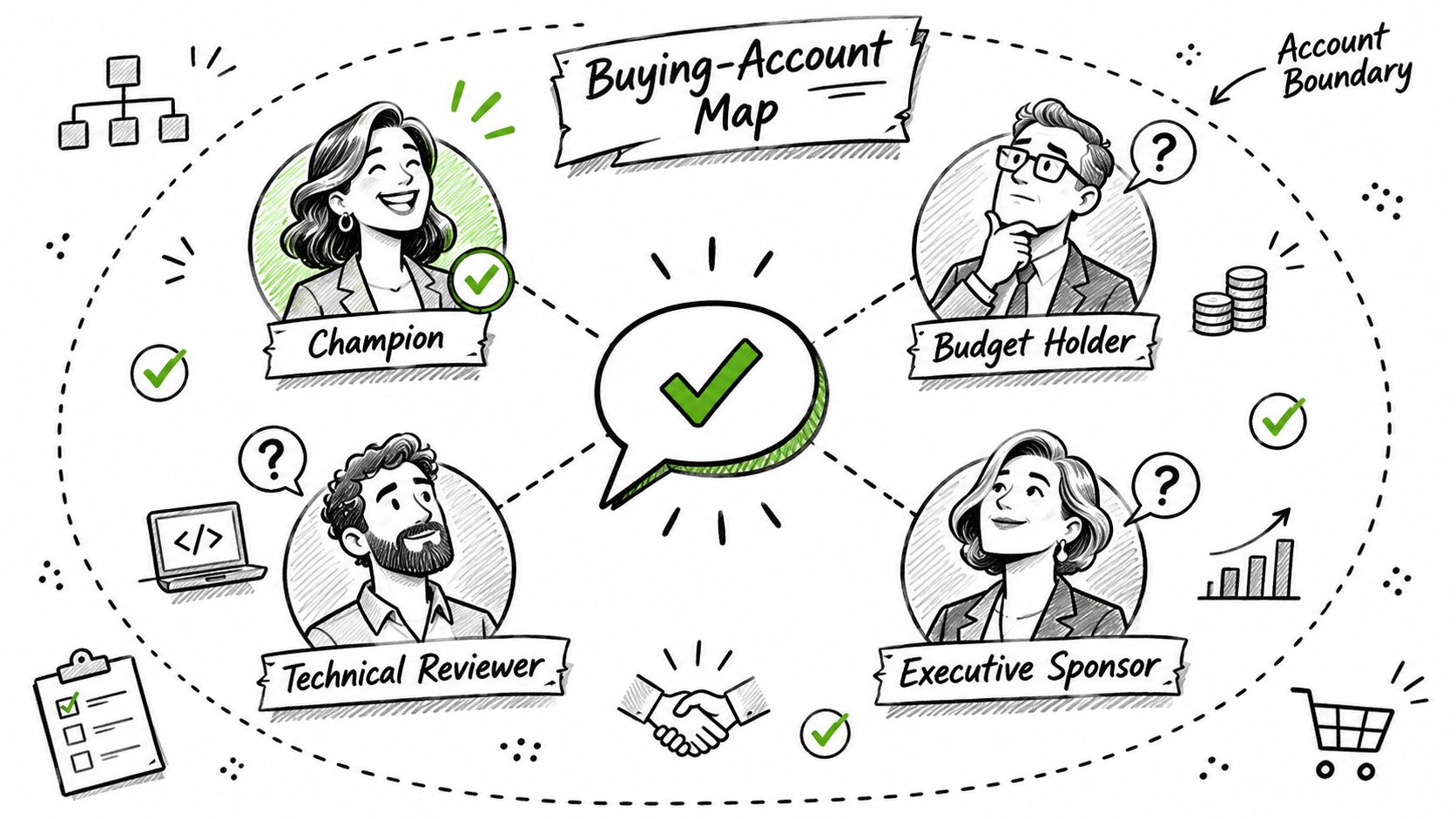
So keep five records per account: account fit, contact role, stakeholder influence, problem evidence, consensus status. Five fields, not fifty.
Here's the failure. An operations director replies enthusiastically and asks for a proposal. Nobody has mentioned the finance lead, the team lead who'll run the thing, or the managing partner who signs anything above a set figure. The account is warm, not hot. Treat it as hot and you'll write a proposal that dies in an inbox you never saw.
Four questions for the next message
- Who else would evaluate this? Names, roles, and who tends to push back.
- What objection should I expect? Internal resistance, named early, is easier to handle than resistance discovered in month two.
- How would this get justified internally? If they can't answer, nobody has built the business case yet.
- What event would make this urgent? A renewal, a reorganisation, a lost client.
The gap between one enthusiastic contact and an aligned group is where deals die, so it pays to know who the decision makers actually are before you write the follow-up.
Confirm Your Framework Before the Next Call
Adopt one written framework and test it against your last twenty replies before changing anything else. No new CRM, no scoring tool.
- Write the four criteria down, each with a one-sentence passing example.
- Set the reason codes so every reply lands as qualified, nurture or disqualified the day it arrives.
- Score your last twenty replies with the Reply Gate Score, then check each call against what happened next.
- Set a response target for hot replies and name its owner.
- Review monthly against won and lost deals. Reweighting points is the easy edit; redefining what counts as a problem is the one that changes outcomes.
Step three is where the uncomfortable finding shows up: the replies you were proudest of sometimes went nowhere, and quiet threads that needed three follow-ups produced deals. That's why the B2B sales process built around qualification matters as much as the criteria inside it.
How this runs as a managed service
Outbound Consulting builds the same discipline into its LinkedIn outreach service. With outbound lead qualification, replies are tagged as Interested, Maybe Later, Not a Fit or Wrong Contact, "maybe later" contacts go into follow-up sequences, and qualified leads are handed to your sales team with talking points for the call. The company reports serving more than 2,000 small and mid-sized businesses since 2015. Current plans are on the pricing page.
Frequently Asked Questions About Lead Qualification
What are lead qualification criteria?
The tests a lead must pass before sales spends time on it. For B2B outbound, four cover most cases: ICP fit, a problem with a visible cost, access to the person who approves, and a buying window. Write exclusions too, so you know who never qualifies.
What is the difference between an MQL and an SQL?
An MQL has crossed a fit-and-engagement threshold set by marketing, usually a score. An SQL has been checked by a person, through research or conversation, and judged ready for a sales conversation.
Is BANT still enough for a small team?
The letters hold up; the order doesn't. Outbound replies rarely volunteer budget first, so start with need and timing, then confirm authority and budget once a problem is on the table. A contact who cannot name the approver is not qualified, however warm the exchange feels.
MEDDIC vs BANT: which should we use?
BANT for short cycles and small teams; MEDDIC when deals involve procurement, a champion and formal decision criteria. Most teams of one to ten selling services or mid-priced software are better served by BANT-style gates plus a buying-group check.
Should we score leads with points or use gates?
Gates decide who enters the pipeline; points decide who gets worked first once they're in. A small team replying to every lead the same day needs gates only. Add points when reply volume outgrows the hours available.
What lead qualification questions should we ask?
One per missing criterion, never all at once: "What's driving this now?" (problem and timing), "Who else would weigh in?" (access), and, once the problem is clear, "How are you handling this today?" (budget signal without asking for a number).
Can AI qualify leads?
Yes for the paperwork, no for the verdict. It can summarise threads, flag missing information and draft follow-up questions. Budget authority, real urgency and internal politics still need a person, because a polite brush-off and a genuine evaluation can read the same.
How many replies should we review before changing criteria?
Enough to see a pattern rather than a mood. If the same trait keeps appearing in conversations that passed the gate and stalled on the call, that trait belongs in the definitions. Review rejected replies too; a pattern in what you turned away is the more expensive miss.
If your replies are landing but the calls keep going nowhere, the gap is usually the gate rather than the message. Outbound Consulting applies a written qualification framework to every LinkedIn response and passes you the conversations that clear it. You still take the call; the sorting is already done.